Automated Precision, Inc. (test)
Focus Area: Advanced/Additive Manufacturing
Contact
Adam Hicks
757-846-3631
adam.hicks@apimetrology.com
Automated Precision Inc. (API), founded in 1987 by Kam Lau, Ph.D., in Rockville, Maryland, is a leader in laser-based dimensional metrology solutions. API serves industries like aerospace, defense, automotive, energy, and manufacturing, delivering advanced measurement and calibration tools. The company is renowned for inventing the laser tracker and holds original patents for this technology, which remains central to its product line.
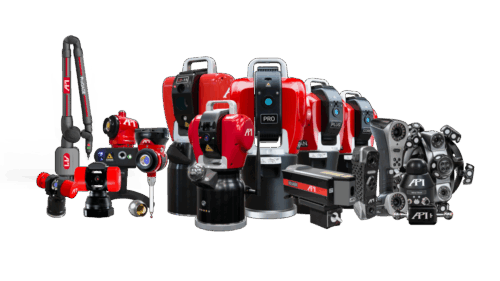
API’s flagship products include the Radian Laser Tracker, XD Laser, iScanMagic and iScanLite 3D scanners, and Dynamic 9D LADAR, designed for precision tasks like part inspection, assembly, machine tool calibration, and reverse engineering. These tools enable high-accuracy 3D measurements, supporting clients such as Boeing, Lockheed Martin, and Ford. API’s Smart Factory Inspection System and robotic calibration solutions, like RoboCal, enhance automation and efficiency in production.
Metrology Solutions
Problem Statement:
In today’s fast-paced manufacturing and industrial sectors, companies face significant challenges in achieving precise, efficient, and cost-effective dimensional metrology. Manual measurement processes and outdated tools often lead to inaccuracies, prolonged production times, and increased operational costs. These inefficiencies hinder the ability to meet stringent quality standards, adapt to complex geometries, and integrate seamlessly with automated production systems.
Technology Solution Statement:
Automated Precision Inc. (API) provides state-of-the-art laser-based dimensional metrology solutions to revolutionize precision measurement in manufacturing. Our industry-leading technologies, including the Radian Laser Tracker, Dynamic 9D LADAR, and iScanMagic 3D scanners, deliver high-accuracy, non-contact measurement capabilities for complex applications in aerospace, automotive, energy, and beyond. Integrated with API’s Smart Factory Inspection System and RoboCal robotic calibration software, our solutions enable seamless automation, real-time data acquisition, and precise quality control. Supported by advanced software and AI-driven analytics, API’s tools optimize part inspection, assembly alignment, and machine tool calibration, ensuring unmatched efficiency and compliance with Industry 4.0 standards.Benefits Statement:
Automated Precision Inc. (API) delivers cutting-edge laser-based metrology solutions, including the Radian Laser Tracker and Dynamic 9D LADAR, empowering industries like aerospace, automotive, and energy to achieve unparalleled accuracy and efficiency. Our advanced tools and services streamline part inspection, assembly, and calibration, reducing measurement time and costs while ensuring compliance with rigorous standards. With API’s Smart Factory Inspection System and robotic calibration solutions, clients enhance automation, boost productivity, and gain a competitive edge through precise, data-driven manufacturing processes.Precision Additive (test)
Focus Area: Advanced/Additive Manufacturing
Contact
Mike Simek
mike.simek@precisionadditive.com
317-319-3953
Precision Additive Solutions, Inc. is advancing the Laser Powder Bed Fusion (LPBF) ecosystem with the first platform engineered specifically for the safe, repeatable, and high-quality production of aerospace-grade parts at scale. Our system is built to process reactive alloys (magnesium, aluminum, titanium), non-reactive alloys (Inconel, copper), and refractory metals (tungsten, molybdenum, cobalt) with precision, consistency, and industrial throughput.
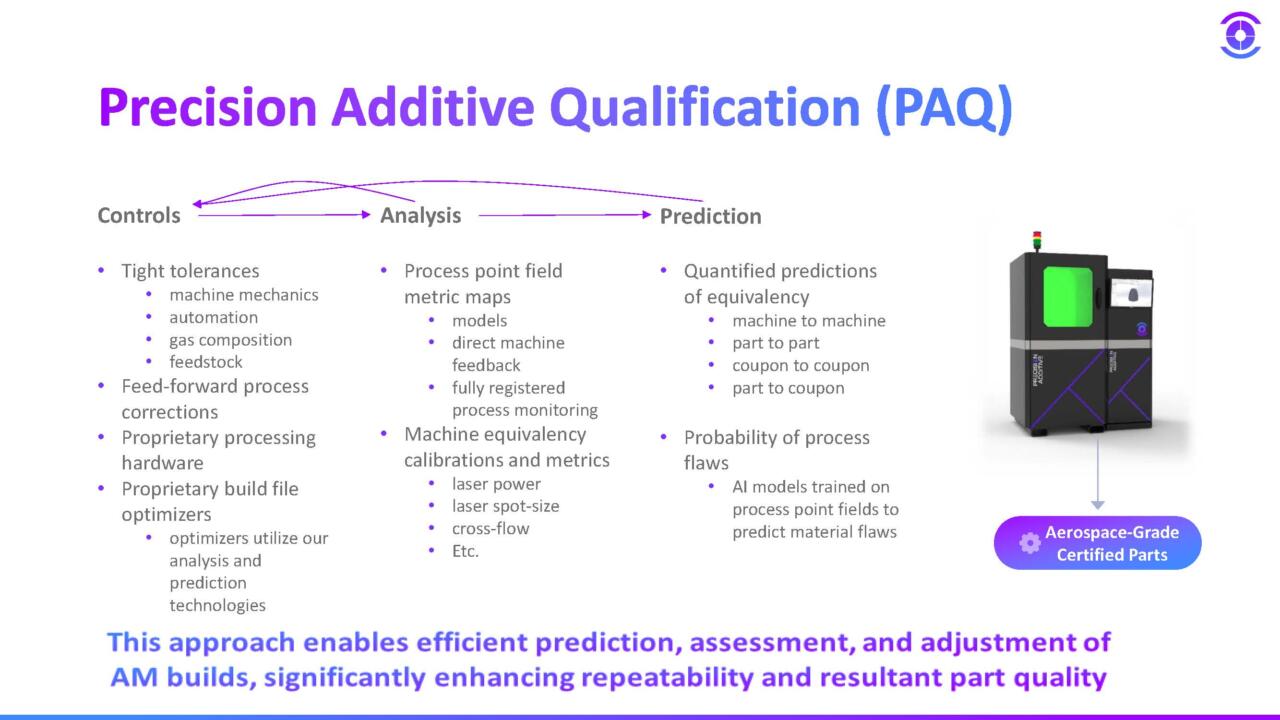
We integrate three core innovations that set us apart: Selective Stepped Laser Melting (SSLM™) – A proprietary process for adaptive melt control that enhances material integrity; Specialized Architecture for Reactive Material Handling – Enabling safe and efficient processing of challenging alloys; Precision Additive Qualification – A rigorous methodology that ensures repeatability and part certification for aerospace and defense.
3D+™ Hybrid Printing Technology
Problem Statement:
Aerospace and defense platforms depend on lightweight, high-performance materials, but the U.S. industrial base is no longer equipped to meet growing demand using traditional manufacturing methods. Today’s production landscape faces four critical barriers:- Diminishing Domestic Manufacturing Sources
- Raw Material Shortages and Extended Lead Times
- Material and Process Complexity
- Limited Scalability
Technology Solution Statement:
Our 3D+™ hybrid printing technology (currently in development) sets us apart. This integrates reactive and refractory material processing, in-situ quality monitoring, real-time adaptive print parameter adjustment capability, in-process machining, small, medium, and large-scale Laser Powder Bed Fusion (up to 1.2m x 1.2m x 1.2m build volume), and a new, high-speed, extremely low spatter laser printing technology in Selective Stepped Laser Melting (SSLM™). SSLM™ provides position-by-position melt pool control through dynamically adjusted colinear beam parameters. It enables spatial variation in energy delivery, adaptive focus diameter control, and real-time thermal regulation. These capabilities predict and minimize porosity, suppress spatter, and allow for both high-fidelity feature resolution and high-rate deposition. This results in exceptionally high-quality finished parts, and a digital twin of the entire build process.Benefits Statement:
Precision Additive addresses enabling true viability for alloys already in use, and pioneering pathways for materials previously inaccessible to additive manufacturing. We have developed a holistic qualification strategy that reduces reliance on coupon testing and instead emphasizes robust process controls, in-situ monitoring, and quality assurance integrated into the machine design. In practice, this approach means strengthening QMS certifications, ensuring regulatory compliance, establishing material traceability, machine-specific baselining, statistical process control, qualifying final part performance, and fortifying data management and cybersecurity.