
Technology Title
U.S. Army’s Virtual Training Suite
Tech Focus Area
Training
Abstract
Problem Statement & Innovation Challenges: Military aviation maintenance training has historically relied on fragmented, vendor-locked, and stove-piped simulation solutions. This decentralized approach drives duplicate expenditures across Program Management Offices, slows technology insertion, and creates an over-reliance on scarce, expensive physical trainers. Crucially, this reliance on physical hardware restricts the number of repetitions maintainers can safely perform on hazardous or complex tasks, leaving a critical gap in procedural familiarization and cognitive readiness before they ever step onto the hangar floor.
Graphic
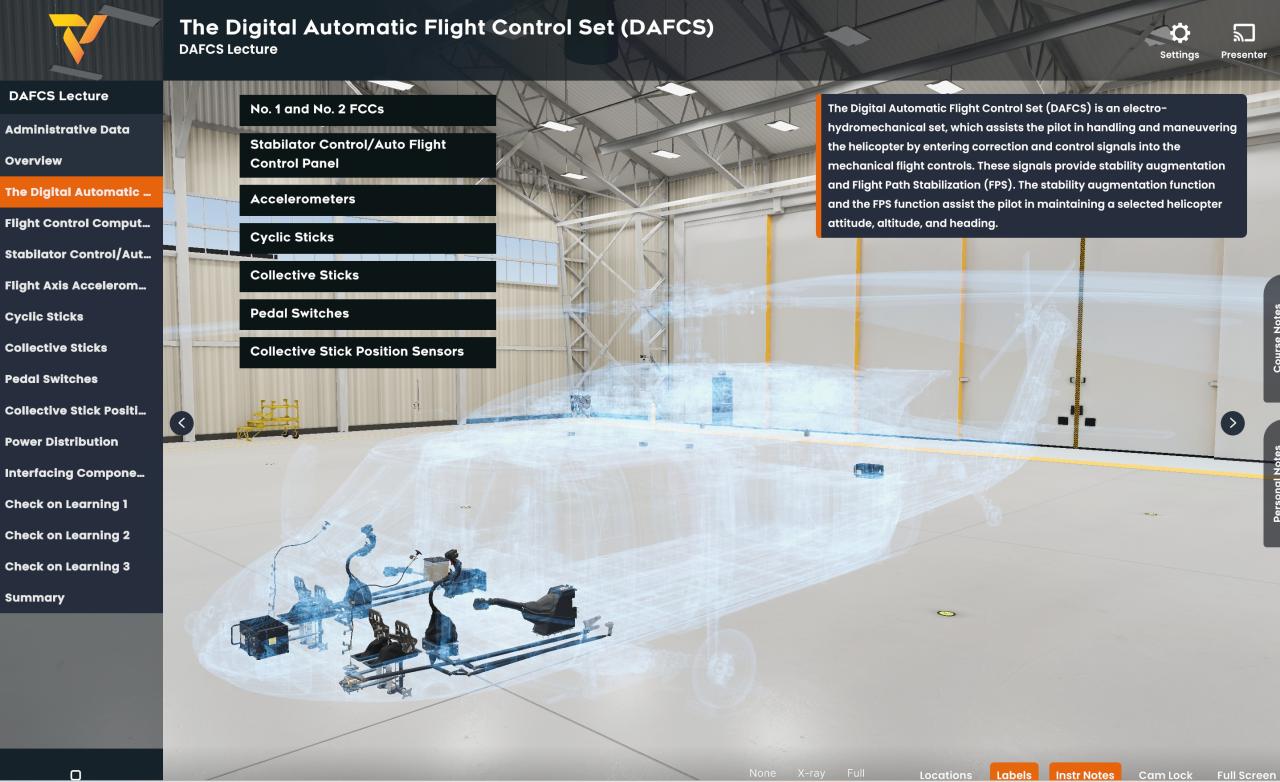
Description of the Innovation & Originality: VTS pioneers a shift from localized, hardware-dependent training to a globally distributed, “anytime, anywhere, on any device” collaborative model. Operating within a cloud-based Virtual Training Environment (VTE), VTS is a centralized, government-owned software platform that standardizes Interactive Media Instruction (IMI) and Extended Reality (XR) training across all aviation platforms. By integrating immersive 3D Learning Environments, a Classroom Management System, and robust Data Analytics into a single ecosystem, VTS represents a massive leap forward from legacy slide-based instruction and proprietary simulations.
Benefits to the DoW & Impact on Maintenance: VTS directly accelerates maintenance efficiency and effectiveness by providing high-fidelity, low-stress virtual repetitions for costly or dangerous procedures (e.g., main rotor removal, complex troubleshooting). By bridging the gap between classroom theory and practical execution, VTS:
- Improves Safety & Confidence: Allows maintainers to master complex tasks virtually before executing them physically.
- Preserves Mission Assets: Significantly reduces wear and tear on physical aircraft used for training.
- Eliminates Commercial Vendor Lock: As a non-proprietary platform with full Government Purpose Rights, VTS eliminates licensing fees, prevents duplicate development, and ensures advancements remain focused on warfighter readiness rather than commercial marketing.
Technical Maturity & Transition Viability: VTS is a highly mature, proven, and fielded capability currently operating at Technology Readiness Level (TRL) 8/9 for its core applications. Its transition viability is unmatched: over the past year, it has accumulated nearly 14,000 active users and supported over 56,000 training sessions across 31 global locations. Development and sustainment follow a rigorous 7-phase Verification, Validation, and Accreditation (VV&A) lifecycle. Securely hosted on the Impact Level 4 (IL4) cArmy Azure cloud with an active Authority to Operate (ATO), VTS is primed for rapid, enterprise-wide deployment.
Cross-Service Application: While initiated by Army Aviation to support rotary-wing platforms (UH-60M, AH-64E, CH-47F, UH-72), VTS was built with a Modular Open-System Approach (MOSA) architecture. This common baseline makes the platform readily scalable and inherently applicable to all military service branches and the Defense Logistics Agency (DLA). VTS is designed from the ground up to securely host and distribute training for any future DoW system, seamlessly adapting to Air Force, Navy, or Marine Corps maintenance requirements.



