Technology Title
Remote Capture, Engineering Assistance, and Tele-Maintenance
Tech Focus Area
Workforce Development/Visualization
Abstract
Focus Area: Depot and field maintenance modernization integrating Remote Capture, Engineering Assistance, and Tele-Maintenance (RCEAT) into a secure reach-back workflow linking on-site maintainers with remote engineering experts.
Problem Statement: Maintenance increasingly depends on a shrinking pool of specialized engineers who cannot be present at every site. Aging platforms produce non-standard faults and undocumented configurations beyond existing technical data. Resolving them often requires escalation, SME travel, or component shipment, adding cost, extending downtime, and delaying return-to-service, especially for dispersed or contested-environment operations. Inconsistent condition capture and missing assistance records reduce efficiency and repeatability.
Graphic
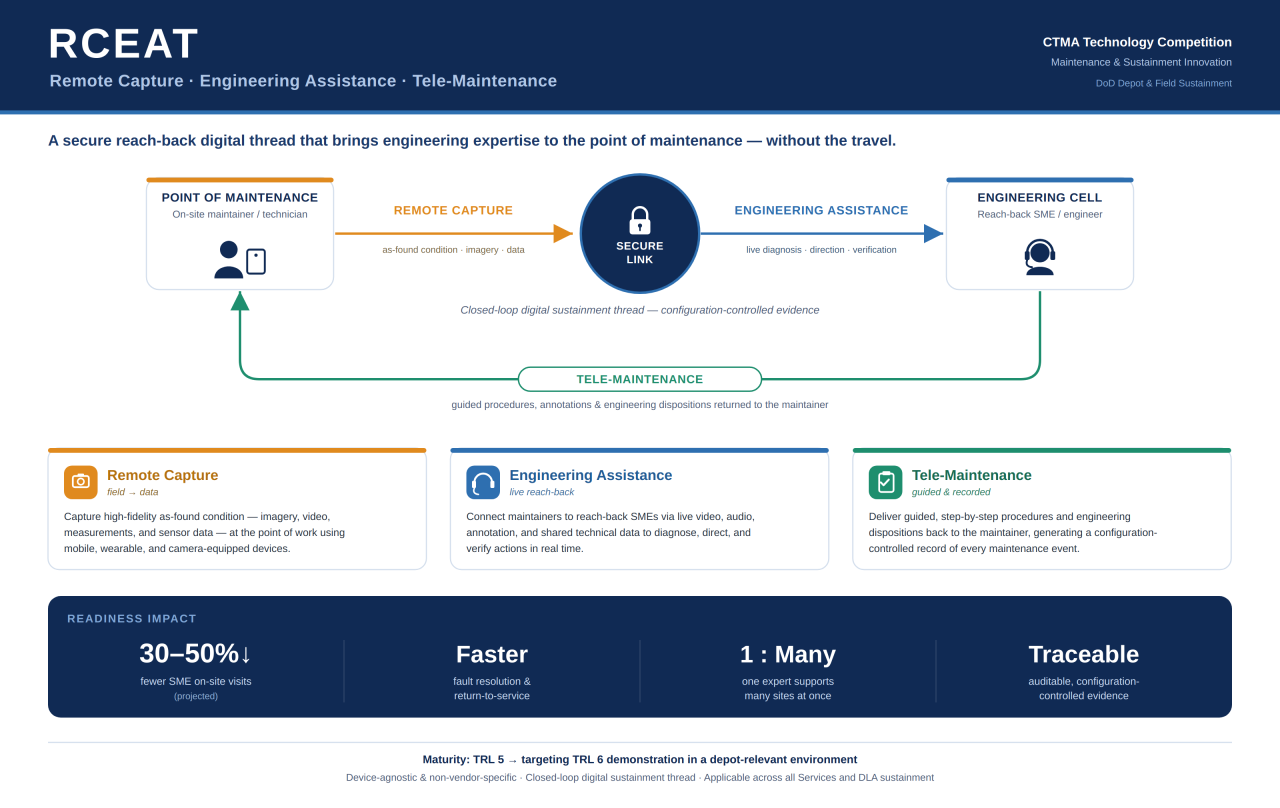
Description of the Innovation Solution: RCEAT unifies three capabilities. Remote Capture records high-fidelity as-found condition (imagery, measurements, and sensor data) at the point of work. Engineering Assistance connects maintainers to reach-back SMEs through live video, annotation, and shared data to diagnose and verify in real time. Tele-Maintenance returns guided procedures and dispositions while generating a configuration-controlled record, forming a closed-loop digital thread. Device-agnostic and non-vendor-specific, it integrates with existing depot systems and security boundaries.
Benefits to the DoD: RCEAT extends scarce expertise across sites while cutting resolution time:
- Reduced SME travel and cost (projected ~30–50% fewer on-site visits)
- Faster fault resolution and return-to-service
- Extended reach of the limited engineering workforce
- Improved workforce training and knowledge retention via recorded sessions
- Traceable, auditable maintenance evidence
Platform-independent and applicable across all Services and DLA sustainment.
Innovation Challenges: Key challenges include secure connectivity at the point of work (including low-bandwidth or contested environments), protecting controlled technical data (ITAR/CUI), and integrating with accredited networks. These are mitigated through phased deployment, encryption, store-and-forward modes, and configuration-controlled records.
Technical Maturity / Demonstration Results: Elements have been prototyped on representative tasks; current maturity is approximately TRL 5, targeting a TRL 6 depot demonstration. Metrics: reduced SME travel, cycle-time reduction, fewer escalations, evidence traceability, and user acceptance.