
Technology Title
Eliminating Deflagrations in 30mm Pull Apart Operations
Tech Focus Area
Reliability Improvement
Abstract
Problem: Tooele Army Depot (TEAD) uses the APE (Ammunition Peculiar Equipment) 2271 Super Pull Apart Machine (SPAM) to demilitarize 30mm x 173mm rounds. Processing rounds produced by a specific munitions manufacturer resulted in repeated occurrences of deflagration, causing cartridge cases to burst and fragment. This posed a serious threat to the health and safety of the workforce. It also resulted in excessive maintenance downtime to clear the SPAM of damaged cases and repair the equipment. Rounds produced by a different manufacturer did not have the same response and were successfully processed through the original configuration of the SPAM.
Graphic
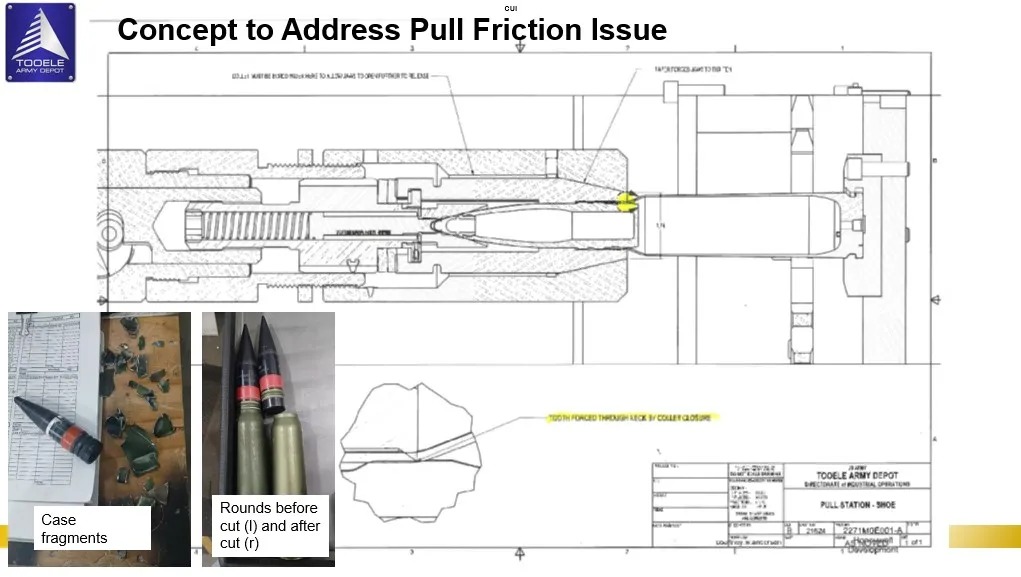
Description of Solution: Examination of technical data on the munitions from the two manufacturers showed a substantial difference in the design of the cartridges. The projectiles that processed correctly had a single crimp, while the problem projectiles had two crimps and a much longer bearing surface which had to be pulled past the double crimps. Engineering analysis determined that the heat generated by pulling apart the double crimp rounds was four times that generated by the single crimp rounds. The lead engineer conceived the idea to cut double-crimp cases below the crimps to reduce friction heat generation. The concept was prototyped, alterations were made to the SPAM, and operational testing was performed, resulting in a drastic reduction of deflagration incidents.
Benefits to the DoW: Prior to the alteration of the SPAM, several million 30mm rounds slated for demilitarization and occupying much needed storage space, could not be processed safely and efficiently. With the alteration of the SPAM, the rounds can now be safely demilitarized, clearing space for new munitions. It’s estimated that the alterations to the SPAM have produced 50% cost savings of this process.
Innovation Challenges: The primary challenge with the new approach was to make it a high-volume operation. Integrating a case cutting step into existing automated equipment had not been attempted before and presented several problems. This new configuration required a much longer stroke length and necessitated opening the collet jaws wider than previously required. Refinements had to be made to address these issues during testing. See included drawing.
Technical Maturity/Demonstration Results: During baseline testing using the old configuration, four lots were tested resulting in 8 deflagrations in 1,560 rounds processed. Following the upgrade, testing of 27,052 rounds resulted in only two deflagrations, which were determined to be caused by misadjustment to the new alteration. After correcting adjustments, 17,000 rounds were run without incident. Compared to the baseline, the deflagration rate was 69 times lower with the potential to be eliminated with the final adjustments. Currently the system is beginning a Limited Rate Initial Production phase in which 354,000 rounds will be processed.



