
Technology Title
DEVCOM C5ISR Center Mixed Reality Training Capability
Tech Focus Area
Training
Abstract
Problem: Across the Department of War (DoW), maintaining complex tactical systems and equipment requires highly skilled technicians capable of translating abstract technical manuals into real-world repairs. Traditional instruction relies heavily on static classroom lectures, 2D paper schematics, and desktop-based computer training. This creates a significant conceptual gap when technicians transition to physical systems in the field, leading to longer training cycles, high error rates, diagnostic inaccuracies, and increased risks of damaging high-value assets during training.
Graphic
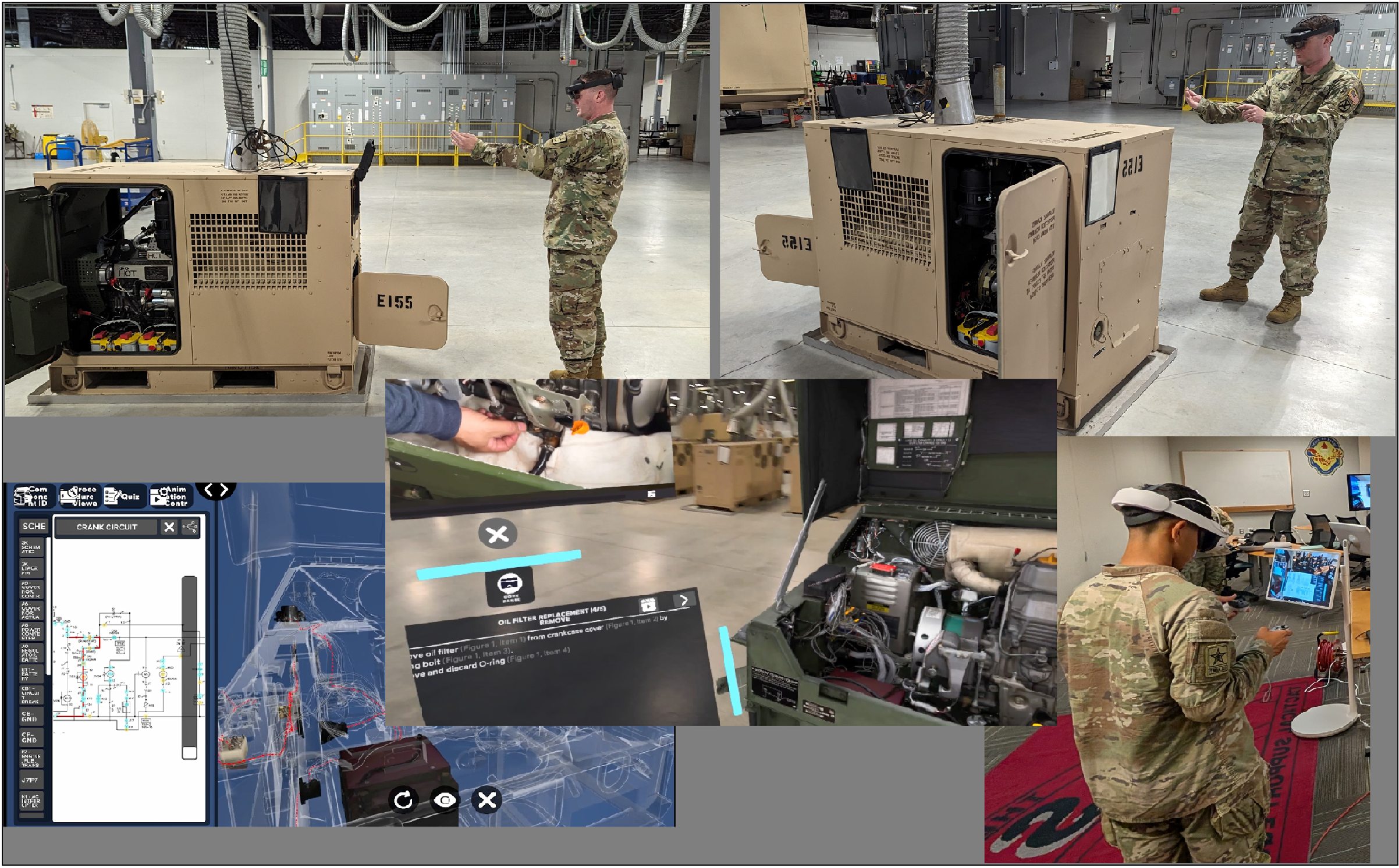
Description: To bridge this gap, this innovation utilizes a scalable, platform-agnostic Mixed Reality (MR) training framework. By generating high-fidelity, interactive 3D “digital twins” of complex tactical machinery, the solution overlays active, animated 3D circuit diagrams, fluid flows, and structural pathways directly onto physical hardware or virtual models using commercial-off-the-shelf (COTS) headsets. Technicians are guided through step-by-step maintenance procedures, component identification, and real-time fault-isolation simulations in an immersive, safe environment.
Benefits: By transforming static training into active, spatial learning, this technology drastically reduces maintenance cycle times and accelerates student throughput across training pipelines. It minimizes the reliance on actual, mission-critical hardware for training, protecting physical equipment from novice-operator damage and saving significant lifecycle costs. Standardized, digital assessment tracking provides commanders with objective proficiency data, ultimately boosting warfighter readiness and equipment availability in tactical environments.
Challenges: The primary challenge lay in establishing a robust pipeline to ingest complex CAD and engineering data, optimize it for real-time mobile MR rendering, and precisely align digital overlays with physical assets. This capability is highly mature (TRL 7+), having been fully validated through a live deployment at the CASCOM Ordnance Schoolhouse (Fort Lee, VA). There, high-fidelity digital twins and interactive MR training applications were successfully developed and utilized for 3kW, 15kW, and 60kW Advanced Medium Mobile Power Sources (AMMPS) tactical generators. Students utilized these headsets to visualize complex wiring schematics, identify physical components, and troubleshoot common faults (such as “black smoke” startup failures). This successful, multi-system schoolhouse deployment proves the technology is fully mature, highly scalable, and ready for wider joint-force adoption.
Results: This solution directly impacts DoW sustainment by modernizing how technicians perform preventive maintenance, troubleshooting, and repairs. Its primary originality lies in the “active schematic” visualization, allowing trainees to “see” invisible system processes (electrical currents, hydraulic pressures) in 3D space. Crucially, the underlying development framework is platform-agnostic and modular, meaning it can be readily adapted to any complex system—from marine propulsion and aviation systems to tactical vehicles and ground power generators—across all service branches and the Defense Logistics Agency (DLA). The technology is designed for open-architecture integration, avoiding proprietary vendor lock-in and focusing entirely on enhancing joint-force maintenance proficiency.



