
Technology Title
Leveraging Generative AI to Improve AIrcraft Availability
Tech Focus Area
CBM+
Abstract
Problem / Summary: Today’s maintainers face severe resource constraints and time limits. Untracked duration anomalies in Work Unit Code (WUC) and Job Control Number (JCN) tasks waste thousands of non-productive hours, lowering aircraft availability. ThroughPut’s Generative AI interface builds on existing G081/IMDS data to automate context retrieval, streamline troubleshooting, reduce erroneous enterprise demand signals, and enforce best practices. Existing Phase III deployments achieved a 1–4% increase in Aircraft Availability (saving 37,500 labor hours per weapon system). At Air Force scale, a GenAI layer promises up to a 5% availability increase (50–75 aircraft) while capturing non-standard outlier repair solutions missing from Technical Order (TO) data.
Graphic
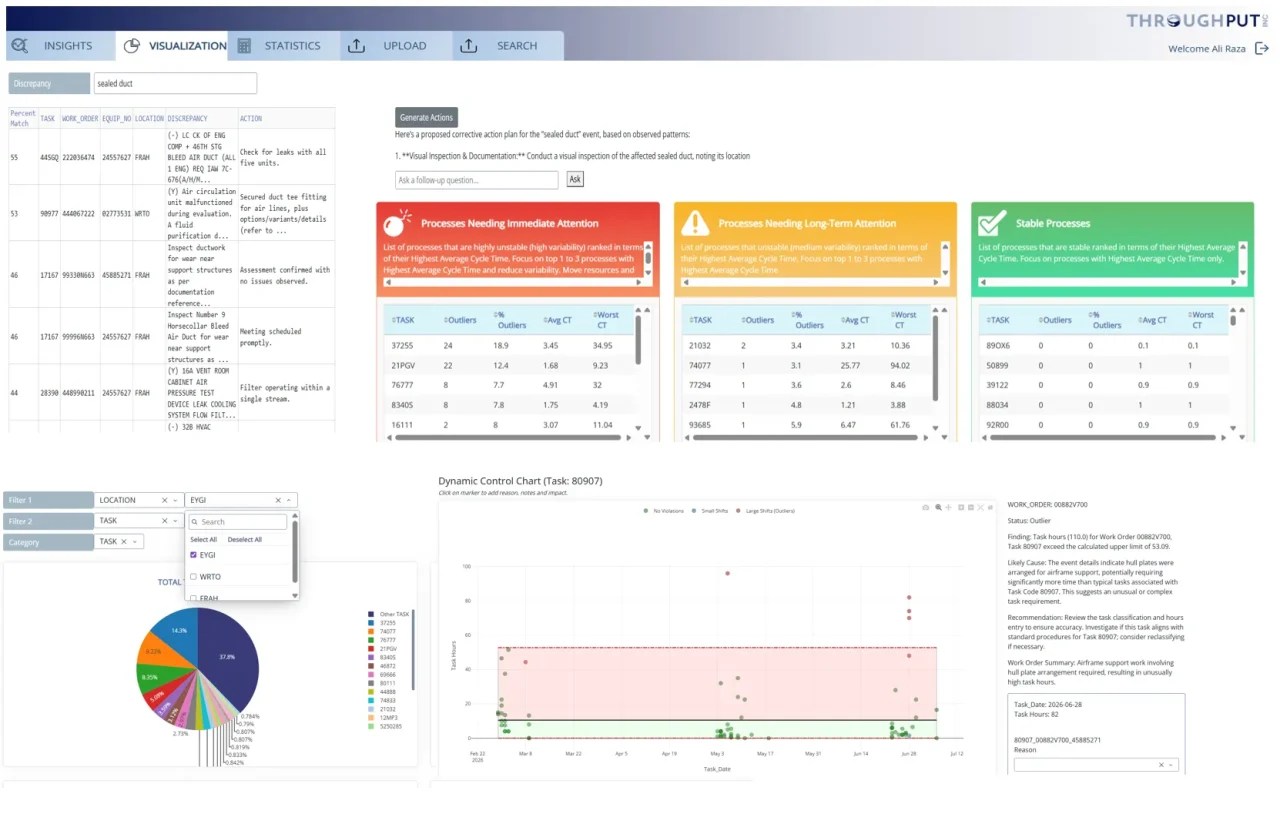
Description of Solution: ThroughPut tokenizes G081/IMDS discrepancy logs, corrective actions, and narratives. Using vector similarity search, the platform surfaces relevant historical entries to a localized LLM (gemma3:12b) that generates tailored corrective steps. To perform root-cause analysis, patented bottleneck-detection technology isolates labor-hour outliers on a timeline and prompts the local LLM to flag data errors, task mis-entries, or process anomalies.
Maintenance Relevance & Impact: The underlying system cuts problem-resolution timelines from six months to three weeks, yielding up to a 6x ROI. Adding GenAI turns 2-hour weekly manual troubleshooting into an instantaneous task—a 10x retrieval improvement—reducing user workload to raw-data verification.
Originality & Contribution: ThroughPut holds end-to-end patents and Technical Data Rights for ELI V2.0. Unlike commercial systems trained on public internet data, ThroughPut relies on internal G081/IMDS event data. It acts as an operational expert, resolving unique outlier events that standard TO manuals fail to cover.
Avoidance of Commercialism & Deployment: The system operates as a decentralized, equipment-specific expert guide for forward-deployed or off-station maintainers lacking senior supervision. Deployed on local GPUs with G081/IMDS historical data stored on local hard drives, maintainers can iteratively prompt the system until repairs are complete.
Technical Maturity: The underlying AI system is at TRL 8, currently active across Active Duty and National Guard wings (transitioned from a 2021 Phase I SBIR). The GenAI interface replaces complex control charts with direct natural-language troubleshooting.
Benefits to the Department of the Air Force / DoW: Applicable across all service branches and DLA, the platform serves as a “Grammarly for Maintenance.” It flags widespread human data errors (reaching ~50% in WUC and part entries) before false positive orders disrupt the supply chain. Preventing inventory mismanagement makes up to 5% more equipment operational.
Feasibility & Practicality: Currently active at 4 bases, the system is prepared to scale to 25 and 90 Air Force wings. Unit deployment requires 1–2 weeks using local hardware, with cross-unit insights shared via standard communication platforms (e.g., MS Teams). Payback occurs within 3 months.
Innovation Challenges:
- Data Integrity: The tool uses redundant valid fields to detect and clean narrative and labor errors.
- Cybersecurity: Using local LLMs instead of cloud platforms keeps all data securely contained.
- TO Data Access: While direct TO integration is pending, the system successfully acts as a decision-support tool by referencing verified maintenance history.



