
Technology Title
The Manufacturing Decision Layer: Turning Legacy Parts Into Sourceable Ones at Portfolio Scale
Tech Focus Area
Business Processes/Partnerships
Abstract
Problem Statement: A maintenance technician submits a demand for a part with no source of supply. The technical data is a decades-old scanned drawing: no 3D model, no vendor, no qualification record. Someone must decide how it can be made, at what cost, and by whom. Today that work runs by hand, part by part, across hundreds of thousands of parts, by scarce engineering experts. DoW can already move protected technical data and produce at the point of need. What it cannot do is decide, at scale, what to make.
Graphic
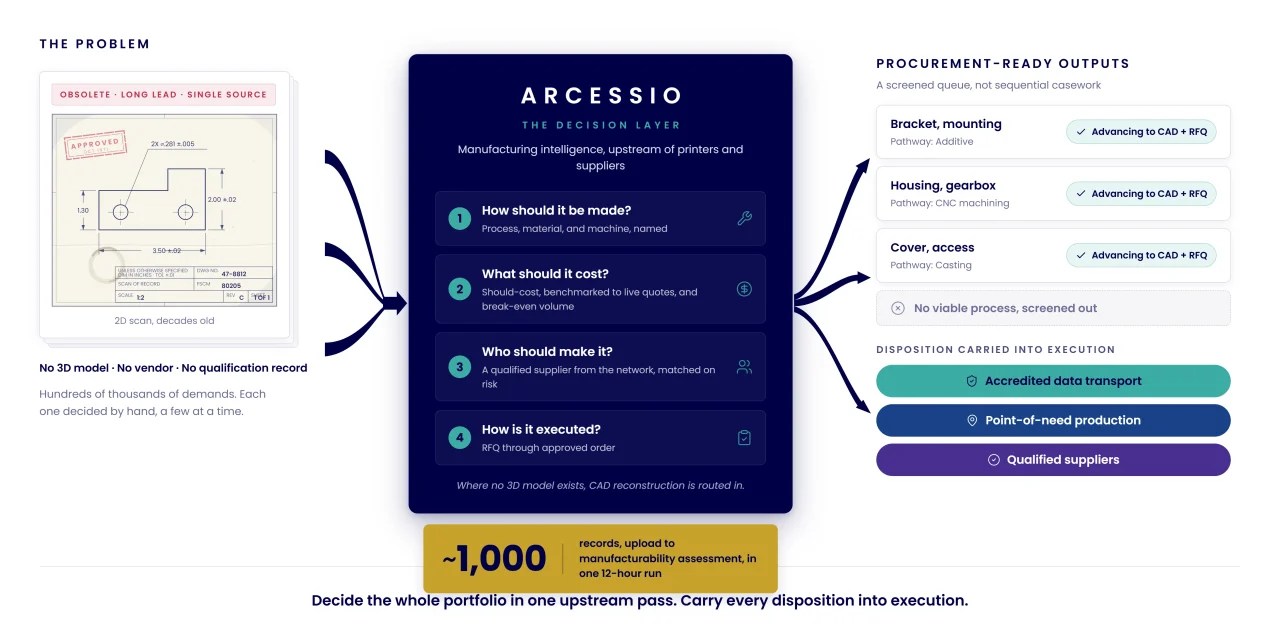
Description of the Innovation Solution: Arcessio is an AI-powered manufacturing intelligence and execution platform that sits upstream of depots, printers, and commercial manufacturers as the decision layer. From a drawing, it builds a structured part record and screens for viable processes. Where no 3D model exists, it routes CAD reconstruction, and the production workflow runs from the validated model. For each part, Arcessio names the process, material, and machine; estimates a should-cost and the break-even volume where the economical process changes; and matches a qualified source from the network on capability, certification, and risk. It carries the disposition into execution, from RFQ through approved order, maintaining a digital thread from analysis to acceptance. Arcessio is process-agnostic across additive, CNC machining, injection molding, and casting, and applies to any Service or DLA.
Benefits to the DoW: Arcessio turns parts triage from sequential casework into a portfolio operation. Across large part populations, planners identify manufacturable candidates, sourcing risks, CAD reconstruction needs, and production pathways in one pass, rather than hours of analysis per part. Long-lead, obsolete, and single-source parts surface before they become readiness constraints, and viable demand routes to the right organic or commercial capability. Where manual disposition clears a handful at a time, Arcessio works the whole portfolio in one pass.
Innovation Challenges: Legacy 2D data is uneven, and manufacturability does not equal qualification. Arcessio produces an evidence-linked recommendation; engineering authority and approval remain with the government. CUI work runs inside an existing accredited environment, and integration with Service repositories, PLM, ERP, and procurement systems is organization-specific.
Technical Maturity / Demonstration Results: Arcessio is executing an 18-month NCMS CTMA Cooperative Agreement sponsored by DASW-MR with PM Motor Transport, PM Ground Based Air Defense, and Marine Depot Maintenance Command, ending in a transition roadmap. The effort entered at TRL 5, targeting TRL 6. In a parallel demonstration, Arcessio moved roughly 1,000 of 1,100 publicly releasable government 2D drawings from upload to manufacturability assessment in a single 12-hour run, evaluating parts at portfolio scale.



