
Technology Title
Integrating Critical Chain and Earned Value Project Management to Modernize Aviation Phase Maintenance
Tech Focus Area
Business Processes / Partnerships
Abstract
Aviation phase maintenance is essential to materiel readiness, but it is often hindered by unpredictable workloads, resource constraints, poor man-hour forecasting, and frequent interruptions that force maintainers into inefficient multitasking. These conditions reduce schedule predictability, delay aircraft return to service, and limit leaders’ ability to make timely, data-driven decisions. In Army Aviation, these delays directly affect available flight-hour “bank time,” a key generator of combat power and readiness. Existing maintenance planning and tracking methods often fail to accurately reflect conditions on the maintenance floor, creating a cycle of low-confidence data and reactive decision-making.
Graphic
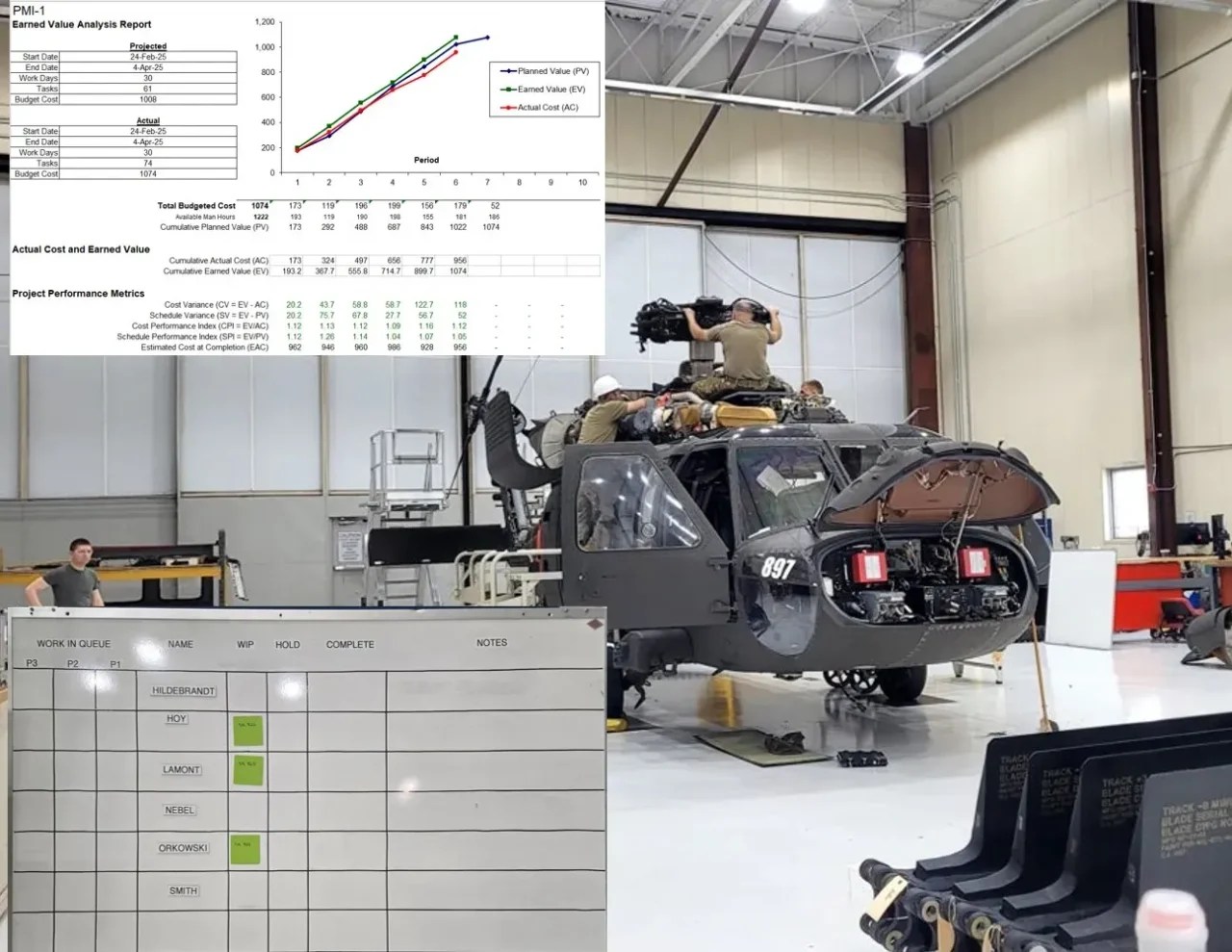
This submission proposes an integrated phase maintenance management framework that combines P4T3-based planning with Critical Chain Project Management and Earned Value Management. The innovation consolidates maintenance requirements into standardized tasks, organizes them into five major phase stages—DEPOP, INSPECT, REPOP, RIG, and CLEAN-UP—and sequences work around the true production constraint: the phase mechanic. The framework uses a work breakdown structure, projected man-hours, project buffers, earned value worksheets, and a phase board to improve workflow visibility, control work in progress, reduce unnecessary task switching, and generate more accurate completion forecasts before and during execution. Rather than relying on static timelines or inflated estimates, leaders gain a dynamic decision-support tool that links real-time performance to projected delivery dates and resource requirements.
The benefits to the Department of War include improved maintenance efficiency, more predictable cycle times, better manpower utilization, and higher aircraft availability without compromising quality or safety. The model strengthens readiness by giving leaders objective data to protect maintenance flow, allocate support resources, and identify bottlenecks for continuous improvement. Because the framework is based on broadly applicable project-management principles rather than a platform-unique toolset, it also has potential utility across multiple Services and other maintenance environments where constrained labor, variable workload, and schedule pressure are common.
The concept is technically mature at the demonstrated application level. The integrated model has been applied across seven completed UH-60 PMI-1 and PMI-2 inspections in garrison and while mobilized, demonstrating repeated use across several teams and environments rather than a single pilot effort. That repeated application shows the approach can support tracking of planned value, earned value, actual cost, schedule performance, and cost performance while also refining standardized task-level man-hour estimates over time. As a result, the model has proven practical, measurable, and sustainable in an operational maintenance environment. It’s easy to train, costs nothing to implement, and rapidly impacts team morale and unit readiness. When applied correctly, the integrated model has demonstrated up to a 20 percent reduction in phase completion time over traditional methods, supporting its feasibility for broader transition across Department of War maintenance organizations and other Service-level sustainment activities.



