Technology Title
Autonomous Drone-Based Spot Repair and Coating Sustainment System
Tech Focus Area
Coatings and Corrosion Prevention
Abstract
Apellix has developed an autonomous UAV system for spot repair and coating work on vertical, elevated, and remote military assets, operating without scaffolding, manlifts, or GPS.
Problem Statement
Routine coating repair on ships, vehicles, hangars, and depot structures consumes far more manpower and time than the coating work itself requires. For sixty to seventy percent of routine spot repair sites, access setup and teardown — scaffold erection, manlift staging, and fall safety work — take hours or days while the coating task takes only minutes. This gap drives excess cost, deferred readiness, and fall-risk exposure across all service branches. Current methods apply that full access overhead to every repair event, no matter how small or local the affected area.
Graphic
Description of the Innovation Solution
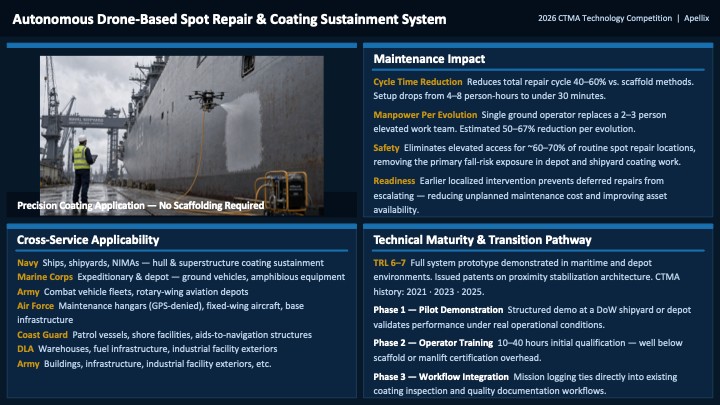
The system uses a multi-rotor UAV with patent-protected proximity control to hold a stable, precise position next to large vertical surfaces in GPS-denied settings. Onboard sensors correct in real time for air effects from surface proximity and rotor wash, keeping the tool on target without fixed anchors. A controlled coating module sets fluid flow, spray rate, and dwell time to meet film-build and coverage specs. The platform performs surface prep and coating with no personnel at height and adapts to hull sections, bulkheads, vehicle panels, and structural members across varied asset types and geometries.
Benefits to the DoW
Test results show total repair cycle time cut forty to sixty percent versus scaffold methods. Manpower per event drops fifty to sixty-seven percent by removing access setup and teardown from the workflow. Personnel leave elevated zones entirely during coating work, removing the main source of fall injury in this job class. The system applies to Navy ships and shipyards, Marine Corps expeditionary and depot work, Army ground vehicle and aviation depot ops, Air Force hangar and base structures, Coast Guard vessels, and DLA facilities, giving broad cross-service readiness and cost impact.
Innovation Challenges
Stable position control near large surfaces without GPS is the core challenge, made harder by variable rotor wash and surface reflection effects. Linking controlled coating output with live position data to hold on-spec results as surface state and tool angle vary adds control depth. Adapting the platform to the wide range of asset shapes and sizes across service branches requires a modular build and field-adjustable run settings.
Technical Maturity / Demonstration Results
The system is at Technology Readiness Level six to seven, with prototypes run in maritime and depot settings through CTMA cycles in 2021, 2023, and 2025. Proximity control and coating methods are covered by issued patents. The transition path starts with a pilot test, then operator training of forty to eighty hours — well below scaffold cert overhead — and ends with tie-in to current maintenance work orders and inspection records.