
Technology Title
ASKA InterModal Platform: Maintenance-Centered Design
Tech Focus Area
Autonomous Logistics
Abstract
Autonomous flight and drive systems are typically two separate vehicles, each with its own structure, maintenance record, and crew, doubling training, tooling, and diagnostic burden. Fixed-interval or reactive maintenance adds troubleshooting, removals, manpower, and downtime.
ASKA’s IMP is engineered to minimize maintenance burden by design. The airframe uses high composite content with 7075 aluminum components, built through CNC-machined parts and molded composite sections requiring minimal post-processing, avoiding gearbox and lubrication complexity that drives part count and inspection burden in conventional platforms. Maintenance centers on Line-Replaceable Units and high-reliability components: propulsion-motor and battery-module replacement each target approximately 30 minutes, and in-wheel motor sets swap in 10–30 minutes, much like a standard vehicle. On-site composite repair kits address the ~90% carbon-fiber structure. Being one vehicle, not two, means one structure, one record, and one crew.
Graphic
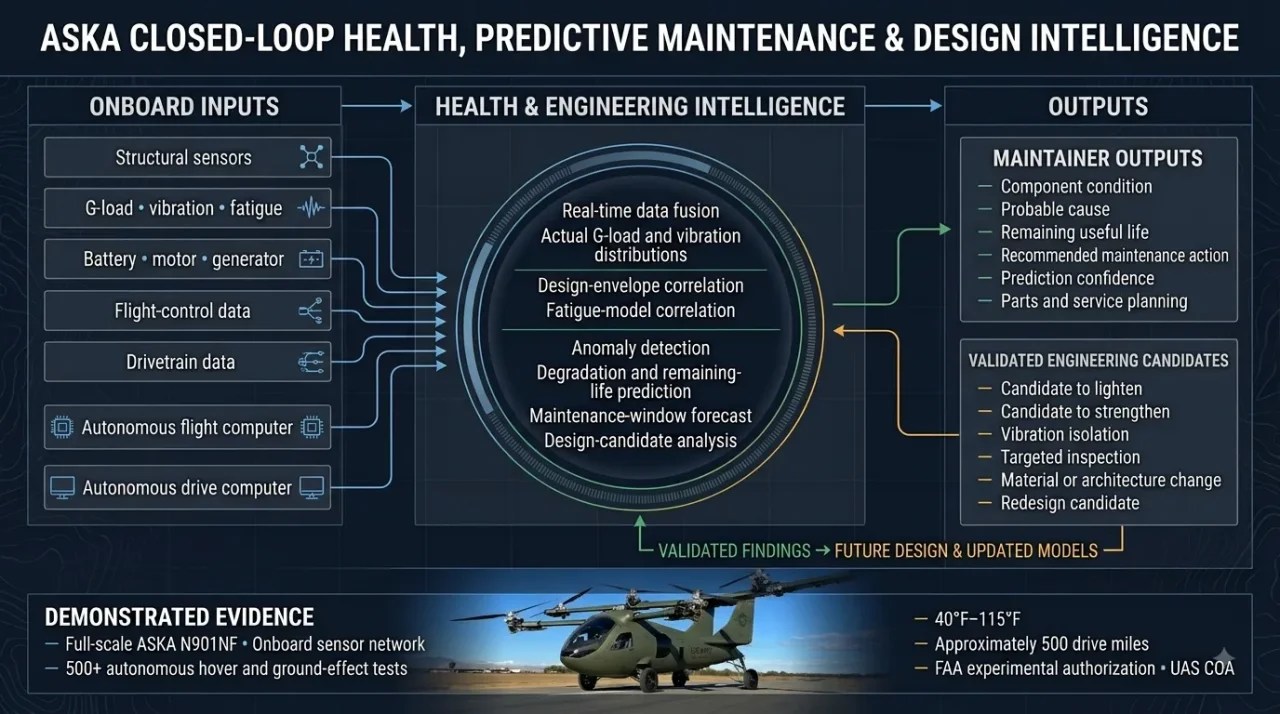
ASKA Integrated Vehicle Health, Predictive Sustainment, and Design Optimization Intelligence builds on this low-part-count design, connecting the flight and drive computers to sensors already on the vehicle, fusing structural, battery, motor, generator, flight-control, and drivetrain data into a single real-time health picture, so the system can recommend whether to continue, reroute, switch modes, or divert for maintenance in real time rather than on a fixed schedule. G-loads, vibration, and fatigue accumulation are correlated with the models used to size components, and analytics estimate remaining life and identify probable causes, creating a feedback loop: components below validated envelopes may become candidates for lighter geometry or materials; hotspots trigger reinforcement or redesign. Design changes require human review, engineering analysis, test, and certification.
Together, low-part-count hardware and one health picture enable more agile maintenance decisions, faster fault isolation, fewer no-fault-found removals, and higher availability at approximately $150/flight hour. Fleet learning improves fatigue models, diagnostics, and future air-ground designs.
Transition requires validating sensor calibration, fatigue-model correlation, prediction accuracy, false-alert controls, cybersecurity, data rights, and maintenance interfaces, functioning at the tactical edge with auditable, human-authorized recommendations.
The full-scale ASKA prototype (N901NF) integrates sensors across its structure, batteries, motors, generators, and flight controls, with fatigue-model correlation planned in the extended test campaign. Under a valid FAA Special Airworthiness Certificate and a UAS COA (#2025-WSA-599-SAC), it completed 500+ autonomous hover and ground-effect flight tests across 40°F–115°F, plus approximately 500 drive miles, supporting health-model validation, fault injection, and evaluation of maintainability and weight-optimization candidates.



