
Technology Title
Cu29 SPARE: (Sustainment Printing for Additive Repair of Electronics) Using Desktop and Industrial FDM/FFF 3D Printers
Tech Focus Area
Advanced/Additive Manufacturing
Abstract
Problem Statement: DoD maintenance organizations face sustainment risk from long lead times, obsolete electronics, fragile wiring, outsourced PCB production, and limited replacement parts. When conductive pathways, antennas, sensors, shields, interconnects, or circuit features fail, maintainers often rely on suppliers, depot fabrication, wiring workarounds, or unavailable assemblies. These delays increase downtime, manpower burden, cost, and readiness risk across air, ground, maritime, space, and DLA-managed systems.
Graphic
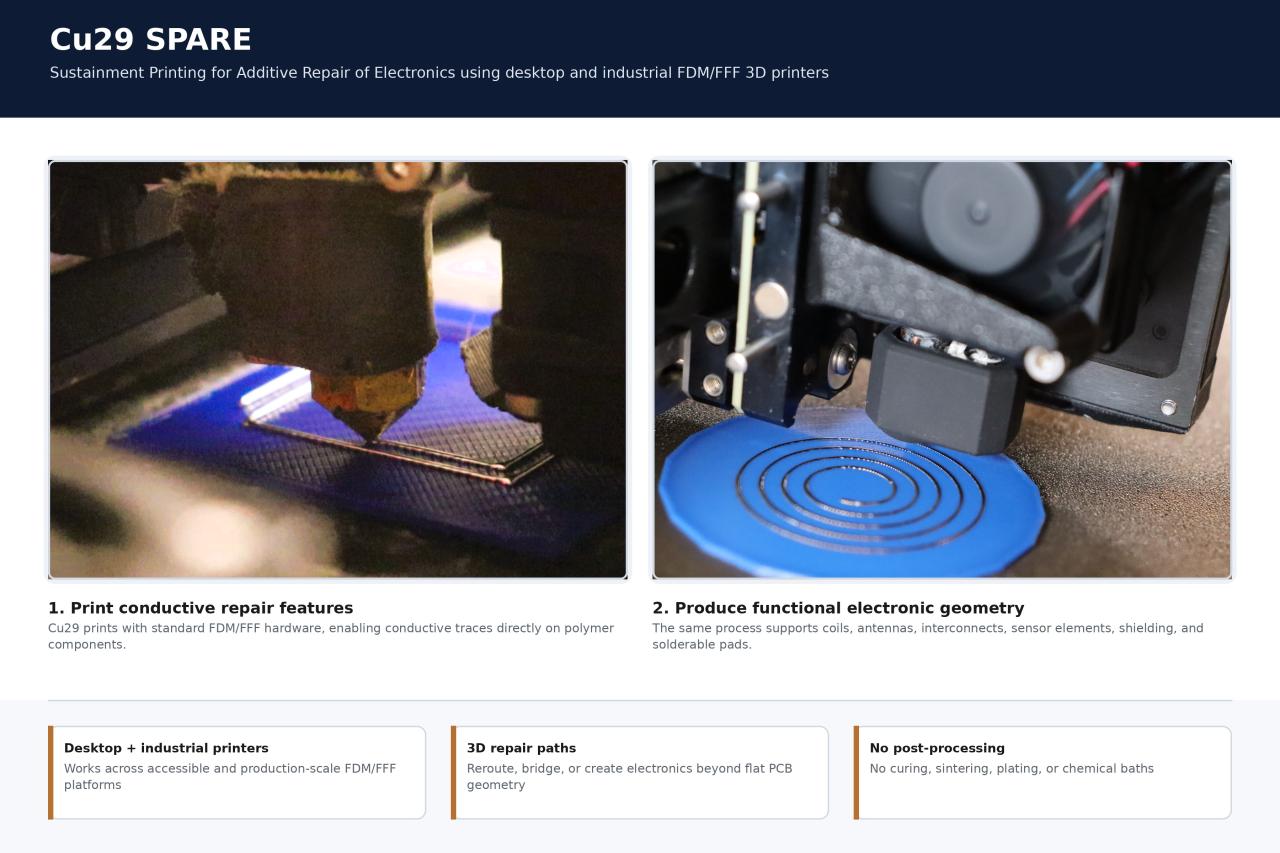
Innovation Solution: Cu29 SPARE, Sustainment Printing for Additive Repair of Electronics, uses Cu29, an all-metal conductive filament, to print functional electronic features using desktop and industrial FDM/FFF 3D printers. The capability enables traces, interconnects, antennas, sensor elements, EMI shielding, diagnostic fixtures, solderable pads, and repair structures to be printed into or onto polymer and structural components. It also uses the third dimension to repair, reroute, bridge, or create electronics in geometries that flat PCBs and wiring harnesses cannot support. This enables both repair of damaged conductive features and fabrication of new non-planar, conformal, or fully 3D electronics directly within or along the maintained structure. Unlike polymer-loaded conductive filaments, Cu29 provides orders-of-magnitude higher conductivity. Unlike specialized additive electronics systems, it requires no proprietary million-dollar printers, conductive inks, curing, sintering, plating, or post-processing, and is not limited to low-amperage or low-voltage use cases.
Benefits to the DoD: Cu29 SPARE moves selected electronics repair closer to the point of need. It can help maintainers prototype replacement conductive features, reduce long-lead PCB dependence, simplify wiring and assembly, support obsolescence workarounds, create lighter integrated parts, and restore or create electronic function using additive manufacturing infrastructure familiar to DoD users. Because Cu29 works on low-cost desktop printers and industrial-scale FDM/FFF systems, the approach is practical for depot, lab, and distributed sustainment environments.
Innovation Challenges: Transition requires application-specific validation, repeatable print profiles, maintainer design rules, environmental and electrical test data, and public-release training documentation. Kupros is addressing these through printer compatibility testing, component libraries, slicer profiles, onboarding guidance, and validation of traces, antennas, solderable interfaces, and higher-power articles.
Technical Maturity/Demonstration Results: Cu29 is TRL 6 to 7. Demonstrations include conductive traces, flexible circuits, coils, antennas, solderable interfaces, and test articles evaluated at 12,500 V and 5 A. Public material data reports resistivity of 1.226 x 10^-5 ohm-cm. Cu29 has been demonstrated on low-cost desktop and industrial FDM/FFF systems.