
Technology Title
Automated Distributed Diagnostics and Anomaly Processing Topology (ADDAPT)
Tech Focus Area
CBM+
Abstract
Damage Tolerance (DT) has historically been employed to manage integrity of metallic aircraft components, where parts are assumed to have cracks just smaller than can be reliably detected with common Non-Destructive Inspection (NDI) techniques, and using assumed loading profiles, models predict the number of flight hours necessary for those cracks to evolve to an unsafe length.
Graphic
Programmed Depot Maintenance (PDM) is planned such that there are at least two opportunities for NDI to reliably identify these cracks before the fatigue limit is reached. Once a phased inspection has taken place and no crack has been observed, again it is assumed that the crack is just below the limits of detection. The US Air Force Aircraft Structural Integrity Program (ASIP) has had a tremendously successful safety record, however the traditional DT approach has room for modernization. On one hand current practice can be extremely conservative, leading to reduced operational availability (Ao) due to the assumptions of pre-existing small cracks and the loading that will be experienced on a typical flight. On the other hand, there is potential for accelerated crack growth with deviations from assumed flight profiles or if multiple adjacent small cracks link together.
Metis Design Corporation (MDC), in collaboration with the F-15 System Program Office and ASIP, is demonstrating Intelligent Damage Tolerance (IDT), adhering to the same general strategy for managing structural integrity, but leveraging additional non-traditional sources of input to supplement assumptions with quantifiable aircraft-specific measurements. To complement and enhance traditional DT, IDT will employ Structural Health Monitoring (SHM) technology—in-situ sensors strategically placed to retrieve safety-of-flight data on-demand without need for depot tear-down or manual inspection. Condition Indicators (CI) extracted from SHM data are used to estimate component remaining useful life (RUL) to maximize Ao.
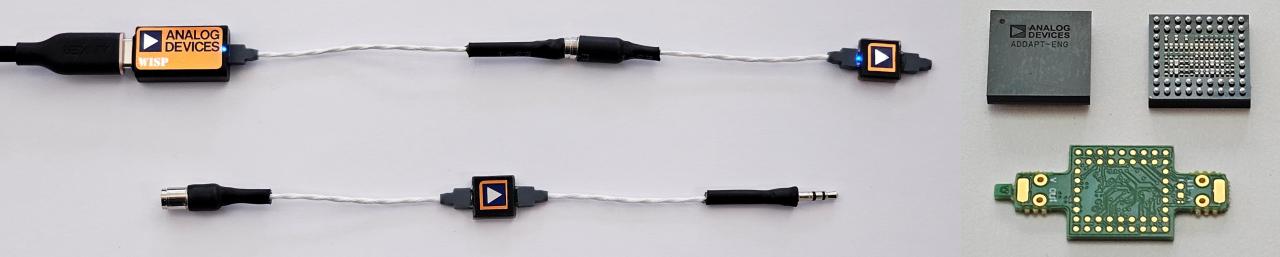
The Automated Distributed Diagnostics and Anomaly Processing Topology (ADDAPT) SHM system uses a network of 10 x 10 x 3 mm packaged system-on-a-chips that weigh < 1 g to locally digitize standard off-the-shelf sensors and place their data on a serial-over-power bus. Depending on number of ADDAPT Edge nodes on the network, a single twisted-pair cable can facilitate testing for dozens of sensors over tens of meters. Each ADDAPT Edge not only acquires data but can process signals to extract features and run real-time diagnostic algorithms, including machine learning. The ADDAPT Base at the front of the bus synchronously choreographs the Edge units, can fuse data sources from multiple Edges, and has flexible power and data interfaces to be operated in standalone or fully-integrated modes. Once implemented within the F-15 fleet, ADDAPT will be able to provide an on-demand in-field account of structural integrity for flight critical structures, allowing safe operation beyond the PDM interval when necessary.



