
Technology Title
Autonomous Hull Inspection Robots for Condition-Based Maintenance Intelligence
Tech Focus Area
Enhanced Inspection
Abstract
The ability to sustain operations in a contested logistics environment depends on how quickly vessels move through maintenance and return to the fleet. FleetBOT, an autonomous, dual-use hull inspection and cleaning platform, serves that need with a single objective: moving vessels through dry dock and back to service faster. It accomplishes this through two pathways: validated hull condition before a vessel arrives to inform work-package scoping, and automated inspection in the yard so hull work runs parallel with other trades.
Graphic
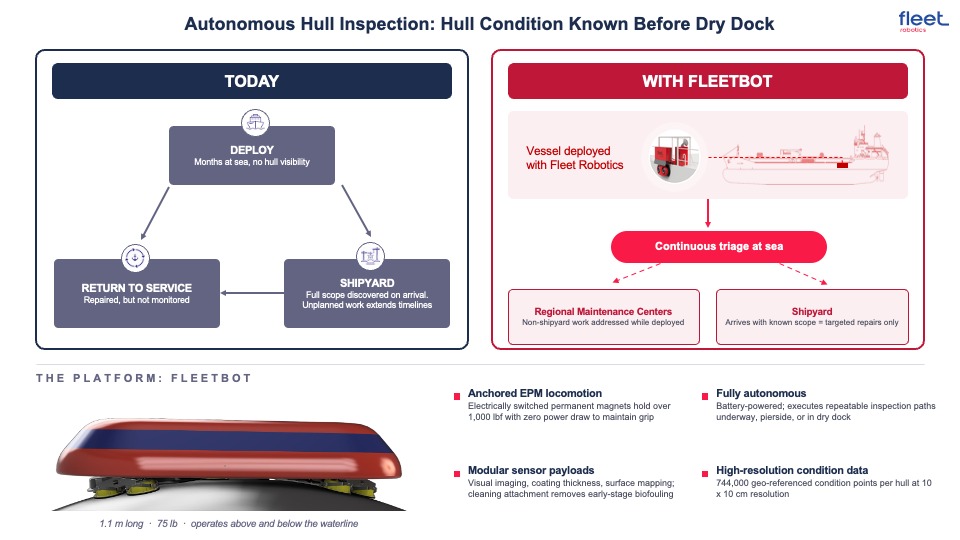
The Technology: FleetBOT is a compact, 75 lb hull-crawling robot built around a novel locomotion mechanism. Electrically switched permanent magnets adhere it to the hull with over 1,000 lbf of holding force while drawing no power to maintain grip, enabling sustained, battery-powered, fully autonomous operation above and below the waterline. That strength and efficiency give it access to the hull in any operating condition: underway, pierside, or in dry dock. On each deployment, the robot executes repeatable inspection paths with minimal oversight, carrying sensor and maintenance payloads matched to the use case, from visual imaging, coating thickness, and surface mapping to removal of early-stage biofouling, and capturing 744,000 geo-referenced condition points per hull at 10 x 10 cm resolution. The output is repeatable, high-resolution hull condition data that operators and shipyards can use to plan work and move vessels through maintenance faster.
Benefits to the Department of War: The platform reduces vessel downtime, returns skilled labor to repair work, and replaces manual, serial hull evolutions with automated workflows. Today those evolutions begin blind: hull condition is confirmed only in dry dock, so work is scoped on incomplete information and dock time grows at direct cost to readiness. Knowing hull condition before arrival reverses that sequence. Work is scoped once, and each defect found before work-package finalization avoids an estimated 500 to 1,000 man-hours of unplanned work. In the yard, automated inspection frees over 600 skilled man-hours per hull and takes scaffolding, man-lifts, and over-the-side work off the schedule. Between availabilities, sustained hull cleanliness reduces fuel consumption. Because every service operates steel hulls, the same capability serves Navy surface vessels, Military Sealift Command, Army watercraft, and the Coast Guard.
Technology Maturation and Transition: The dual-use platform is at TRL 6, corroborated in commercial and defense markets. Commercially, vessel trials are complete, DNV has completed a feasibility study, and an ABS MOU is focused on integrating the platform into classification inspection workflows. In defense, NAVSEA SBIR Phase I is complete and validation in naval operational environments continues under Phase II. This maturity allows the Department to transition a proven system rather than fund new development.



