
Technology Title
Sentry: Rapid Part Intelligence for Maintenance Readiness and DMSMS Risk Management
Tech Focus Area
Reliability Improvement
Abstract
Problem Statement: Maintainers across DoW organic and commercial repair facilities lose critical time when a component cannot be confidently identified, authenticated, sourced, or assessed for obsolescence risk — particularly circuit card assemblies (CCAs) and electronic parts affected by diminishing manufacturing sources and material shortages (DMSMS). Today, SMEs often reconstruct evidence from photos, labels, technical data, vendor records, and legacy systems manually, creating schedule delays, avoidable downtime, and risk of exposure to counterfeit or nonconforming parts entering the supply chain.
Graphic
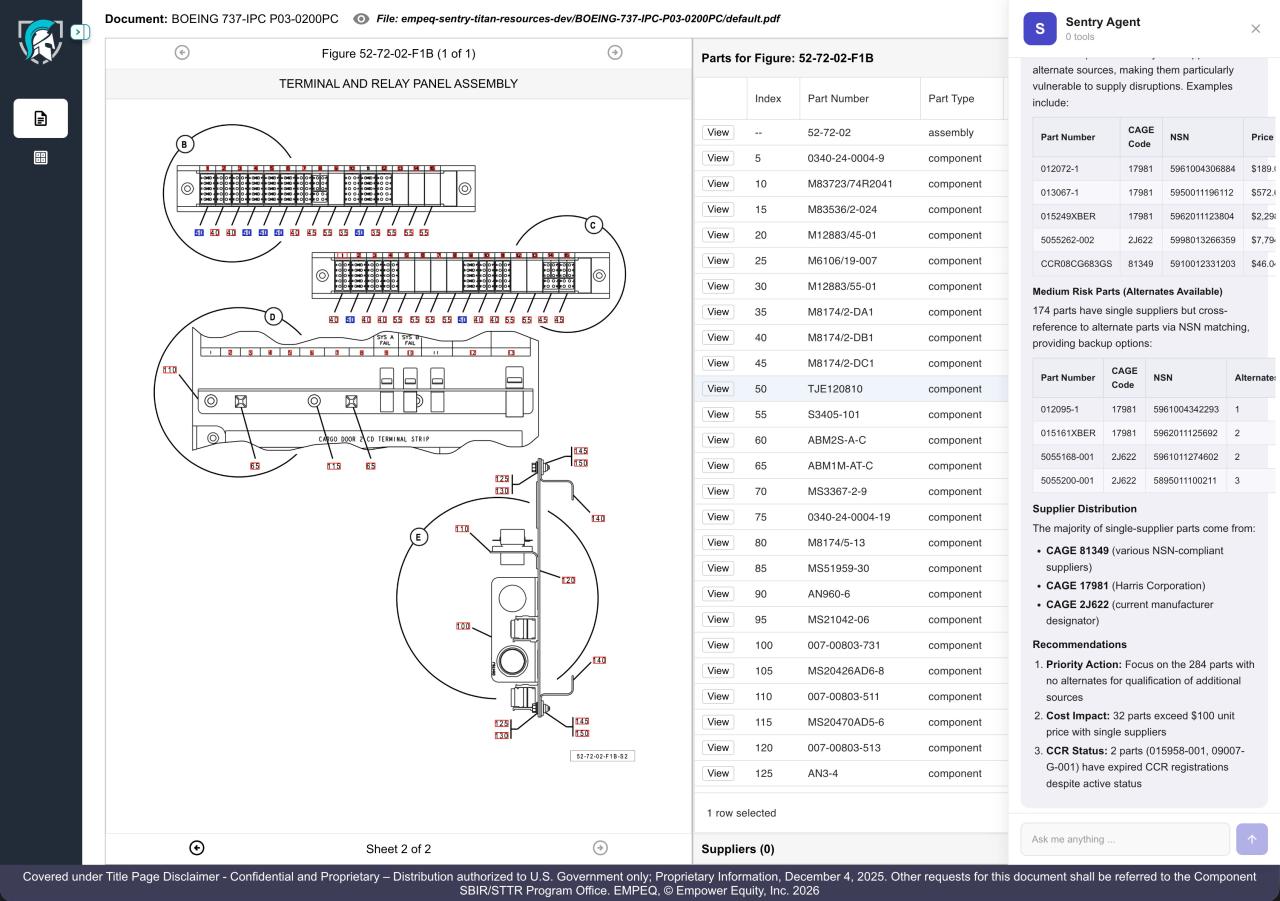
Description of the Innovation Solution: Sentry is an evidence-based parts intelligence platform that performs rapid component identification, authentication, and DMSMS risk scoring in support of DoW sustainment operations. Starting from a part photo or component record, Sentry uses computer vision and source-grounded data models to identify and authenticate CCAs and similar components, connect them to technical and supplier evidence, surface approved or potential alternates, and flag near-term and future DMSMS risk. Each result includes provenance, confidence scoring, and human review so the tool supports, rather than replaces, maintainer, engineer, and supply-chain decision-making.
Benefits to the DOW: In operational testing, the tool demonstrated rapid CCA identification and validation from approximately 10 to 30 minutes manually to 6 to 8 seconds, with all observed CCA cases correctly identified in the evaluated sample, with an estimated recovery of approximately 4,000 labor hours annually per Air Logistics Complex — valued at roughly $2.04M — by reducing manual part identification and authentication time. More importantly, faster and more reliable part intelligence helps reduce avoidable aircraft and weapon-system downtime by shortening the time between part uncertainty, sourcing action, and maintenance resolution.
Innovation Challenges: Key challenges included training a model robust enough to generalize across varied CCA form factors, markings, damage states, and legacy inventories; integrating with existing technical data and authentication standards; and validating performance against government-controlled test articles to meet DoW data-assurance requirements.
Technical Maturity/Demonstration Results: The technology has completed operational test (OT) activities and is fielded within a USAF-authorized Impact Level 5 environment. It has been matured under an Air Force SBIR award and a Tactical Funding Increase (TACFI) contract, progressing from prototype to operational use supporting Air Logistics Complex sustainment activities. The capability is applicable to maintenance organizations across the services and DLA because part identification, authentication, obsolescence, and sourcing delays are not platform-specific problems.



