
Technology Title
ASCEND – Aligned Supply Chain Execution for National Defense
Tech Focus Area
Business Processes / Partnerships
Abstract
Problem Statement: When an aircraft is down for parts, the fix rarely waits on the part alone. It waits on an analyst reconciling status, demand, repair capability, inventory, cost, and readiness effect across systems that do not talk to each other, delaying support for repairables and consumables across the Joint Force. The result is longer Maintenance Customer Wait Time (MCWT) and Repair Cycles, more Not Mission Capable Supply (NMCS) hours, and more Cannibalization.
Graphic
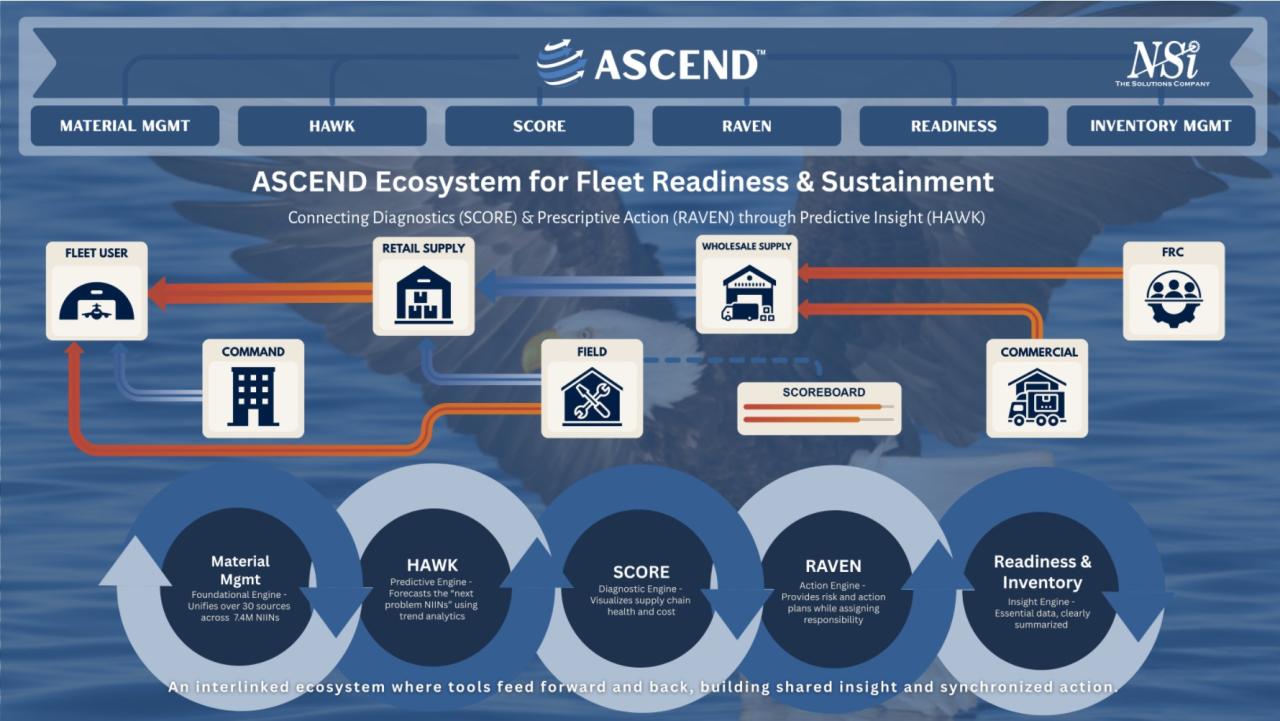
Description of the Innovation Solution: NSI’s ASCEND Suite of digital tools, featuring I-Level Reform and RAVEN modules as well as others, provided this integrated solution to Material Readiness fusing over 30 authoritative sources across 7.4 million NIINs. I-Level Reform provides insight to performance, material alignment, and repair dependencies. It identifies bottlenecks and highlights like or similar sites with repair capabilities, displays mismatched allowances, and exposes process gaps that impede repair throughput. RAVEN scores 30 months of requisition history for demand likelihood and the maintenance consequence of an unavailable item, producing NIIN and site-specific action plans. A dashboard shows risk; RAVEN assigns it. Each action ties maintenance demand and readiness consequence to the responsible sustainment pillar, evidence, and next step, routed daily to the wholesale, retail, I-level, depot, or program user who owns it.
Benefits to the DOW: ASCEND replaces fragmented handoffs with a prioritized queue connecting flight line, I-level, depot, supply, and program decisions. Acting earlier reduces MCWT, protects maintenance schedules, limits NMCS time and cannibalization, and aligns material and repair priorities to flight line demand. The engine is platform agnostic: the same scoring and assignment apply to any Service reparable supply chain and DLA managed items; only source systems and Service codes.
Innovation Challenges: Human validation of configuration, condition, repair status, and data quality must precede action; this protects decision authority but slows execution at scale. AI-assisted confidence scoring can route exceptions while experts keep authority. Expanding beyond the Navy means mapping Service codes, rules, and decision authorities while preserving provenance, plus data sharing agreements and integration with each Service’s maintenance system of record.
Technical Maturity and Demonstration Results: RAVEN is at TRL 9 and supports DoW mission operations now. It is in continuous use at the Naval Air Forces Maintenance Operations Center (MOC), the nerve center for Materiel Readiness of every Navy/Marine Corps aircraft, afloat and ashore. It is also used in daily mission operations at two ACAT I program offices – USMC H-53 and Navy P-8, as well as by NAVSUP WSS. It is deployable across DoW for any Military Service, using authoritative maintenance, supply, and other product support data to provide quantum gains in Material Readiness for all warfighter systems.



