
Technology Title
Continuous Quantitative Structural Strain Trending as a CBM+ Complement to Inspection
Tech Focus Area
CBM+
Abstract
Problem Statement: DoW maintainers still plan most structural work from calendar, flight-hour, and cycle-based inspection programs. Between those events, airframes and other high-value structures accumulate strain that the next scheduled NDT visit cannot see. The sustainment cost is familiar: no-find teardowns, unscheduled depot induction, late discovery of meaningful change, and technician hours spent opening structure rather than measuring it. Surface cameras and computer-vision tools do not close this gap. They observe appearance. They do not record continuous quantitative strain or bind it to operational context.
Graphic
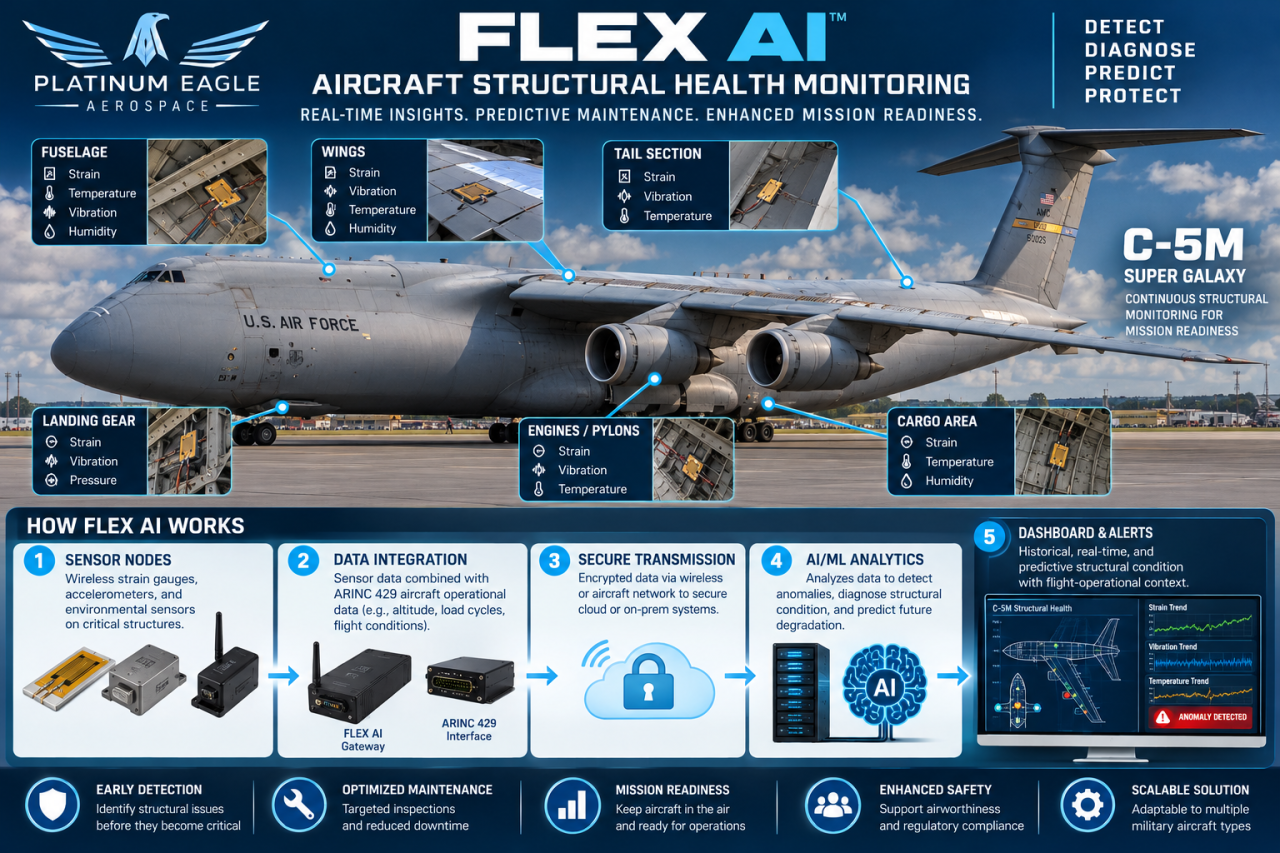
Description of the Innovation Solution: FLEX AI™ is an intelligent structural health trending and monitoring platform. Adhesive-mounted strain-sensing patches, including rosette and multi-axis configurations for metallic and composite structure, feed a gateway that can capture high-rate bursts when strain behavior changes rapidly. Sensor data are fused with operational context, such as flight-phase or weight-on-wheels-style inputs where avail
Benefits to the DoW: The same CBM+ need exists across the services and DLA-supported depots: know actual structural condition, not only last-inspection status. FLEX AI™ supports earlier visibility into structural change, better inspection targeting, fewer unscheduled events, a historical record that travels with the asset, and remote visibility for distributed fleets. The sensing layer is platform-agnostic, so the same trending approach can apply to aviation, marine, and other high-value structures without forcing a new inspection method onto the maintainer.
Innovation Challenges: The principal challenge is disciplined transition: keep the technology inside existing airworthiness and inspection programs rather than claiming it substitutes for them. This public entry contains no proprietary install data. Remaining work includes depot and organizational maintenance-system integration, EMI-hardening on operational platforms, and training maintainers to interpret trends, not only to install sensors.
Technical Maturity / Demonstration Results: The sensing and trending architecture has been demonstrated in a successful proof-of-concept demonstration. An FAA Supplemental Type Certificate is in process, with a target to finish before the end of 2026. Remaining work is certification completion, production documentation, and service-specific implementation — not a paper concept. Analytics then identify meaningful change over time so engineering can keep a continuous structural record between scheduled inspections. FLEX AI™ is not a camera or computer-vision system. It does not replace an Airworthiness Directive or any mandated NDT. It complements inspection by improving when and where NDT is applied.
.



