
Technology Title
FLAGSHIP (Federated Logistics & Availability Generation for Shipyard Health, Integration & Planning)
Tech Focus Area
CBM+
Abstract
Naval maintenance organizations operate in a data-rich but decision-poor environment in which authoritative maintenance, supply, and scheduling data remain fragmented across systems such as OMMS-NG, Navy ERP, and SKED. This fragmentation forces maintainers and planners to reconcile information manually, slows response to emerging sustainment issues, and obscures the relationship between equipment condition, part availability, work sequencing, and mission impact. The result is a reactive maintenance posture that increases logistics delay, manpower burden, maintenance cycle time, and readiness risk. To address this problem, we present FLAGSHIP, a predictive sustainment and explainable artificial intelligence architecture designed to improve maintenance decision-making without replacing existing systems of record. Using the CRISP-DM methodology, FLAGSHIP federates maintenance, logistics, and scheduling data through a semantic layer that creates a unified readiness-focused view while preserving compatibility with heterogeneous source systems. The analytical approach is anchored to Operational Availability on Ao=MTBM/(MTBM+MMT+MLDT) which frames prediction in terms directly relevant to maintainers and planners.
Graphic
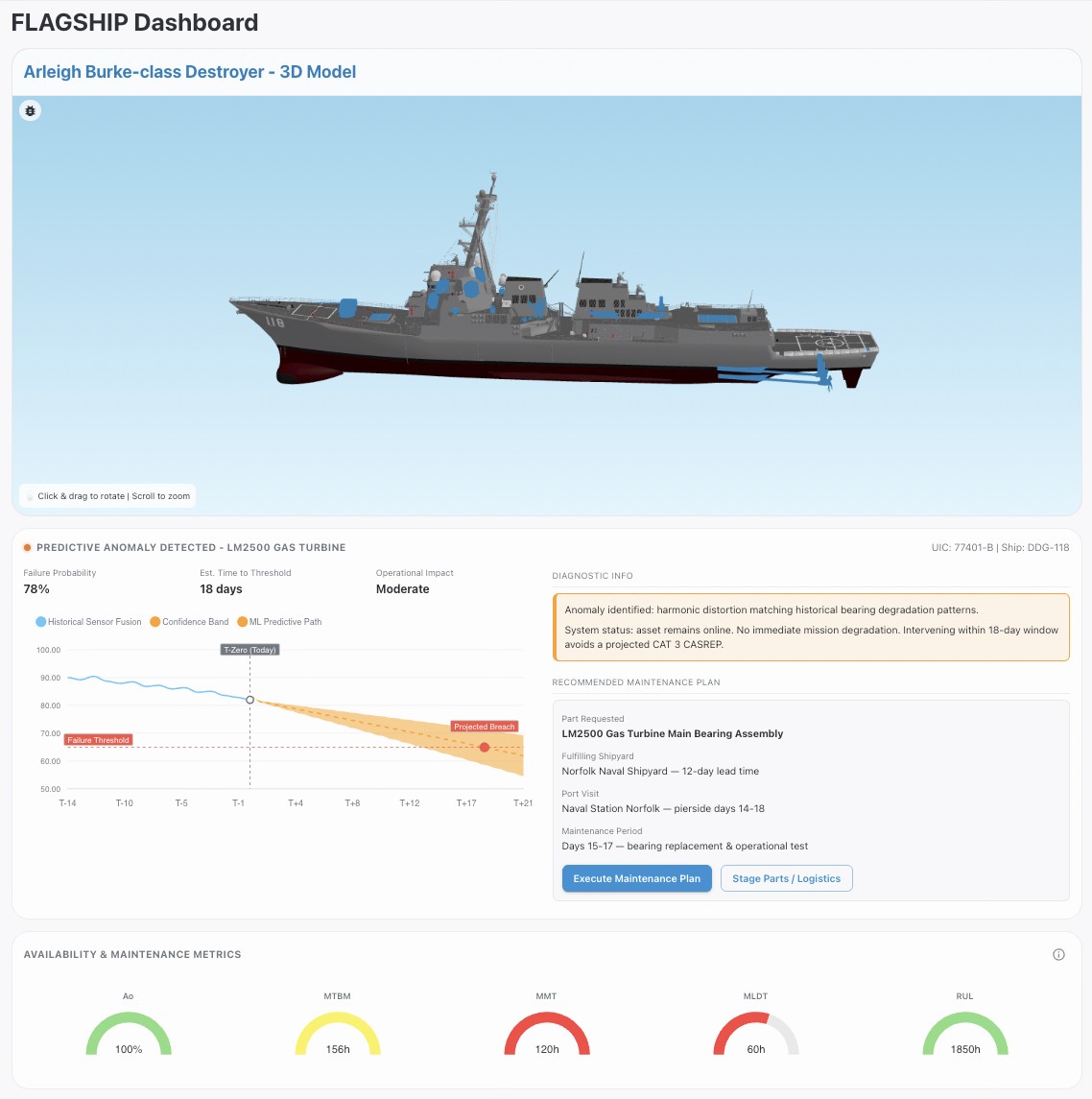
For modeling and evaluation, FLAGSHIP applies Gradient Boosted Decision Trees in an XGBoost-style implementation to sparse, heterogeneous sustainment data and uses SHAP-based explanations to expose whether predicted readiness risk is driven by reliability history, equipment behavior, or logistics constraints. This design improves interpretability and supports human review in operational maintenance workflows. In synthetic federated testing, the approach achieved approximately 0.80 F1 and 0.81 PR-AUC for early readiness risk detection, while the prototype also demonstrated low-latency analytics and scalable throughput suitable for maintenance decision environments. The architecture reduces manual data reconciliation, improves maintenance prioritization, lowers logistics delay, and supports faster readiness-focused decisions, with applicability beyond Navy shipyards to depots, aviation maintenance organizations, and Defense Logistics Agency coordination environments. Remaining challenges include validation with live operational data, integration across heterogeneous authoritative systems, and alignment with security and authorization constraints in defense environments. To support transition, FLAGSHIP is being refined through stakeholder engagement, including a dedicated teaming day, follow-on scalability work with Google Public Sector’s NAVSEA team, and internally developed NIST SP 800-53 Rev. 5-aligned codebase and dependency scanning intended to accelerate ATO preparation.



