
Technology Title
Eclipse X9 PETG Thermoplastic Composite
Tech Focus Area
Additive Manufacturing
Abstract
Problem Statement: Department of War (DOW) maintenance organizations must sustain aging and dispersed systems while facing long replacement-part lead times, corrosion, diminishing manufacturing sources, and limited point-of-need repair. Conventional metal parts can require tooling, machining, coatings, and centralized supply chains, increasing cycle time, cost, and equipment downtime.
Description of the Innovation Solution: Eclipse X9 is a basalt-reinforced recycled-PETG thermoplastic composite for pellet- and filament-based additive manufacturing. The approach combines corrosion-resistant feedstock, large-format additive manufacturing (LFAM), digital part files, near-net-shape deposition, finish machining, and hybrid inserts/hardpoints to produce maintainable components without conventional tooling. Candidate applications include panels, covers, ducts, housings, brackets, fixtures, tooling, and non-pressure structural parts where corrosion, obsolescence, or lead time drives sustainment burden. A digital thread links material lot, build parameters, inspection, machining, and quality evidence
Graphic
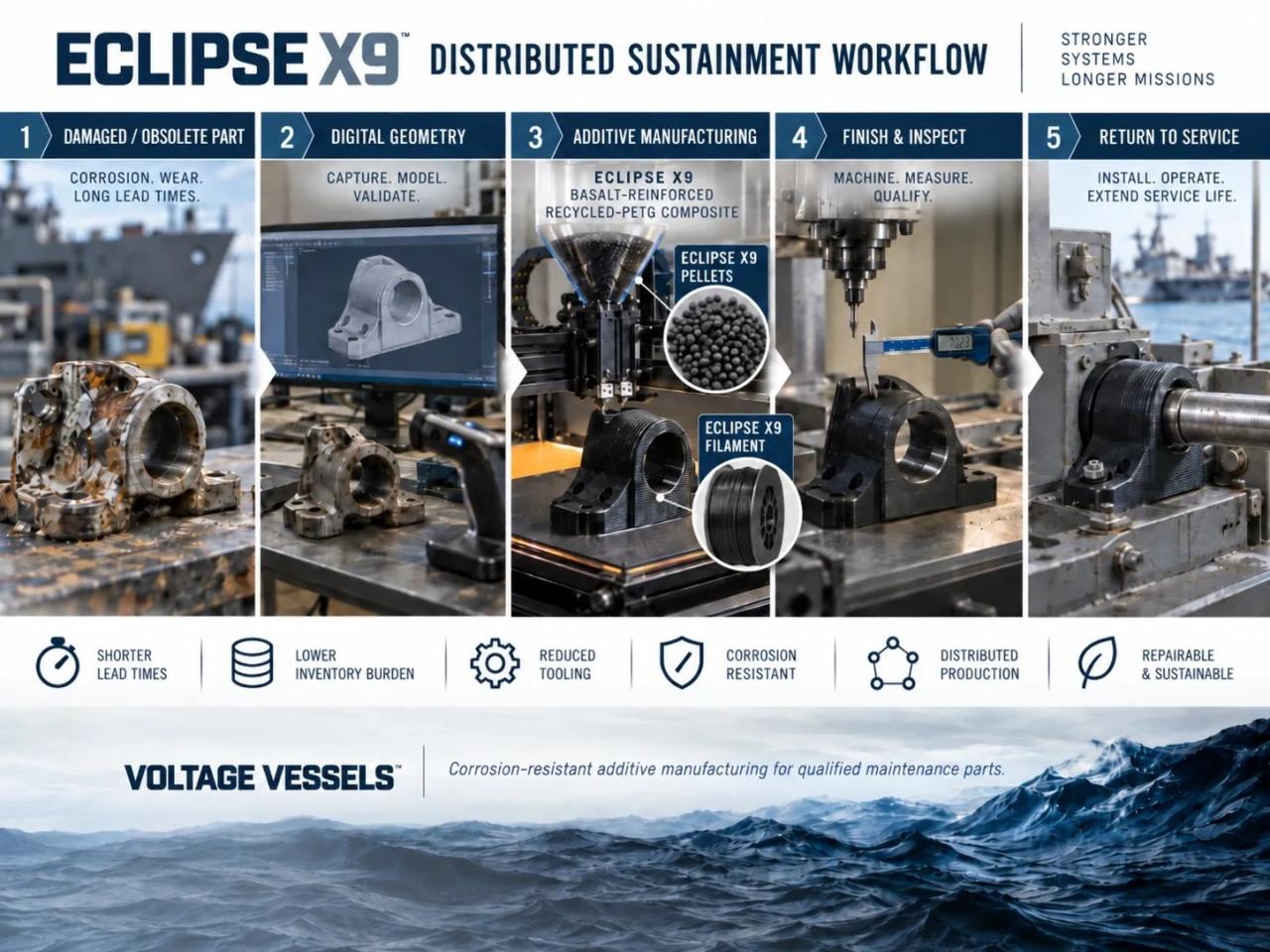
Benefits to the DOW: Eclipse X9 can move selected sustainment work from “order and wait” toward digitally enabled manufacture, inspect, install, and repair. Benefits include shorter replacement lead times; reduced corrosion/coating maintenance; lower inventory and transportation burden; rapid reproduction of obsolete or low-volume parts; repairable thermoplastic structures; reduced tooling; and distributed production at depots, shipyards, expeditionary sites, and qualified commercial cells. The architecture applies across maritime, ground, aviation-support, infrastructure, and DLA maintenance environments.
Innovation Challenges: Key challenges are additive anisotropy, interlayer bonding, moisture control, dimensional stability, creep, damage tolerance, environmental/fire requirements, repair qualification, and inspection correlation. Mitigation uses controlled feedstock conditioning, qualified process windows, orientation-specific testing, witness coupons, dimensional/NDE inspection, environmental conditioning, and progressive qualification.
Technical Maturity/Demonstration Results: The Eclipse X9 material/LFAM platform is assessed at TRL 8. Testing has produced approximately 108 MPa tensile strength in favorable printed orientation. University of Maine ASTM D790 testing reported 112.98 MPa flexural strength in a favorable orientation and 36.09 MPa cross-orientation, demonstrating structural potential while quantifying anisotropy. Voltage technical records also report water absorption below 0.4% and heat-deflection temperature above 70 C. Current maturation focuses on repeatable process control, application-specific qualification, inspection, and representative DoW maintenance demonstrations.



