
Technology Title
Rapid Technology Exercise REPTX
Tech Focus Area
Business Processes/Partnerships
Abstract
Problem Statement: The Department of War needs faster, more operationally grounded methods to identify, stress-test, and advance commercial and emerging technologies against real sustainment gaps. In an era of great power competition, the ability to repair and recover forces while still forward is a decisive advantage. Traditional evaluation and demonstration approaches, while thorough, often struggle to keep pace with the speed of technological change and the compressed timelines of potential conflict.
Graphic
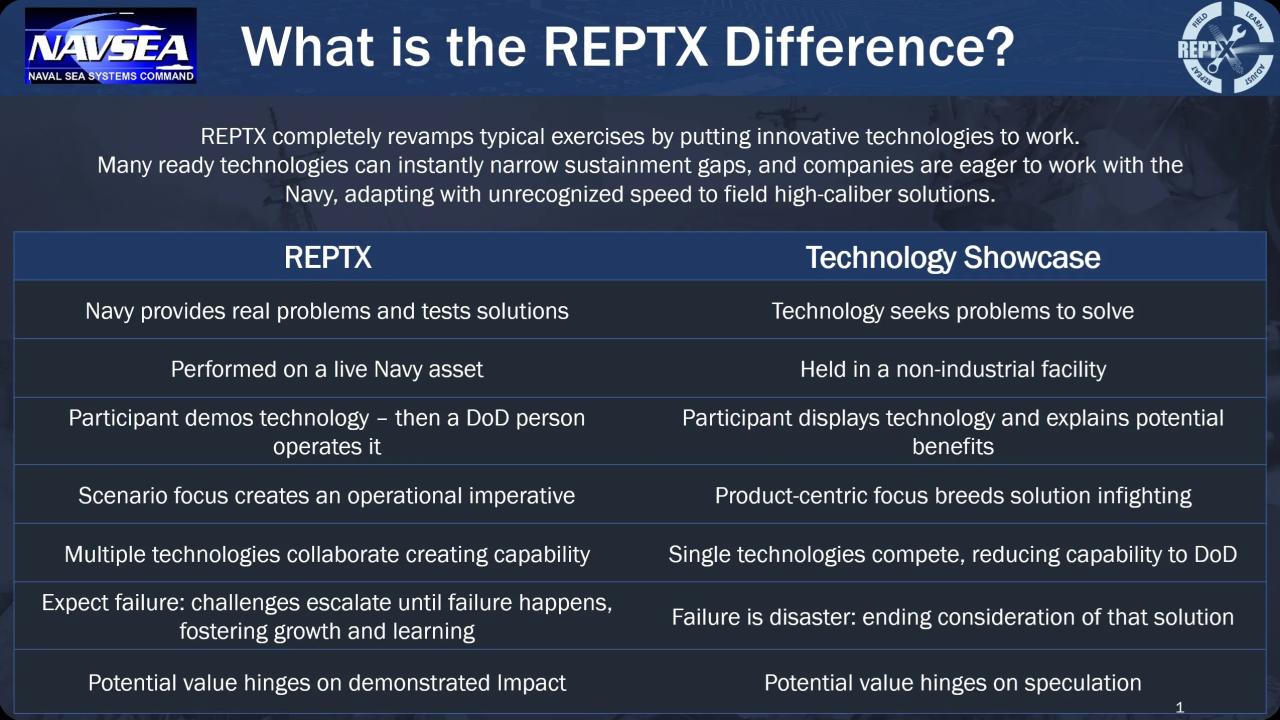
Description of the Innovation Solution: REPTX is a live, operationally realistic exercise model that places commercial and emerging technologies into unpredictable military conditions rather than controlled laboratory or showcase settings. Companies face real-world scenarios, direct warfighter evaluation, and genuine risk of failure. The model prioritizes speed, operational relevance, and learning over perfect performance. Core principles include rigorous entry criteria, live conditions, warfighter feedback, and a deliberate path from evaluation to adoption.
Benefits to the Department of War: REPTX compresses the time from technology discovery to informed decision. It gives the Department direct insight into what works under stress, exposes integration challenges early, and creates a shared understanding between operators, engineers, and industry. The model has been recognized across OSD, CTMA/NCMS, and other DoW organizations as an effective method for identifying and rapidly advancing solutions to critical gaps. It has influenced parallel efforts, including NCMS STRATO-T events focused on Air Force aircraft repair challenges, and was featured in a dedicated panel at the 2026 CTMA Partners Meeting. PBDE employment was enabled by strong partnership with PACFLT, MDSU, SUPSALV, MARMC, and other operational stakeholders.
Technical Maturity / Demonstration Results: Since inception, REPTX has evaluated more than 130 companies across multiple events ranging from shore facilities to active ships. The model continues to evolve around known gaps. In 2026, NESAR executed Train-REX—a focused REPTX variant designed to identify and validate training solutions for expeditionary capabilities—demonstrating how the core REPTX framework can be tailored to specific problem sets while retaining its emphasis on live conditions and warfighter evaluation. By treating failures as learning opportunities and keeping conditions deliberately difficult, REPTX produces decision-quality data faster than traditional demonstration pathways. As the Department faces compressed decision timelines, REPTX offers a proven mechanism to convert commercial innovation into expeditionary sustainment advantage at the speed the force requires.



