
Technology Title
Physics Grounded Predictive Sustainment
Tech Focus Area
CBM+
Abstract
Problem Statement: DoW maintenance often relies on scheduled inspections, built-in-test messages, and fixed thresholds. Equipment operates under changing loads, environments, and configurations, while labeled failure data remain sparse and connectivity may be limited. These conditions can delay warning, complicate fault isolation, and contribute to unnecessary removals, no-fault-found events, and lost readiness.
Graphic
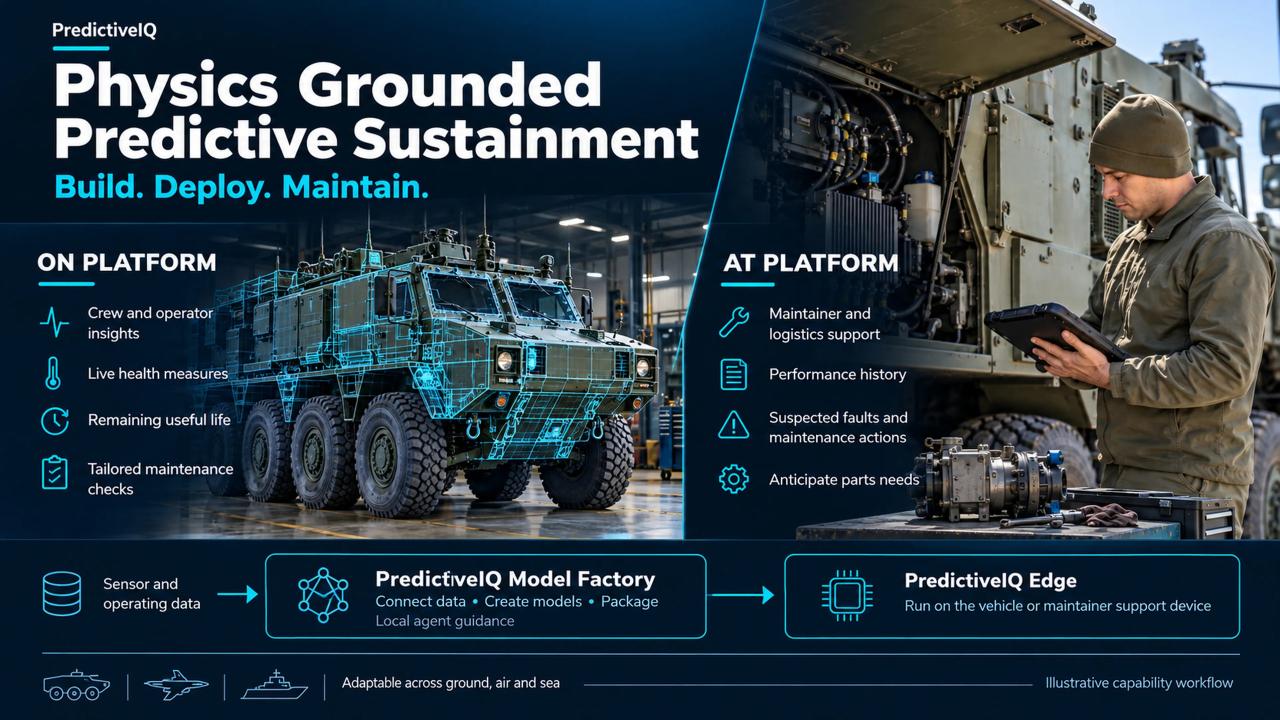
Description of the Innovation Solution: The capability uses Physics AI to combine available platform data with known physical relationships among speed, load, temperature, pressure, vibration, and degradation. Engineers use Continuum Model Factory to map signals, train candidate models, test them against measured and simulated cases, quantify uncertainty, and package approved models. Continuum Edge runs those models on or near the platform for crew, operator, and maintainer use, including in disconnected, disrupted, intermittent, and limited-bandwidth settings. Outputs can include health and condition indicators, virtual sensors, and uncertainty-aware remaining useful life.
Benefits to the DoW: The capability is intended to identify developing degradation earlier, focus inspections, shorten troubleshooting, reduce unnecessary removals, and improve parts and maintenance prioritization. A common model-development and edge-deployment path can be adapted across ground vehicles, support equipment, power systems, ships, and aviation platforms without making every application a separate software product.
Innovation Challenges: Sensor availability, data quality, platform variation, and limited representative failure data remain central challenges. The approach addresses them through physical constraints, measured and simulated data, transfer learning where appropriate, explicit uncertainty, and application-specific validation and acceptance criteria. It does not replace field validation or maintainer judgment.
Technical Maturity and Demonstration Results: The technology has progressed through two Army SBIR Phase II efforts. Working software supports model creation, validation, packaging, and edge execution, and is being integrated for ground-vehicle applications. Component models and containerized deployment paths have been demonstrated in representative software and test environments. Current work is expanding access to representative vehicle data and establishing controlled field validation. Performance will be assessed through detection lead time, false-alert rate, diagnostic usefulness, maintenance cycle time, and readiness impact.



