
Technology Title
SIGNALSEED: Physics-informed Synthetic Data for CBM+
Tech Focus Area
CBM+
Abstract
Problem Statement: The Department of War (DoW) is fielding new and upgraded weapon systems whose health-management algorithms depend on failure data that often does not exist. Mission-critical systems are intentionally designed not to fail; new platforms lack historical fault data, while major upgrades can invalidate legacy loading and condition-indicator baselines. Obtaining representative failure data through fleet operations can require tens of thousands of operating hours, delaying effective condition-based maintenance and driving conservative inspections, unnecessary component removals, higher sustainment cost, and reduced availability
Graphic
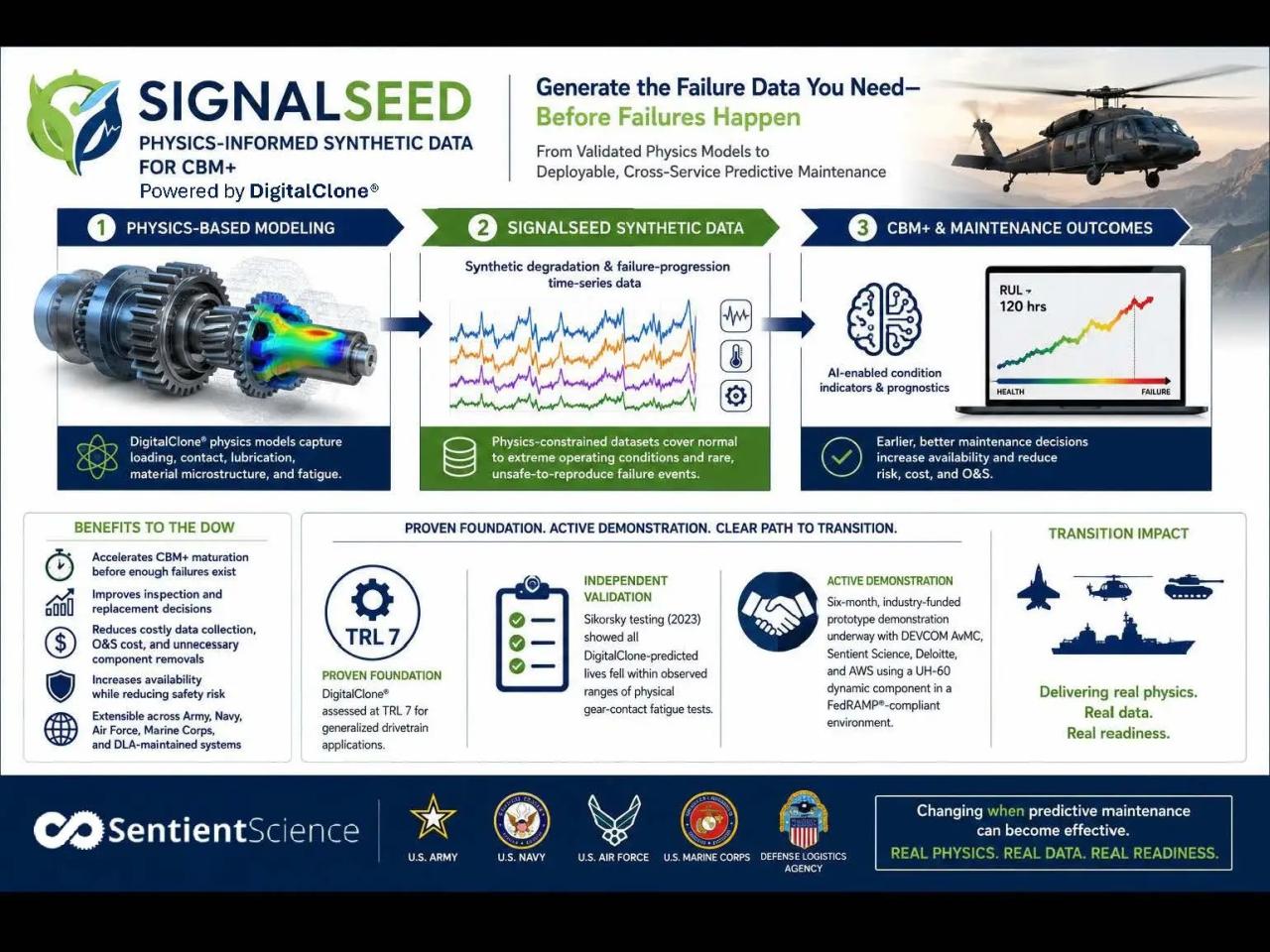
Description of the Innovation Solution: SignalSeed is a physics-informed synthetic-data capability that generates realistic degradation and failure-progression datasets before sufficient fleet data exists. It uses DigitalClone® physics-based digital engineering to model component loading, contact mechanics, lubrication, material microstructure, damage initiation, and fatigue progression. These simulations are transformed into synthetic time-series datasets for developing and refining condition indicators, prognostic models, and AI-enabled health-management algorithms. Unlike purely statistical or generative synthetic data, SignalSeed constrains generated data using the governing physics and failure mechanisms of the actual component. This enables rare, emerging, and unsafe-to-reproduce failure conditions to be explored without intentionally failing operational assets.
Benefits to the DoW: SignalSeed changes when predictive maintenance can become effective. Instead of waiting years for sufficient fleet failures to accumulate, maintainers and sustainment engineers can develop and evaluate health indicators before representative failure histories exist. This can accelerate CBM+ maturation, reduce dependence on costly operational data collection, improve inspection and replacement decisions, and increase availability while reducing safety risk and O&S cost. The same physics-informed approach is extensible across Army, Navy, Air Force, Marine Corps, and DLA-maintained systems incorporating gears, bearings, drivetrains, and other fatigue-critical components.
Innovation Challenges: Transition requires demonstrating that synthetic degradation signatures remain representative across sensors, operating environments, platforms, and failure modes. SignalSeed addresses this through correlation with physical test and operational data, uncertainty quantification, and integration with existing HUMS/CBM+ workflows.
Technical Maturity/Demonstration Results: SignalSeed builds on DigitalClone, assessed at TRL 7 for generalized drivetrain applications and supported through a U.S. Army DEVCOM AvMC SBIR Phase III contract for continued rotorcraft drive-system technology development. Independent Sikorsky testing published in 2023 showed that all DigitalClone-predicted lives fell within the observed ranges of physical gear-contact fatigue tests. A six-month, industry-funded prototype demonstration is underway with DEVCOM AvMC, Sentient Science, Deloitte, and AWS, using a UH-60 dynamic component to generate and evaluate SignalSeed synthetic data in a FedRAMP-compliant environment. This establishes a defined transition path from validated physics models to deployable, cross-Service predictive-maintenance capability.



