
Technology Title
AI Powered Job Performance Aid
Tech Focus Area
Training
Abstract
Problem Statement: Workforce development is limited by schoolhouse throughput, instructor capacity, and warfighter location. Effective training is typically available through defined curriculum at set times and locations.
Virtual Maintenance Trainers (VMTs) are high-fidelity simulations of systems such as Close-In Weapon System (CIWS) providing visualizations for troubleshooting and repairing faults. Built with the Virtualized Advanced Learning Environment (VALE) Software Development Kit (SDK), the Modeled Objects Virtual Environment (MOVE) state machine tracks the status of all components. VMTs can be available worldwide, but usefulness is limited without expert knowledge and guidance.
Graphic
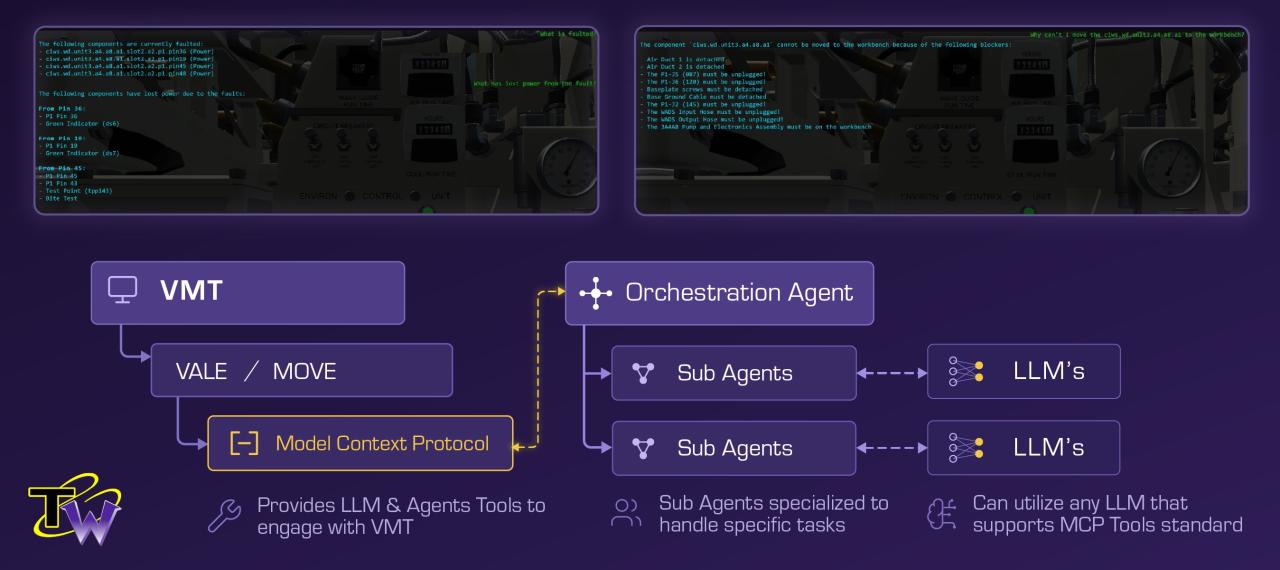
Innovation Solution: This technology takes existing VMT technology and incorporates Artificial Intelligence (AI) utilizing a Model Context Protocol (MCP) server, agents, and Large Language Model (LLM) to create an intelligent job performance aid that is knowledgeable about the state of the simulated system and likely reasons for fault symptoms.
VMT MCP follows a widely used standard to allow agents and LLMs to engage with the VMT through MCP tools in MOVE. It utilizes the existing VMT deployment environment and server resources, including VMT user interface interactions. This agentic system supports agent tool and MCP compliant LLMs, such as frontier models developed by industry leaders, with no additional overhead. VMT MCP is also built to support additional LLMs and small reasoning models that can call agent tools. This allows for flexibility in different environments and use cases without the LLM being trained.
Benefits to the Department of War (DoW): The VALE SDK, including MOVE, is government owned and can be used to develop VMTs simulating any system. Any VMT made with the VALE SDK will be able to utilize MCP to provide instructor assistance, increase throughput, and be an intelligent job performance aid on deployment. VMT MCP is designed to be lightweight, deployable to any location regardless of internet availability, and usable without paying license fees or LLM tokens. The availability of this resource will increase warfighter ability to independently troubleshoot and fix faults that would have otherwise required outside assistance.
Innovation Challenges: Successfully deploying this technology on existing assets without needing datacenter resources required engineering agents to use small reasoning models and quantized LLMs. Allowing the MCP server to reside within the VMT to provide simulation context required developing ways for the agent to gather information by sending incomplete responses to the client through communication pathways within the existing VMT architecture.
Technical Maturity: VMT MCP development is currently at Technology Readiness Level (TRL) 4. A prototype has been developed with the CIWS VMT and has been successfully demonstrated to stakeholders. Future development will add tools and validate the technology in a deployment environment.



