
Technology Title
Augmented Fire Watch: Edge-AI Thermal Monitoring for Hot Work and Unattended Spaces
Tech Focus Area
Energy, Environment, Health, and Safety
Abstract
Problem Statement: Hot work is a leading fire risk during ship and depot maintenance, and every permit requires a dedicated human fire watch for the work and the post-work cool-down period. Each position costs about $6,120 per month (40 hrs/wk, ~1.5 people per shift), yet only about half of a shift is effective observation. A single availability can generate dozens of simultaneous permits, pulling qualified workers and Sailors off skilled maintenance to stand watch. GAO attributes roughly $4B in losses to fires at Navy and DoD sites since 2008.
Graphic
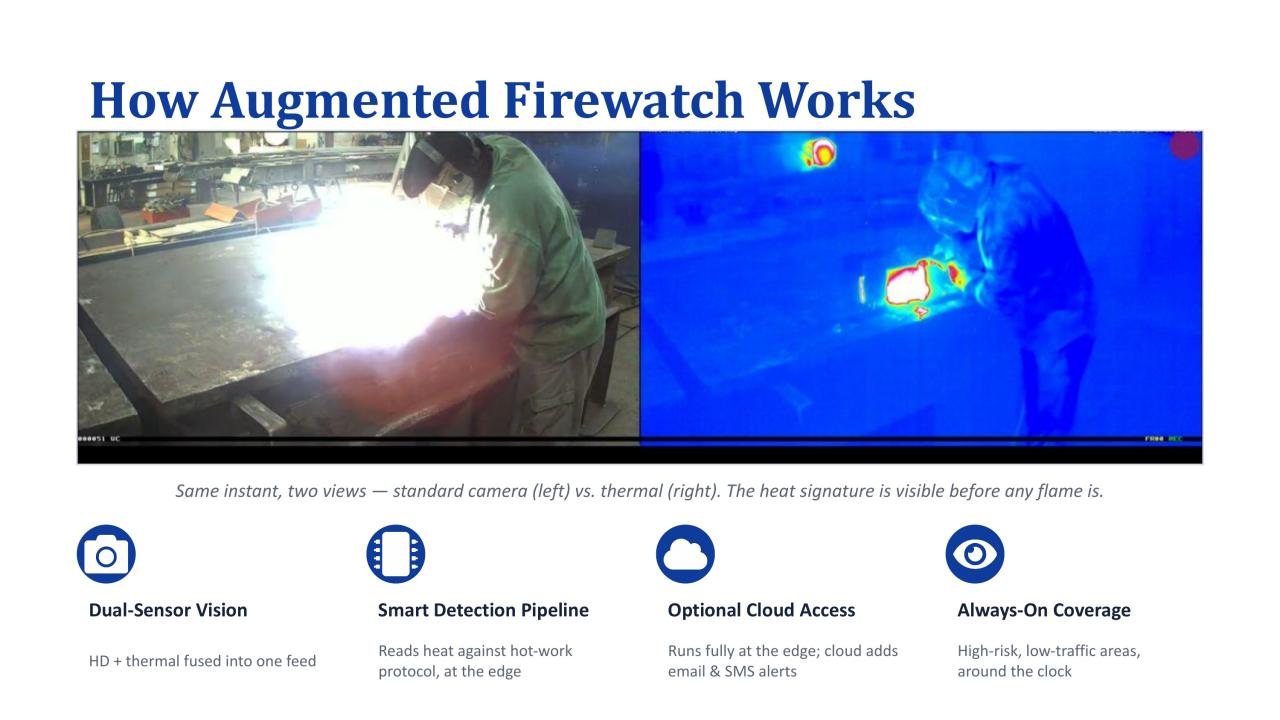
Innovation Solution: Augmented Fire Watch pairs a calibrated long-wave infrared (LWIR) sensor with an HD visible camera in a rugged magnet- or tripod-mounted kit. An onboard decision model runs entirely at the edge: it separates expected weld signatures from abnormal heat, tracks rate of temperature rise, flags combustibles near the arc, and sounds an on-site alarm with no network required. Every reading is logged with thermal imagery, metadata, and timestamps. When authorized, alerts escalate by text or email and live feeds reach a central watch station. NDAA-compliant hardware runs 8+ hours on battery.
Benefits to the DoW: Each system provides continuous, documented observation for 100% of the monitored period, versus about 50% effective observation from a human watch. For every fire watch position a system offsets, the DoW recovers about $6,120 and 240 labor hours per month; offsetting 100 positions at a single shipyard returns roughly $7.3M and 288,000 labor hours per year to skilled maintenance. One operator can oversee many sites from a central station, and automatic records support NAVSEA and NFPA 51B compliance without added paperwork.
Cross-Service Applicability: Fire watch is required at every shipyard, RMC, Army and Air Force depot, Marine Corps maintenance center, and DLA facility. The kit deploys in minutes aboard ship, in dry docks, hangars, and expeditionary sites.
Innovation Challenges: Steel compartments block RF, so all detection and alarm logic had to run onboard. Welding arcs and preheated metal must not trigger nuisance alarms, requiring tuned thresholds, dwell times, and spatial logic. Current policy requires a human fire watch; near-term use augments that watch, with policy acceptance and integrated suppression as the path to reducing it.
Technical Maturity / Demonstration Results: The system is at TRL 7: a full prototype demonstrated in an operational environment. It has been field-tested during live hot work, including aboard Navy vessels, and was live-fire tested alongside NAVSEA and NESAR during the battle damage assessment and repair exercise aboard EX-USS PELELIU, detecting controlled burns and alarming locally without connectivity. It uses proven commercial thermal hardware.



