
Technology Title
JLTV Digital Maintenance and the Path to Predictive Readiness
Tech Focus Area
Training
Abstract
Problem Statement: Joint Light Tactical Vehicle (JLTV) operators and maintainers must connect technical manuals, inspection findings, vehicle diagnostics, and maintenance records across separate tools. Repeated transcription and incomplete fault context delay diagnosis and obscure emerging problems. Army and Marine Corps users share a need for timely, traceable maintenance decisions.
Graphic
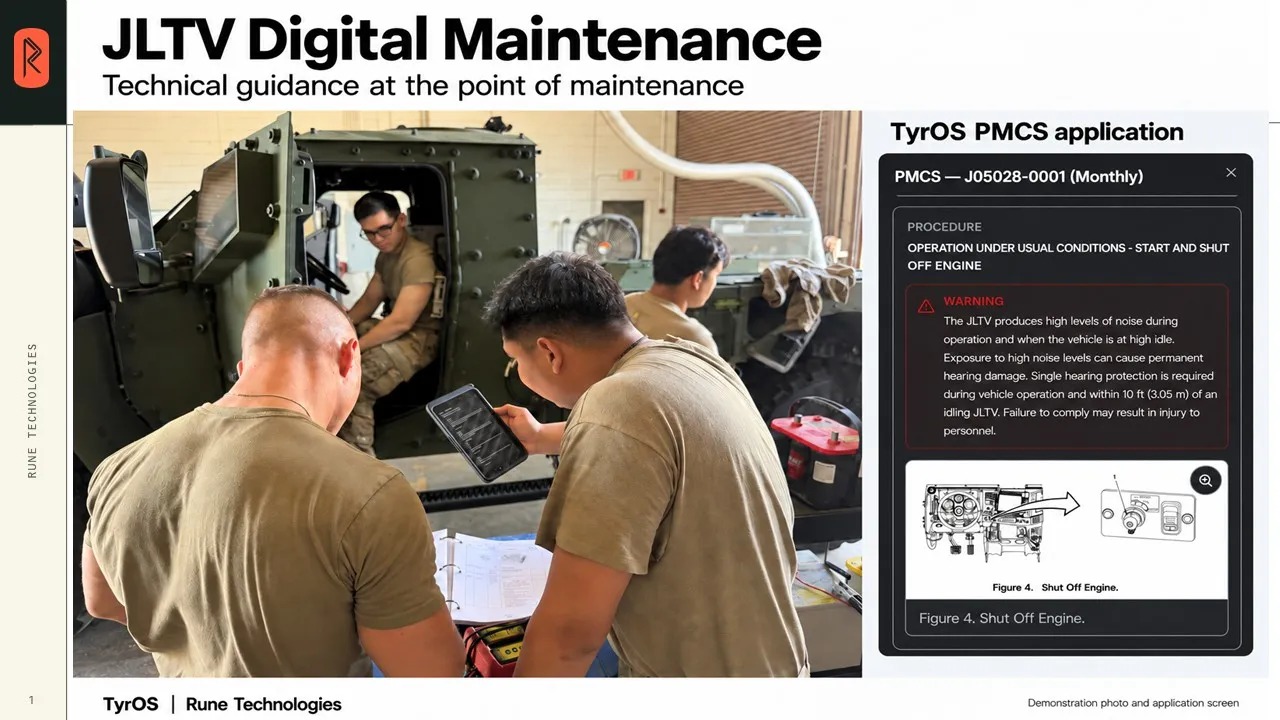
Description of the Innovation Solution: TyrOS, a logistics software platform developed by Rune Technologies, includes a maintenance application that links technical-manual-guided preventive maintenance checks and services (PMCS), authorized operator troubleshooting, digital fault capture, mechanic review, and maintenance-control decisions. Its contribution is the connection between procedural guidance, human observations, and vehicle-health data within one workflow. Maintenance control retains final fault-status authority. Structured inspection records and vehicle telemetry provide a foundation for condition-based analysis and future predictive models; failure prediction requires separate validation.
Benefits to the DOW: The workflow is designed to reduce duplicate entry, improve inspection completeness, and shorten the path from fault discovery to maintainer action. Traceable findings can improve maintenance prioritization and readiness visibility. JLTV provides an Army and Marine Corps starting point; adapting manuals, terminology, and system interfaces could extend the approach to other services. Validated demand and fault data could also inform Defense Logistics Agency parts planning. These benefits require measurement against current practice.
Innovation Challenges: Transition requires validated manual content by vehicle variant, reliable offline synchronization, approved devices and networks, and interfaces to service maintenance systems. Engineering review of source manuals and recurring maintainer testing address content and workflow risks. Predictive validation must link sensor histories to confirmed failures and measure warning time, missed failures, and false alerts before operational reliance.
Technical Maturity and Demonstration Results: On 31 August 2026, a live JLTV demonstration with 1st Cavalry Division exercised PMCS, guided troubleshooting, mechanic and maintenance-control review, DA Form 5988-E generation, and leader visibility. Users praised readable manual figures and step-by-step guidance and requested recurring equipment testing. An earlier demonstration displayed actual JLTV onboard data through a partner interface. These results establish a demonstrated digital workflow and access to vehicle data, not validated failure prediction. Quantified reductions in labor, downtime, or cost remain to be established through comparative trials.



