
Technology Title
Nakamir VAMBRACE: Hands-Free, Voice-Searchable Maintenance Guidance on the Wrist
Tech Focus Area
Training
Abstract
Problem Statement: Shipyards, depots, and flight lines are losing experienced maintainers to retirement while onboarding new personnel at a high rate. Critical procedural knowledge often exists only in senior technicians’ heads, and conventional courseware takes weeks to produce. As a Puget Sound Naval Shipyard subject-matter expert put it, instructions must be updated for over 100,000 assets, each needing one or more procedures, and existing methods are too slow. The stakes are high: failure to follow procedures contributes to the majority of maintenance accidents and incidents.
Graphic
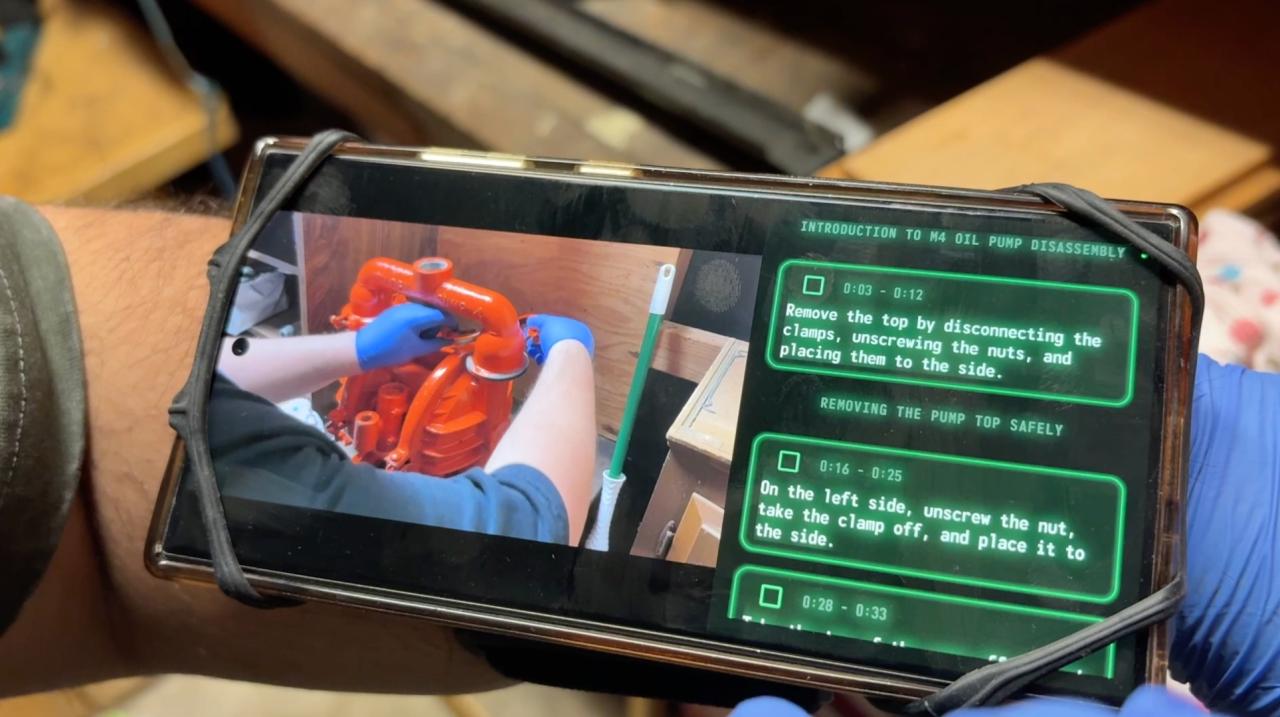
Innovative Solution: VAMBRACE reverses the documentation process. Instead of a writer authoring content after the fact, the expert performs the task once while explaining it aloud, recorded on a phone, smart glasses, or any camera. An AI pipeline turns the recording into a voice-searchable video library that jumps to the exact moment answering a question, an auto-generated structured checklist, and a step-by-step completion record that creates an audit trail. Maintainers use a COTS phone in an off-the-shelf wrist mount and query it by voice, keeping their hands on the equipment. Capture and playback run fully offline.
Benefits to Maintenance:
- Cycle time: an estimated ~95% reduction in time to create structured procedural content versus conventional courseware.
- Manpower: the expert doing the job produces the documentation, with no separate production team.
- Safety and compliance: logged checklists reinforce procedural adherence and give supervisors verifiable records.
- Readiness: tacit expertise becomes a permanent, searchable asset before senior personnel retire.
Cross-Service Applicability: The method is asset-agnostic, covering ships, aircraft, ground vehicles, and support equipment. It has been demonstrated at Navy sites and four Air Force installations. It applies directly to Army and Marine Corps maintenance and to DLA inspection and receiving procedures. Offline operation suits shipboard, expeditionary, and restricted environments.
Innovation Challenges: The main barriers are cyber accreditation and ATO, device approval for recording in controlled spaces, and supply-chain compliance. Camera access is needed only by authorized SMEs or instructors creating content; trainees and maintainers using the guidance need no camera at all, which greatly reduces the number of recording-capable devices in controlled spaces. The platform already includes role-based access control and an approval workflow that can require senior sign-off before guidance is published, mirroring existing technical-authority chains.
Technical Maturity: VAMBRACE is at TRL 6. It has been demonstrated at Train-REX, the NCMS Technology Showcase in Bremerton, the NW Tech Showcase in Tacoma, and NSWC Port Hueneme, and at Yokota, Kirtland, Tinker, and Edwards AFBs. The commercial version is in operational use at Pratt & Whitney, Suzuki, and Oki Electric.
Feasibility and Transition: Implementation requires only COTS phones or tablets and off-the-shelf mounts, with no fixed infrastructure or 3D asset libraries. Procedures supplement, rather than replace, authoritative technical data. An active Navy SBIR Phase II with NUWC Division Keyport provides a transition vehicle.
Conclusion: VAMBRACE makes the expert’s explanation the documentation, at the speed and scale DoW’s asset base demands.



