
Technology Title
Remote 3D Maintenance Training for Expeditionary Forces
Tech Focus Area
Training
Abstract
Problem Statement: Maintenance training depends on the limited availability of equipment and subject matter experts. When either is unavailable or far away, qualification stalls, creating a skills deficit. Meanwhile, retiring maintainers take undocumented knowledge with them, and technical orders leave junior maintainers to translate 2D text and line art onto a three-dimensional component.
Graphic
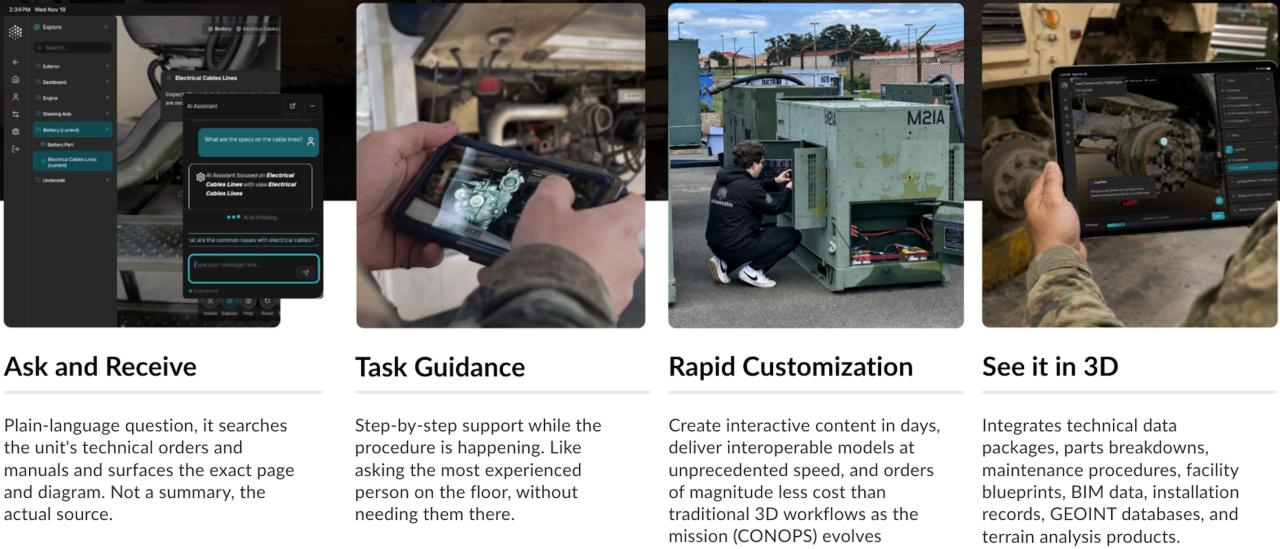
Innovation Solution: Schemata turns ordinary phone video into a photorealistic, navigable 3D copy of the exact asset or space, labeled down to the component and bound to official documentation. A trainee taps a part to pull up its procedure or asks a plain-language question and gets a cited answer; if the documentation is silent, the system says so rather than guessing. It runs in a browser on standard laptops and tablets: no headset or simulator required.
Benefits to the DoW: Before Schemata, the 97th Air Mobility Wing’s vehicle training program struggled with instructor capacity and vehicle availability. With Schemata, qualification continued when training vehicles were unavailable (42% of the year), class capacity doubled, each instructor saved 12 to 20 hours per month, and every trainee reported increased confidence and time savings. Faster qualification returned maintainers to the line sooner, turning training throughput into maintenance capacity.
Cross-Service Applicability: Any maintenance activity can build training from what it already has: phone video and technical documents. Schemata is fielded at 11 Air Force installations. It is one of six providers selected for the Navy Expeditionary Sustainment and Repair (NESAR) Repair Technology Exercise (Train-REX) and is building training for the Expeditionary Maintenance Repair Facility, a Naval Sea Systems Command (NAVSEA) capability fielding to the fleet. Work is also underway with Naval Air Systems Command (NAVAIR) and Army’s Capability Program Executive for Simulation, Training, Test & Threat (CPE-ST3).
Innovation Challenges: Low-light and reflective shipboard spaces degrade reconstruction quality. Each 3D model and document set must be tracked to the specific tail number, hull, or configuration it represents, since two assets of the same type are rarely identical. Connectivity is limited afloat and inside hulls, and cloud hosting can raise security concerns, so fully offline use on a tablet or local server is targeted for late 2026.
Technical Maturity / Demonstration Results: The system is at Technology Readiness Level (TRL) 8: complete, qualified through test and demonstration, and in active government use. It was built with Air Force maintainers under Small Business Innovation Research (SBIR) contracts, passing usability and content accuracy testing with Airmen at two government-accepted milestone reviews. Schemata already executes SBIR Phase III work with NAVAIR, subcontracts supporting NAVSEA, and an Other Transaction Authority (OTA) with the Army, with an Air Force SBIR Phase III expected soon.



