
Technology Title
IMPAct: Integrated Maintenance Planning & Activation
Tech Focus Area
Business Processes/Partnerships
Abstract
Problem Statement: The Air Force depends on organic depot activations to expand sustainment capability and maintain weapon system readiness. These activations are managed across the Warner Robins, Ogden, and Oklahoma City Air Logistics Complexes using different systems, processes, and reporting methods. As a result, activation data must be manually consolidated from multiple sources, creating delays and limiting enterprise visibility. Leadership lacks a common operating picture of activation activities, making it difficult to assess workload, identify activations requiring support, prioritize future efforts, and determine where capacity exists across the organic industrial base
Graphic
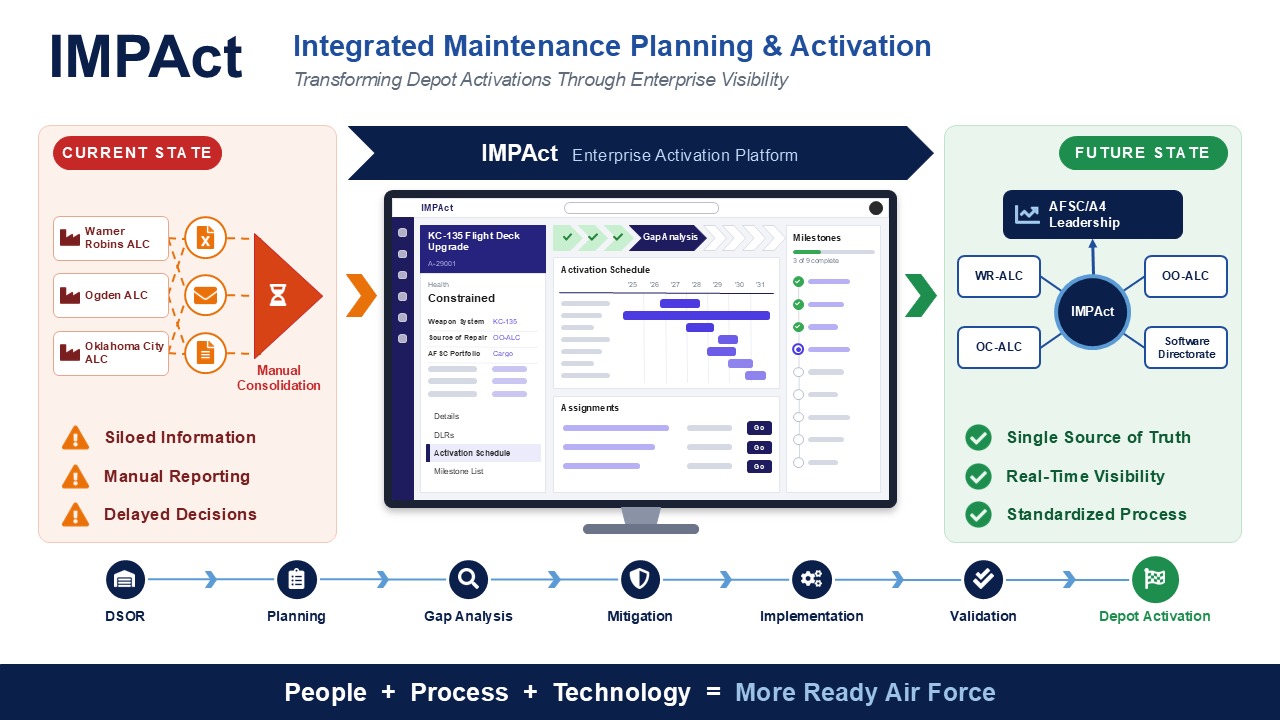
Innovation Solution: Integrated Maintenance Planning & Activation (IMPAct) is a centralized depot activation management platform designed to capture, track, and report activation activities from Design Source of Repair (DSOR) decisions through Depot Level Repairable (DLR) implementation. IMPAct establishes a common data and process foundation across activation organizations by consolidating milestones, workload data, constraints, supporting documentation, and reporting into a single source of truth. Standardized workflows and real-time reporting enable collaboration across the Air Logistics Complexes and Software Directorate while providing AFSC/A4 with timely information to support activation planning, workload management, and decision-making.
Benefits to the DoW: IMPAct improves readiness by providing AFSC/A4 and Air Force leadership with real-time visibility into activation status, workload trends, resource constraints, and emerging risks across the activation enterprise. The platform reduces the manual effort required to collect and validate activation data while improving the accuracy and consistency of reporting. IMPAct supports both DSOR and non-DSOR workloads, providing a comprehensive view of sustainment activities and enabling more informed decisions regarding activation planning, workload distribution, and future repatriation efforts that expand organic sustainment capability.
Innovation Challenges: Creating a shared activation platform requires aligning multiple organizations with different business processes, data structures, reporting methods, and operational priorities. Achieving consensus across the three Air Logistics Complexes, the Software Directorate, and AFSC/A4 requires extensive stakeholder engagement, iterative requirements development, and frequent demonstrations. Establishing enterprise-standard milestones, terminology, and reporting methods while preserving organizational flexibility is a guiding principle for this effort. An Agile delivery approach enables continuous refinement based on stakeholder feedback and evolving mission needs.
Technical Maturity / Demonstration Results: IMPAct has been developed through recurring engagement with AFSC/A4 and activation stakeholders. Users participate in requirements workshops, wireframe reviews, demonstrations, and feedback sessions that continuously shape the solution. Core capabilities for activation lifecycle management, milestone tracking, workflow management, reporting, and enterprise visibility have been defined and are being implemented through an Agile delivery approach. This effort has established the foundation for a standardized, enterprise-wide activation management capability that has not previously existed within the Air Force.



