
Technology Title
Chemical-Free Biofouling and Corrosion Protection for Marine and Cooling Systems
Tech Focus Area
Coatings/Corrosion Prevention
Abstract
Problem statement: Biofouling, the persistent accumulation of marine organisms on submerged surfaces, is a major challenge for industries operating in marine environments. Its impact extends beyond the affected surface, reducing operational efficiency, increasing energy consumption, and generating significant maintenance, economic, and environmental costs. The International Maritime Organization (IMO) estimates that vessels without biological fouling consume 10% less fuel, while the Clean Shipping Coalition estimates the cost of biofouling to the shipping industry at approximately $30 billion annually. In seawater cooling systems, fouling progressively degrades heat-transfer performance and creates recurring cleaning and maintenance requirements.
Graphic
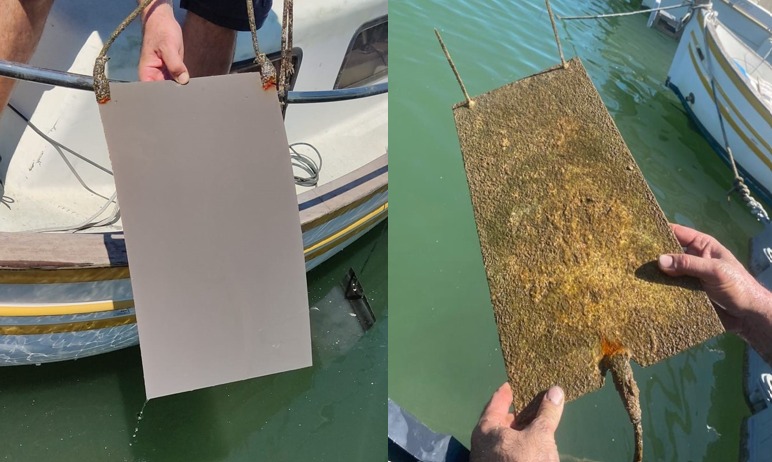
Innovation Solution: The patented electrochemical protection technology developed by Titanium Technology (TiTech) prevents biofouling on submerged surfaces without chemicals, consumables, or mechanical intervention. The system applies low-voltage electrochemical signals through titanium or conductive-coated substrates, creating surface conditions that prevent marine organisms from adhering to and growing on them. Unlike chemical antifouling approaches, this technology does not rely on biocides or the continuous release of metal ions.
Maintenance: The technology shifts biofouling management from periodic removal and cleaning to continuous prevention. By preventing biological accumulation on the surface, it reduces the need for recurring cleaning, maintenance interventions, and associated downtime. Heat-exchanger cleaning can require 1–2 weeks and cost thousands of dollars, with interventions potentially required several times per year. In marine testing, surfaces have remained free of biofouling for more than 2 years, supporting longer maintenance intervals.
Benefits to the DoW: By maintaining clean surfaces in seawater cooling and intake systems, the technology can help preserve heat-transfer performance and operational readiness while reducing maintenance resource needs and downtime. The approach can be applied to heat exchangers, pipelines, and other seawater-contact components relevant to DoW platforms and facilities, supporting reduced maintenance requirements across different marine applications.
Technical Maturity: The technology has reached TRL 7 through successful field testing at the test platforms of Fathomwerx, Enagás, and AkzoNobel. Multiple prototypes have been tested, including heat-exchange systems, propellers, pipelines, and titanium-coated ship hulls. The technology is protected by two PCT patents covering the electrochemical antifouling signal and the application of titanium surfaces to prevent biological growth.
Feasibility: The technology can be integrated into existing seawater systems through titanium surfaces, including titanium-coated components, without necessarily replacing entire systems. Testing across different geometries and applications demonstrates its adaptability to marine components and provides a practical pathway for retrofitting existing equipment while minimizing system modifications. The proposed application focuses on maintenance reduction, operational readiness, and technical performance, rather than promoting a specific commercial product or sales offering.



