
Focus Area: CBM+/Predictive Maintenance
Contact
Marc Aparicio
maparicio@vlinc.com
480-236-4660

VLinc Corporation is a Service-Disabled Veteran-Owned Small Business (SDVOSB) providing aviation sustainment engineering and Integrated Logistics Support (ILS) services for the Department of War and the Department of Homeland Security. VLinc’s leadership has direct Coast Guard aviation engineering heritage: our President & CEO served 21 years on active duty as a USCG aviation engineering officer, including assignments as Fleet Engineer for the H-65 fleet at the Aviation Logistics Center and Director of Engineering at Air Station Borinquen.
Continuous Sustainment Intelligence (CSI): An Integrated Predictive Sustainment Architecture for Coast Guard Aviation
Problem Statement:
Coast Guard aviation sustainment — like all complex defense aviation sustainment — runs largely reactively despite the operational and depot data available to make it predictive. The six analytically intensive ILS disciplines (Reliability and Maintainability, Level of Repair Analysis, Provisioning, Maintenance Task Analysis, Configuration Change Impact Analysis, Supportability) are typically executed as separate studies on separate schedules, producing reports that are filed rather than driving continuous engineering decisions.
Technology Solution Statement:
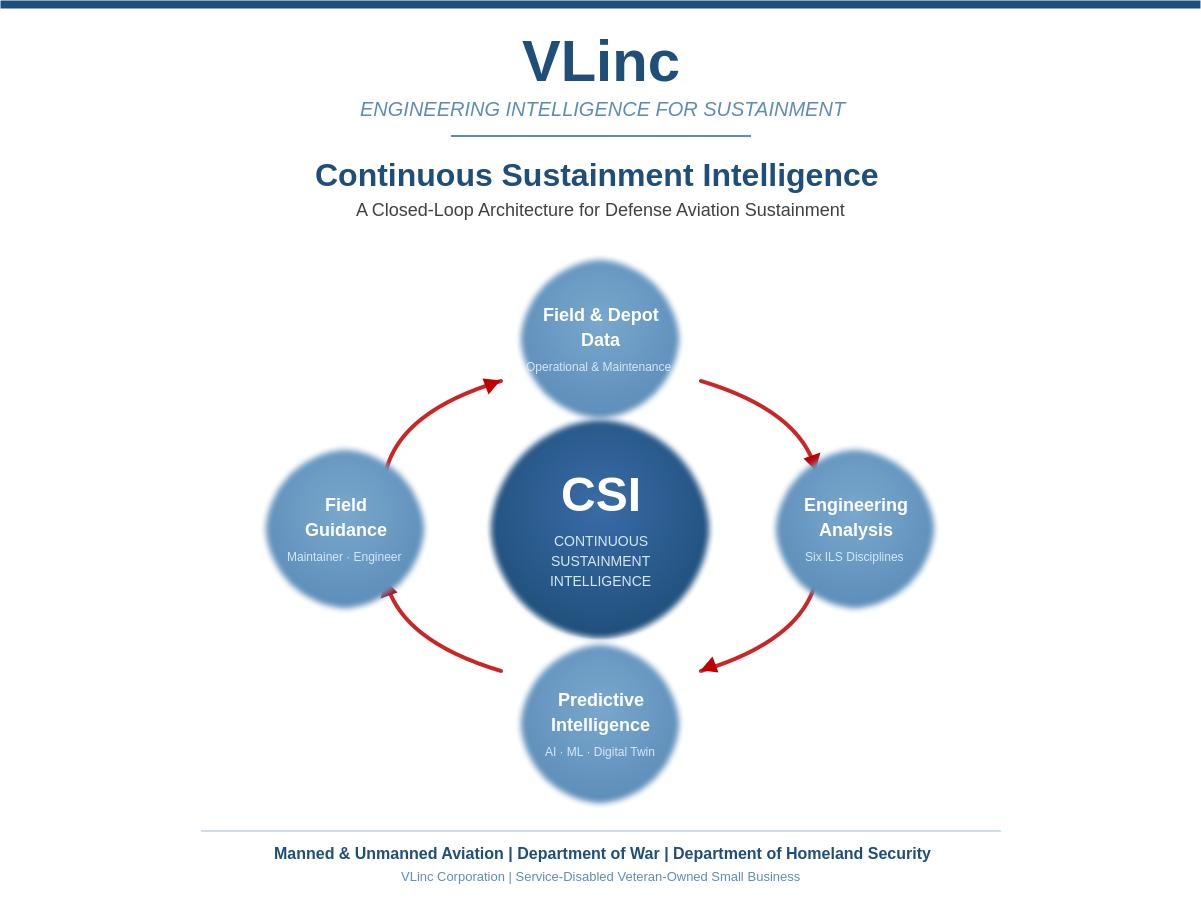
Continuous Sustainment Intelligence (CSI) is a closed-loop sustainment intelligence architecture that integrates structured operational and depot data, continuous engineering analysis across the six analytically intensive ILS disciplines, and scoped analytical capabilities including AI, machine learning, and digital twin applications. CSI converts aviation operational data into integrated engineering intelligence and field-actionable guidance, delivered to maintainers and depot engineers on operational timescales rather than as periodic studies.
Benefits Statement:
For the U.S. Coast Guard Aviation Logistics Center and similar aviation sustainment enterprises, CSI delivers: (1) reduction of the 20–40% reactive sustainment cost burden through earlier failure prediction and integrated change impact analysis; (2) higher mission availability through predictive maintenance grounded in actual fleet operating conditions rather than design-stage assumptions; (3) faster, more defensible configuration change decisions across the full ILS spectrum; (4) more accurate provisioning and supply chain decisions across inventories at the scale of the $1.5B+ ALC parts inventory; (5) force-multiplier effect on existing engineering staff; (6) compatibility with existing ALC information systems and standard DoW and DHS data architectures; (7) institutional knowledge transfer through an integrated operator and engineer training curriculum. The architecture serves both manned and unmanned Coast Guard aviation portfolios.