Technology Title
Modulus Extended: Quantitative 3D Surface Inspection Inside Bores, Pipes, and Tanks
Tech Focus Area
Enhanced Inspection
Abstract
The internal surfaces of large-caliber gun bores, welds inside piping, and shipboard fuel and ballast tanks are among the hardest features in the maintenance enterprise to inspect, yet they directly govern safety and service life of mission-critical assets. Today they are examined mainly with borescopes, which return a qualitative two-dimensional image that cannot capture the depth of wear, erosion, or pitting. As a result, repair-or-replace decisions rest on subjective visual judgment, which can lead to premature replacement of serviceable parts, to missed defects, and to difficult inspections that consume maintainer hours and add safety risk. Furthermore, FY26 NDAA Section 341 reflects the Department’s intent to move beyond visual-only inspection wherever a commercially available diagnostic tool exists.
Graphic
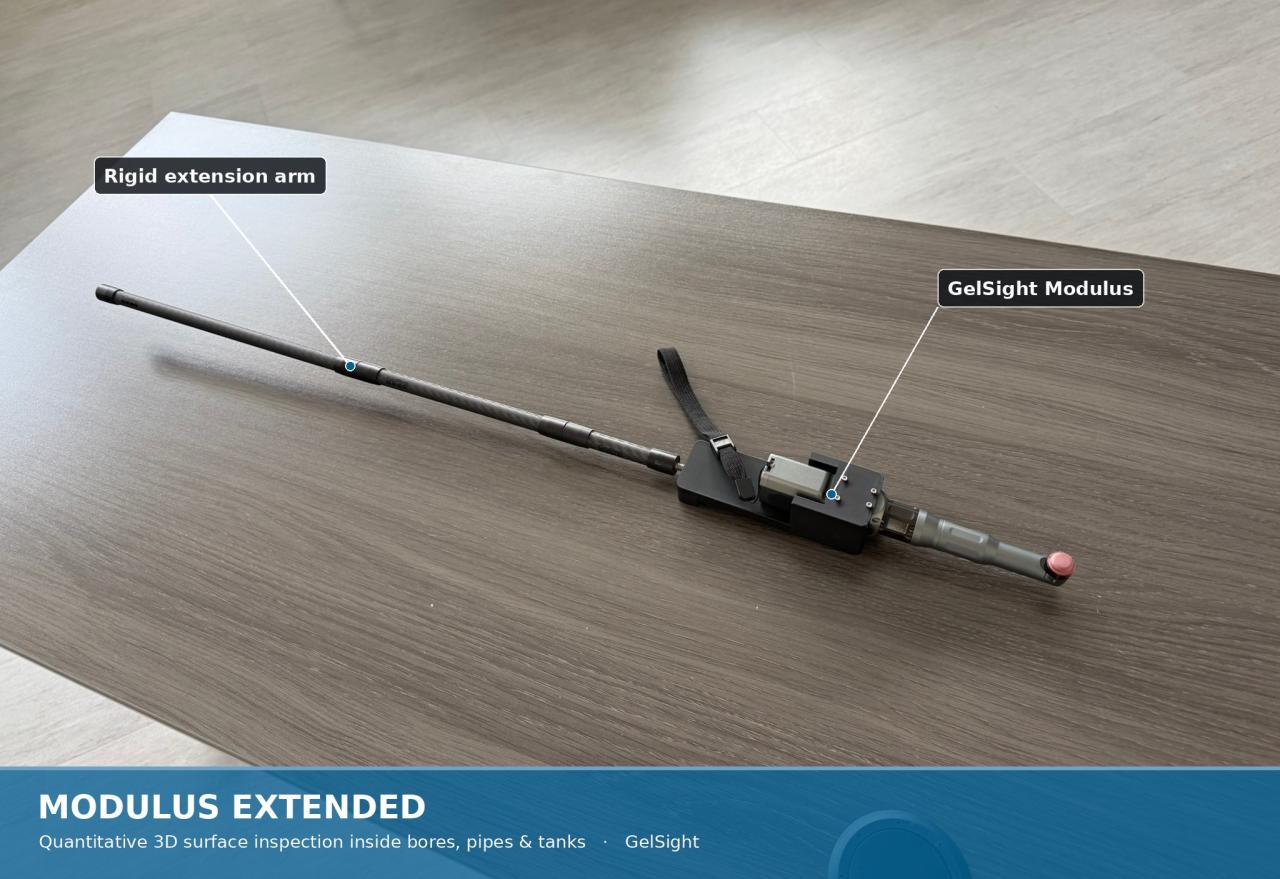
GelSight Modulus Extended answers that need. GelSight technology uses a proprietary elastomeric sensor and computer vision to capture objective, micron-scale, traceable 3D topography on virtually any surface, including metals, composites, and transparent materials. The GelSight Modulus is a fielded, modular platform with interchangeable optics. Modulus Extended adds a rigid extension arm that carries the sensor inside bores, pipes, and tanks, turning a surface that could previously only be photographed into one that can be measured.
For the Department, this replaces subjective calls with objective, repeatable data and a digital record that supports condition-based maintenance and digital-twin programs. It enables confined-space inspections, increases depot throughput and improves readiness while lowering the chance of in-service failures from undetected wear.
The principal engineering challenges are maintaining sensor registration and arm rigidity at varying insertion depths, ensuring adequate gel contact and durability in confined spaces, and providing robustness to the oils, carbon fouling, and residue found in service.
The approach builds on mature technology. GelSight is fielded at TRL 7, with more than 500 systems in service commercially and prior Department of Defense use. Modulus Extended is a working prototype that has measured 3D surface topography inside a 2″ diameter tube at depth of 24″, resolving surface geometry to within a ten-thousandth of an inch and quantifying roughness and pitting that a borescope cannot. Key applications include Air Force integral fuel tanks and Navy shipboard fuel and ballast tanks, where microbially influenced corrosion and coating breakdown cause pitting now assessed only by confined-space entry, and in-pipe welds, where weld-toe profile, undercut, and reinforcement govern where cracks and corrosion initiate. It also serves Army and Marine Corps cannon and artillery tubes and depot remanufacture, improving safety, readiness, and sustainment cost across the force.