
Technology Title
Predictive Digital Engineering and Decision Engine for Maintenance and Sustainment
Tech Focus Area
Business IT and Analytics
Abstract
Problem Statement. Sustaining the force depends on depots, and the plants that feed them, delivering more output faster from fixed floors — output constrained by planning, not equipment. Maintenance lines run under hard limits: qualified labor, station capacity, hazardous-operation separations, and material movement, and the binding constraint shifts with workload and staffing. Leadership cannot see what a line will deliver under surge, by when, and against which bottleneck, before committing labor and capital. Today those answers are built by hand from LMP, MES, and SCADA, take days to weeks, and rest on a retiring workforce.
Graphic
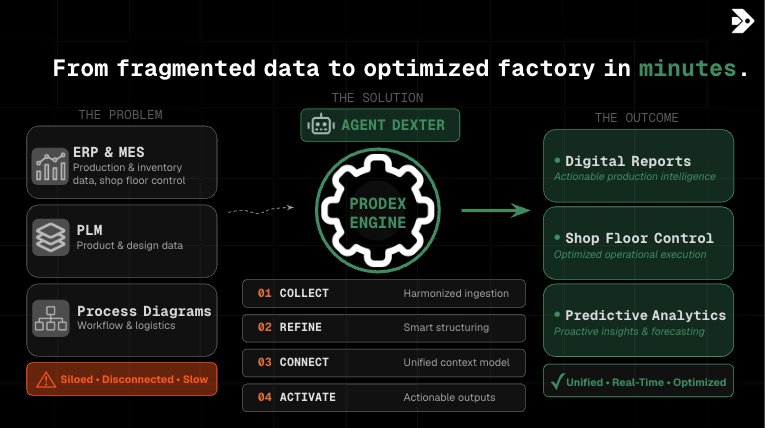
Description. The platform builds a calibrated, executable model of a maintenance floor from existing data in minutes, not the 12 to 18 months a conventional simulation study takes. It encodes the floor’s governing constraints as hard limits, then applies discrete-event simulation, Monte Carlo analysis, and constraint-based scheduling to find the binding constraint and test a change before it is made. A supervisor queries the model in plain language: asked what an overhaul line will deliver at month six under a second shift, it returns a throughput figure, a confidence range, and the constraining station — in seconds, with no analyst and no custom code. It runs above existing systems of record, not in place of them.
Benefits to the DoW. Every surge, capital, and staffing decision is tested against the model before resources move, confirming it relieves the binding constraint rather than adding capacity where output is not constrained. Planning that took weeks returns in minutes, recovering roughly one full-time position per site and preserving retiring planners’ knowledge. Built from each site’s own data, it transfers across the enterprise — Army depots, the Air Force air logistics complexes, Navy fleet readiness centers and shipyards, Marine depot maintenance, and DLA — raising throughput and availability without added headcount.
Innovation Challenges. The hard problem is reasoning across many interacting constraints under uncertainty, fast enough for a live decision, without specialist training. Models build from partial data and refine as data matures. The system deploys to the government cloud under NIST 800-171 and CMMC, with role-based access, audit logging, and U.S.-citizen staffing.
Technical Maturity / Demonstration Results. The capability is at TRL 7+ and in production-grade commercial use processing $100M+ annually, where it delivered an 11% throughput gain and a 33% reduction in work-in-process with no added headcount. McAlester Army Ammunition Plant evaluated it in a live demonstration on 19 March 2026; the plant commander issued a Letter of Support confirming it modeled operations, identified governing constraints, and supported data-driven decisions. A CTMA pilot advances it to TRL 9 through sustained government use, yielding a repeatable transition playbook for the enterprise.