Technology Title
Shipcom AI Predictive Sustainment Operating System (PSOS): AI-Driven Readiness Optimization for Defense Maintenance and Logistics
Tech Focus Area
CBM+/Predictive Maintenance
Abstract
The Department of Defense faces growing sustainment challenges driven by aging weapon systems, increasing maintenance demands, fragmented data environments, supply chain disruptions, and workforce constraints. Maintenance, engineering, logistics, and operational data often reside in disconnected systems, limiting the ability to predict failures, optimize repairs, and ensure material availability. These challenges increase downtime, sustainment costs, and readiness risks across aircraft, ground vehicles, naval systems, and other mission-critical assets.
Shipcom’s Predictive Sustainment Operating System (PSOS) transforms fragmented sustainment data into a unified operational picture that predicts failures, anticipates material shortages, automates workflows, and improves readiness outcomes across the defense enterprise.
Graphic
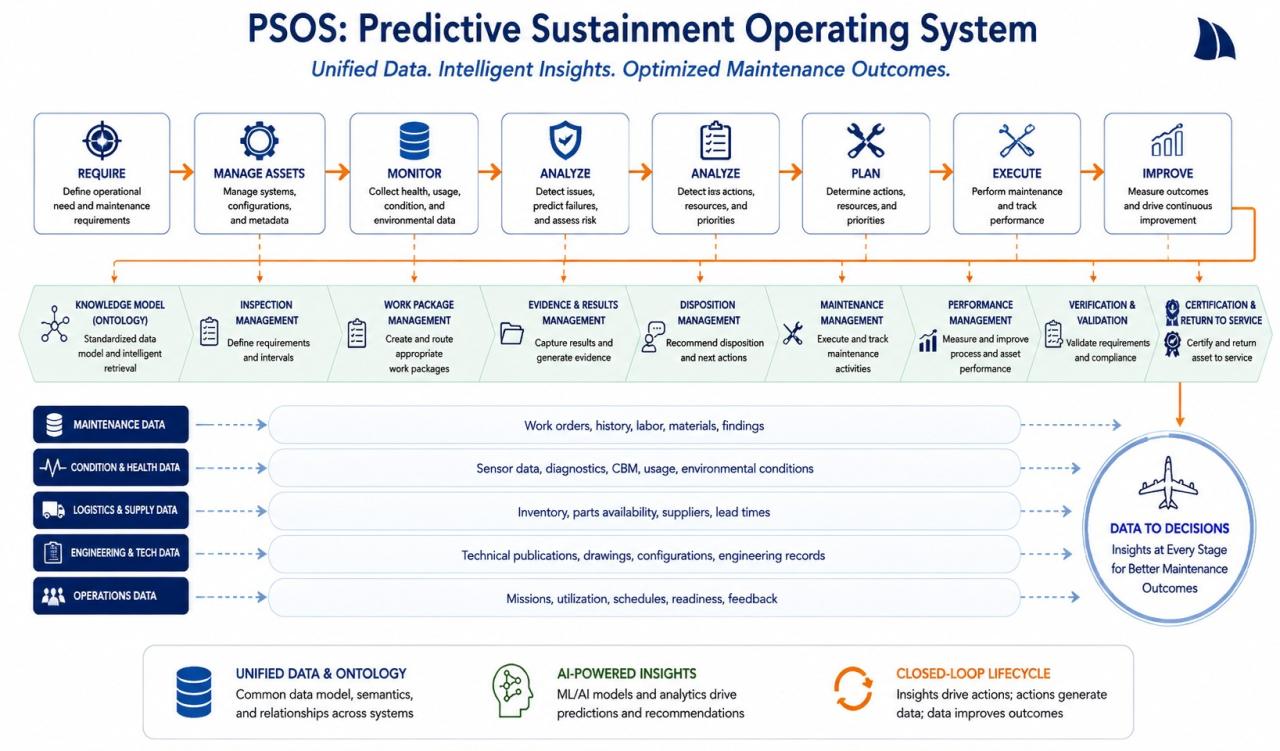
PSOS integrates data from maintenance systems, technical publications, engineering records, supply systems, sensors, and operational sources into a semantic data fabric that establishes a common understanding of sustainment activities. Artificial intelligence and machine learning continuously analyze equipment health, maintenance history, usage patterns, environmental conditions, and supply chain data to identify emerging failures before they occur.
The platform enables organizations to transition from reactive maintenance to predictive and condition-based maintenance. PSOS identifies high-risk components, forecasts remaining useful life, recommends corrective actions, and prioritizes maintenance activities based on operational requirements and available resources.
Beyond predictive maintenance, PSOS incorporates supply chain intelligence into sustainment decision-making. The system forecasts material demand, identifies potential shortages, recommends alternative sourcing options, and synchronizes parts availability with maintenance schedules. This reduces maintenance delays and improves asset availability.
PSOS also provides operational digital twins and readiness dashboards that deliver real-time visibility into asset health, maintenance status, workforce utilization, material availability, and readiness risks. Automated workflows accelerate maintenance planning, work package development, engineering disposition processes, and logistics coordination.
Designed for deployment across aviation depots, shipyards, maintenance centers, operational units, logistics organizations, and program offices, PSOS integrates with existing DoD systems and supports scalable deployment in both enterprise and tactical environments.
Expected benefits include higher mission-capable rates, reduced unscheduled maintenance, shorter repair cycle times, improved maintenance productivity, enhanced supply chain responsiveness, and more accurate readiness forecasting. By connecting maintenance, engineering, logistics, and operational communities through a shared data environment, PSOS enables faster sustainment decisions while reducing lifecycle costs.