
Technology Title
AR-VR Machine Shop Trainer and Job Aid
Tech Focus Area
Workforce Development/Visualization
Abstract
The ARCS AR-VR platform combines virtual reality training and augmented reality job aids to transform complex maintenance procedures into immersive, learn-by-doing experiences. Users are guided through realistic workflows with real-time feedback, visual guidance, and expert insights, building the intuition and confidence needed to execute tasks accurately and independently. The loss of institutional knowledge is a universal challenge, and the ARCS platform directly addresses this by capturing and preserving that expertise within a spatially aware training environment.
Current maintenance training relies on manuals, classroom instruction, and shadowing. Methods that fail to capture the critical institutional knowledge passed informally between experienced technicians and their teams. With that expertise going undocumented, organizations are left vulnerable to knowledge gaps that widen with every departure, reassignment, or retirement.
Graphic
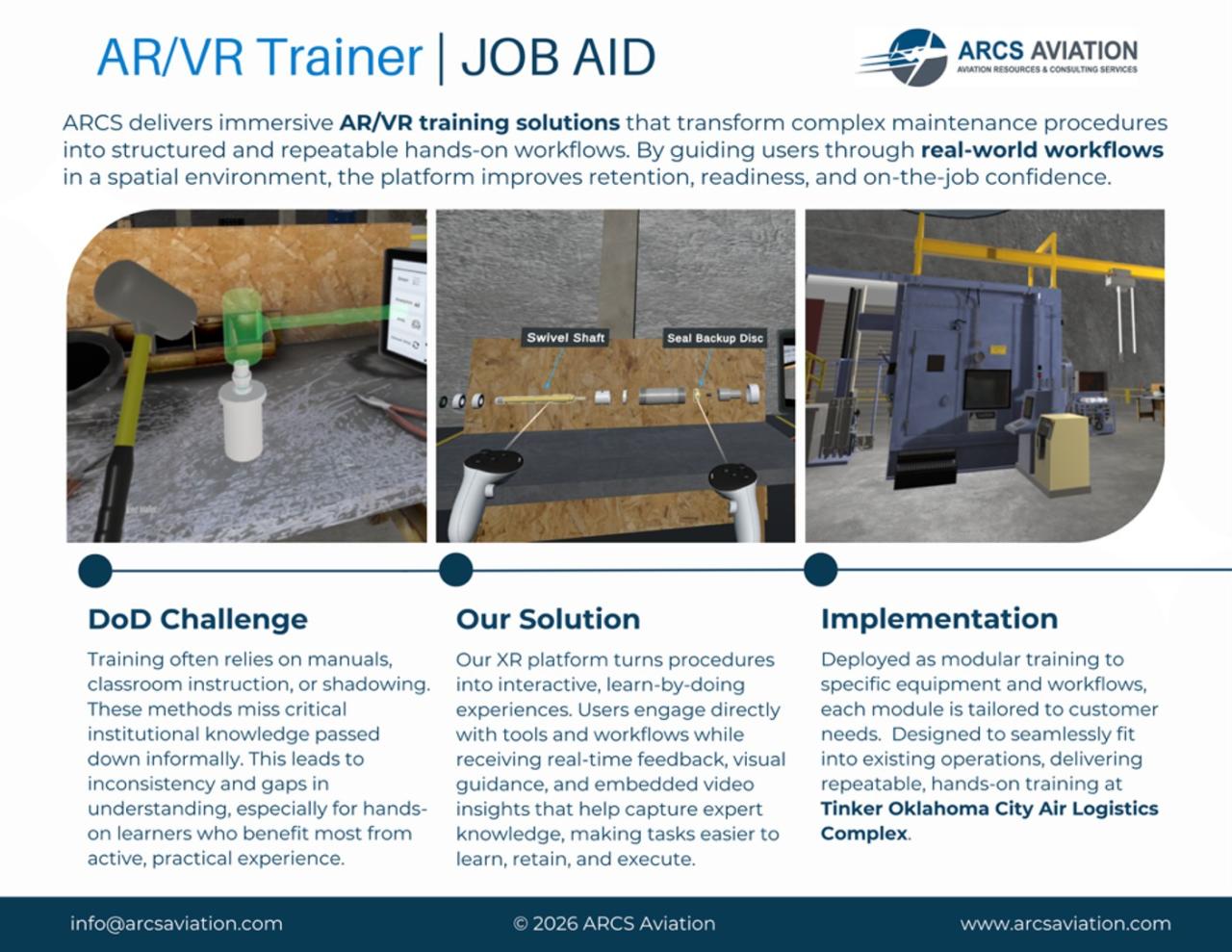
The purpose of this effort was to address that gap directly by developing an immersive XR platform that captures expert knowledge at the source and delivers it as structured, repeatable, hands-on training. Rather than learning from a page or watching someone else do the work, users get their hands on the tools and procedures in a realistic environment, building the kind of confidence that only comes from actually doing the job.
ARCS developed and delivered ten training modules covering preventive and corrective maintenance procedures for Jet Edge waterjet cutting equipment at Tinker Air Force Base, Oklahoma City Air Logistics Complex. Six modules were delivered as immersive virtual reality training experiences, guiding technicians through realistic, hands-on workflows in a spatially aware environment. Four modules were delivered as augmented reality job aids, providing step-by-step procedural guidance with annotated reference imagery and OEM documentation at the point of need. Modules were demonstrated to OC-ALC personnel across multiple site visits throughout the performance period.
A structured pilot study was conducted at Tinker AFB in January 2026 to validate training effectiveness, and the completed systems were turned over to the government upon project completion. All participants improved their knowledge test scores following VR training, with improvement ranging from 5 to 15 percent. Participant perceptions of the VR experience were uniformly positive, with all 20 subjective questionnaire items rated 4 or 5 on a 5-point scale. Participants consistently rated VR superior to manual review across every comparison item, noting that procedural steps were clearer, complex details were easier to understand, and they felt more motivated during VR training.