
Technology Title
Project Hullius: Expeditionary Robotic Hull Repair
Tech Focus Area
Advanced/Additive Manufacturing
Abstract
The U.S. Navy’s global mission readiness is fundamentally constrained by its ability to conduct structural repairs. Historically, critical hull damage like stress fractures or corrosion requires either accepting degraded operational capability or undertaking a costly, lengthy transit to a dry-dock, removing assets from the fight and disrupting rigid shipyard schedules. Project Hullius directly confronts this challenge, providing a revolutionary capability to conduct certified, in-situ structural repairs at the point of need.
Developed with Norwegian partner Kongsberg Ferrotech under the Foreign Comparative Test (FCT) program, Hullius is a forward-deployable robotic maintenance system. It attaches to a vessel’s hull, creating a localized, dry habitat filled with inert gas. Within this habitat, a high-precision CNC gantry system executes a fully automated, end-to-end repair sequence. The process includes Non-Destructive Testing (NDT) to map defects, precision milling to excavate damaged material, and multi-pass Wire Arc Additive Manufacturing (WAAM) to additively manufacture a structurally sound, permanent repair. This entire process is monitored in real-time, generating a comprehensive “digital birth certificate” of Objective Quality Evidence (OQE) to meet the stringent requirements of Navy Technical Warrant Holders.
Graphic
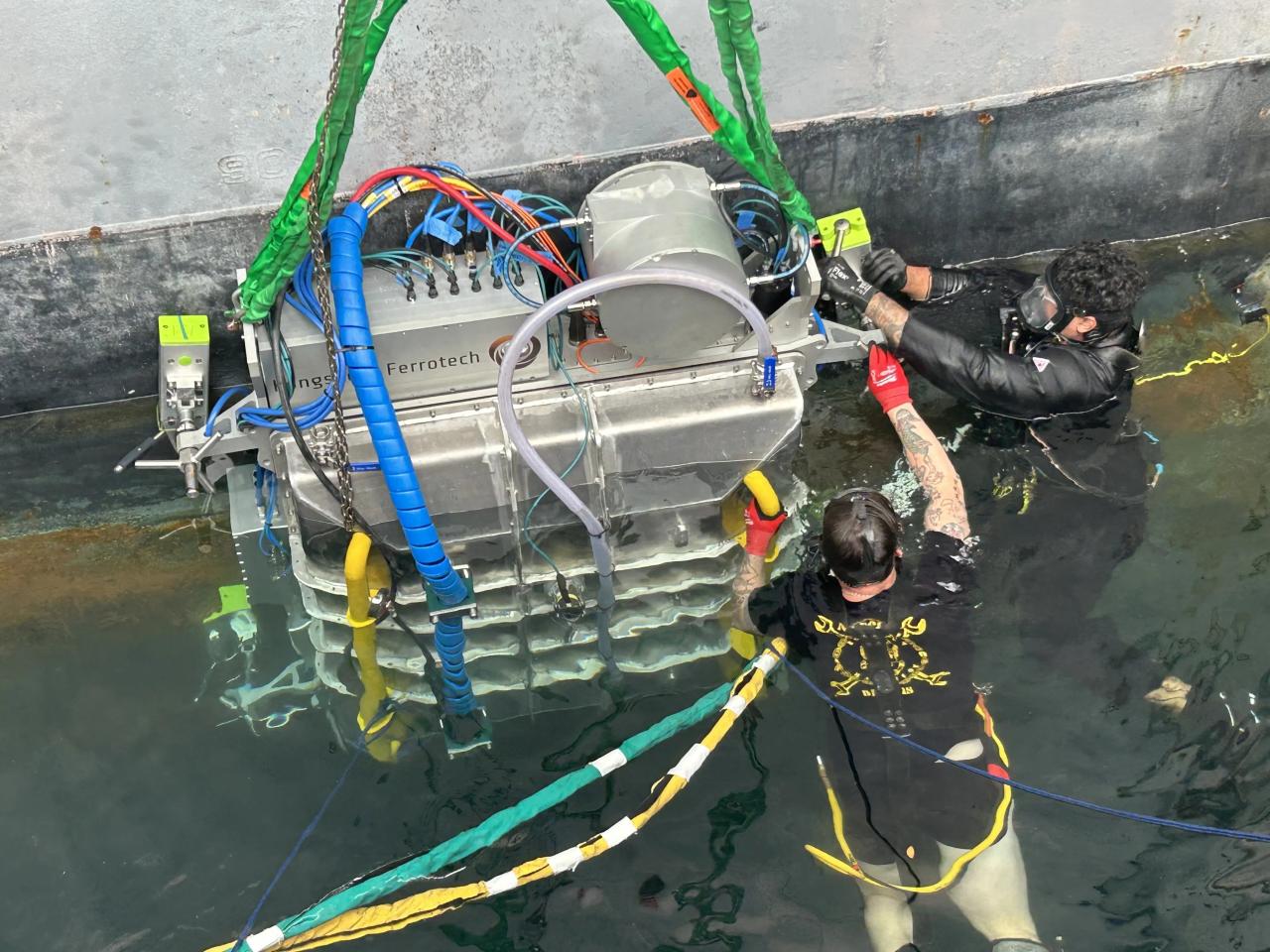
The primary benefit to the DoW is a paradigm shift in expeditionary sustainment, enabling forward-deployed assets to remain on-station and mission-capable. By performing permanent repairs pier-side or at anchor, Hullius protects the fragile dry-dock industrial base from the ripple effects of unplanned emergent work, increasing overall fleet availability. Overcoming significant innovation challenges, the team successfully adapted the system from its commercial origins, qualifying it to use standard U.S. Navy consumables and proving its logistical viability for global operations.
The technology’s maturity was validated at the Pacific Fleet Battle Damage Exercise ’26. There, Hullius successfully demonstrated its core capabilities on a test vessel, executing repairs for pitting, corrosion, and linear cracks. The demonstration proved the system’s end-to-end automated sequence, its positional resiliency after a simulated “wash-off,” and its ability to add new functionality by printing hardware like padeyes directly onto the hull. The system is transition-ready today, with a clear “Crawl, Walk, Run” path to full autonomy.