
Technology Title
Autonomous Aerial CBRN Decontamination System (ADS): An Army Co-Developed Prototype to Eliminate Human Exposure in Contaminated Maintenance Environments
Tech Focus Area
Energy, Environment, Health, and Safety
Abstract
Apellix, in partnership with the U.S. Army, has developed an Autonomous aerial Decontamination System (ADS) prototype: a tethered unmanned aircraft that performs precision CBRN decontamination without placing personnel in the hot zone.
Problem Statement: Manual thorough decontamination of one contaminated vehicle requires 20–30 soldiers in MOPP gear, 45–60 minutes of direct hot-zone exposure, and 500+ gallons of water plus 50 gallons of decontaminant. This is manpower-intensive and places a squad-to-platoon-sized element in prolonged contact with contamination — a cost that scales poorly across a contested, multi-asset environment.
Graphic
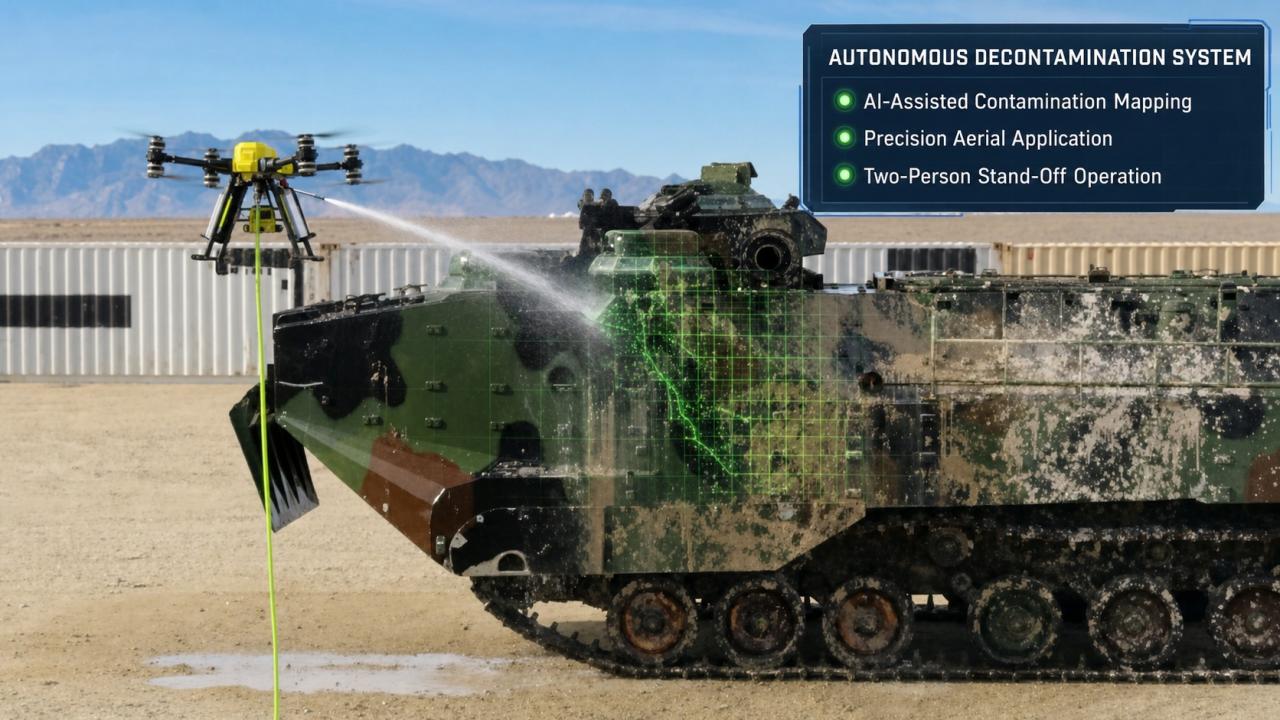
Description of the Innovation Solution: ADS applies Apellix’s patented precision flight control and AI-driven contamination mapping to autonomously survey an asset, plan coverage, and apply decontaminant from a tethered aerial platform while operators supervise from stand-off distance. Demonstrations progressed from a single drone performing repeated decon passes on one vehicle, to two mutually dependent drones coordinating on one asset, to two drones operating independently and concurrently on separate vehicles — validating a path from one-asset to multi-asset, platoon-equivalent throughput without adding personnel.
Benefits to the DoW: ADS targets replacing a 20–30 soldier decon element with a two-person crew, compressing cycle time and cutting water/decontaminant use through precision application versus bulk flooding. The core benefit is exposure reduction: soldiers are removed from direct contact with contamination during the highest-risk response phase. ADS shares its tethered-platform architecture with Apellix’s fielded commercial power-wash and spray-coating drones, giving the Army a co-development partner with an existing production base, not a single-purpose research effort. Applications span Army, Navy, Marine Corps, and Air Force installations, vehicles, and shipboard assets wherever CBRN decon readiness is required.
Innovation Challenges: Remaining work: hardening contamination-detection and mapping accuracy across surface types, validating decontaminant efficacy and dosage control against CBRN test standards, and maturing the multi-drone coordination shown at Dugway into a ruggedized, program-of-record-ready configuration.
Technical Maturity / Demonstration Results: ADS is a proof-of-concept, not a fielded or commercial product. It was field-tested with the U.S. Army at Dugway Proving Ground (Desert Tempest, May 2026) across two events: single-drone repeated-cycle testing, then dual-drone dependent and independent multi-vehicle operation. Because it is pre-commercial, ADS is a candidate for DoW co-investment and program sponsorship to move from validated prototype to fielded capability — with Apellix contributing a decade of tethered-drone manufacturing and flight-control experience to de-risk that transition.



