
Technology Title
Autonomous Blasting, Coating, and Inspection with Physical AI for Naval Sustainment
Tech Focus Area
Coatings / Corrosion Prevention
Abstract
Problem Statement: A ship in maintenance generates no operational value until it returns to the fleet, which makes every day inside the rework window a direct subtraction from availability and, for docked submarines (per discussions with SIB), a cumulative cost of up to $1 million per day. Surface preparation, coating, and inspection most often stretch that window. Manual blasting under hazardous conditions is slow and depends on a skilled workforce that is thinning. Inspection is recorded by hand, with no shared record connecting what was blasted, what was coated, and what was verified, and coating application varies by applicator and environment with very slim room for deposition error. When rework arrives late, it does not just cost labor. It extends the window, keeping the ship in the yard.
Graphic
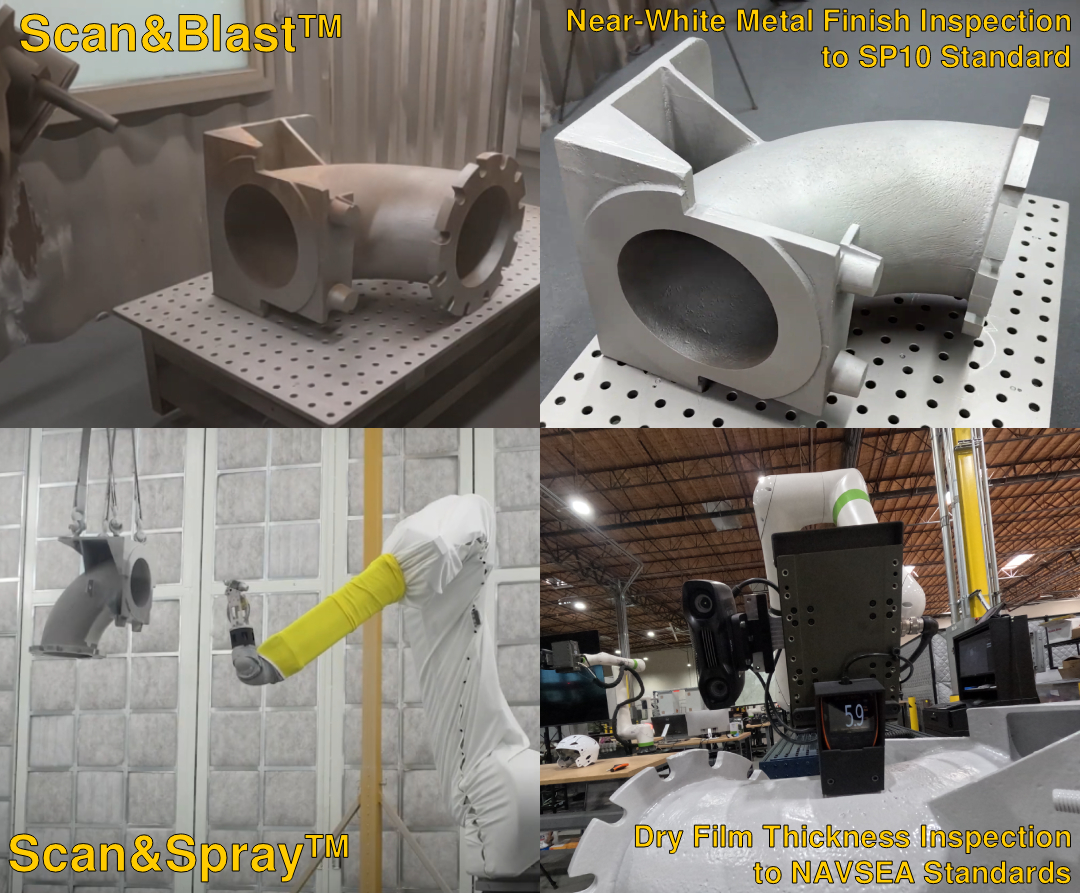
Innovation Solution: GrayMatter Robotics (GMR) unites blasting, inspection, and coating in one autonomous pipeline built on its Scan, Plan, Act, Verify framework. Scan&Blast™ performs autonomous blast cleaning to SSPC SP10 standards, with inline computer-vision inspection mapping non-conforming areas in 3D and triggering selective re-blast automatically. Scan&Spray™ then applies protective coatings using 3D localization and conformal path planning for full coverage on complex geometries. Autonomous dry film thickness inspection is then performed at NAVSEA-specified measurement locations, producing a fully digital, traceable quality record in place of handwritten readings.
Benefits to the DoW: The pipeline removes manual labor from hazardous blasting and coating work, replaces manual visual inspection with 3D-mapped quality records, and closes the loop between preparation, coating, and verification with a reduction in part movement across the warehouse. GMR-Guardian™ maintains cell uptime, GMR-Insights™ turns production data into throughput and quality intelligence, and GMR-Care™ provides ongoing support across the operational lifecycle.
Innovation Challenges: End-to-end automation is hardest to sustain in high-mix environments, where coverage gaps appear and each process still requires inspector sign-off. Qualified inspectors are scarce, so parts often wait between processes for that sign-off. GMR embeds visual and thickness inspection directly into the full workflow, letting robots correct coverage gaps and generate the digital certification that moves parts forward without delay. Blast and coat runs have met NAVSEA coating and thickness criteria on representative hardware; remaining work extends to witnessed MIL and ASTM conformance in an operational depot environment.
Technical Maturity: This pipeline has been validated through a government-sponsored demonstration on representative naval components, meeting blast and coating acceptance criteria with fully digital inspection records for surface cleanliness and coating thickness. Onsite deployment is targeted for late 2026, with full blast, inspection, and coating capability deploying by mid-2027.



