
Technology Title
MDDV
Tech Focus Area
Condition-Based Maintenance Plus
Abstract
Problem Statement: DoW’s Condition-Based Maintenance Plus (CBM+) initiative shifts maintenance from fixed schedules to evidence from diagnostics, prognostics, and reliability data. Yet even where diagnostic technologies exist, that evidence rarely reaches the technician: fault isolation still relies on static, disconnected IETMs, troubleshooting steps don’t adapt to reported conditions, and technician actions go uncaptured for reliability analysis. This last-mile gap limits CBM+’s evidence-based promise.
Description of the Innovation: MDDV operationalizes CBM+ at the point of maintenance. Its dynamic troubleshooting trees present a real-time question-and-answer fault-isolation sequence that adapts to reported conditions rather than a fixed static procedure, and every step is logged for reliability trend analysis. Its S1000D/MIL-STD-3048-aligned common source database structures technical, parts, and wiring data for automated exchange with CBM+ diagnostic and prognostic systems. Zero Wait State navigation gives technicians instant access to serialized parts data, wiring diagrams, and illustrated parts breakdowns to act on condition-based findings without delay, on existing Toughbooks, iPads, and laptops.
Graphic
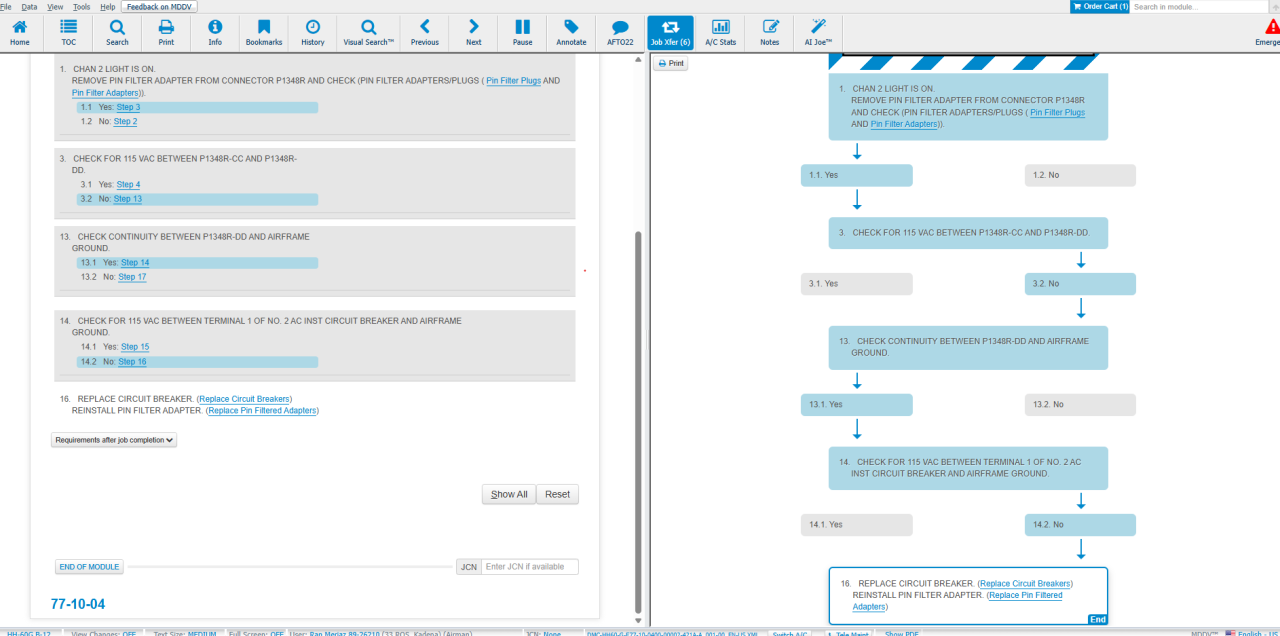
Benefits to the DoW: MDDV closes the gap between CBM+ diagnostic data and the maintenance action, giving reliability engineers troubleshooting and usage data to support Reliability-Centered Maintenance decisions. Faster, condition-driven fault isolation reduces unscheduled downtime and flow days, and standardized S1000D data enables CBM+ data exchange across platforms and services with no new infrastructure.
Innovation Challenges: MDDV’s troubleshooting and trend data augment, rather than replace, sensor-based diagnostics; it does not capture every technician action, so it is one input to CBM+ analysis, not a complete prognostics solution. Automated pipelines linking MDDV records to platform-specific CBM+ systems need further integration, and full-library conversion depends on sustained funding, as MDDV’s five-year MQ-9 deployment ended when that program was sunset.
Technical Maturity / Demonstration Results: MDDV was fielded for five years on the USAF/USMC MQ-9 program, where its troubleshooting and data-capture functions operated against maintenance, flight, weapons, and ground control station data converted to S1000D. MDDV is under active USAF contract with AFLCMC/WA on the AADA Strike program and Advanced Development Programs, with discussions underway with the U.S. Army and Navy. A preliminary CBA for AFLCMC/EZP by the University of Dayton Research Institute (2018) on the C-5M projected a 22.25% average man-hour reduction and up to 3.5 fewer flow days per inspection from MDDV’s navigation and troubleshooting functions alone. MDDV also serves as the enterprise solution for the Ukrainian Air Force, is in advanced discussions with the RAF and Royal Navy and supports commercial programs including Deutsche Aircraft and Hitachi.



