
Technology Title
Forge: AI-powered 2D to 3D Model Reconciliation for Ship Maintenance
Tech Focus Area
CBM+
Abstract
Problem Statement: Navy attack submarines have lost more than 15,000 operational days to maintenance delays from FY2016 through FY2025, contributing to $3.4 billion in idle sustainment costs. Across the broader fleet, a critical driver of these shipyard backlogs is unplanned work discovered only after a vessel reaches drydock. Because a majority of legacy U.S. vessels still rely on thousands of undigitized paper drawings that do not reflect the ship’s current configuration, significant labor hours are wasted reconciling old records and rebuilding 3D models from scratch. This data gap also massively slows down how quickly OEM suppliers can manufacture and deliver replacement parts, exacerbating delays. Without digitizing this foundational data, digital twin transformation remains out of reach.
Graphic
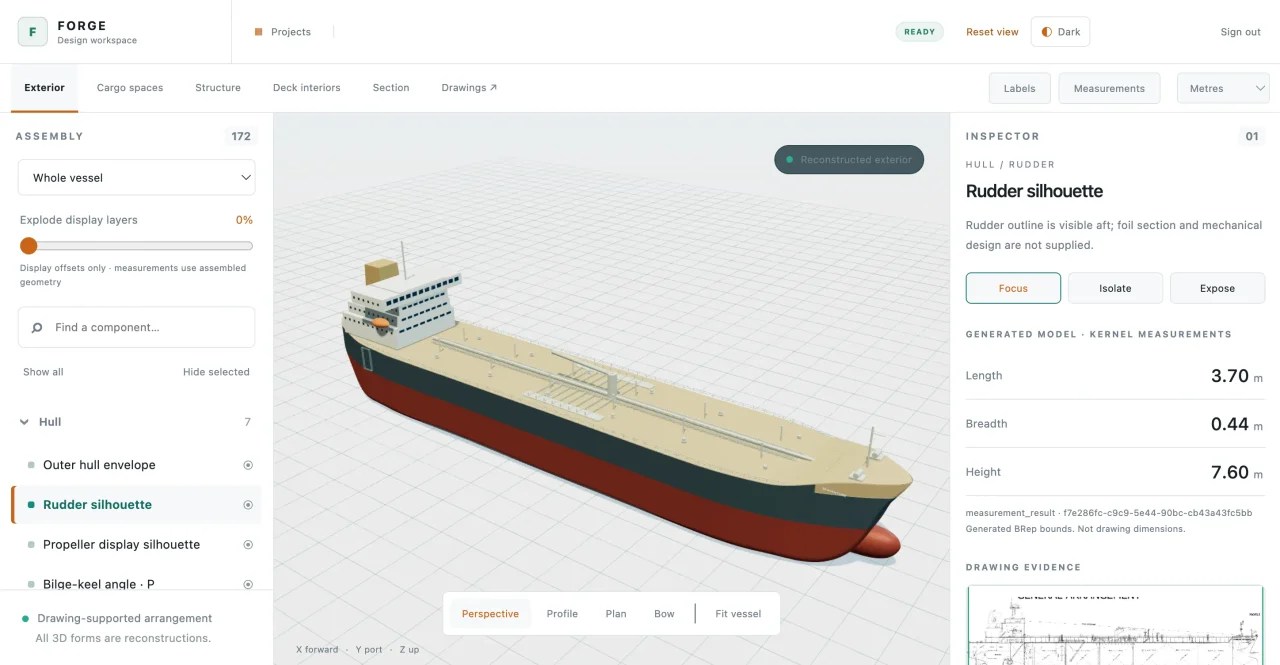
Innovation Solution: Forge is an AI model that automatically reconstructs a ship’s legacy drawings into a 3D model. Once drawings are uploaded, the model identifies the contours of each hull profile, then annotates each profile and part with its parameter and dimension data. This digitized, structured data is auto-rendered into a 3D model significantly faster than manual drafting. The output is exportable as a standard STEP file for the existing CAD/PLM software shipyards already use. For any data missing from the drawings, the model flags it as a gap; users can then upload real-time 3D laser scans, images, inspection records, or measurements, which the model uses to auto-reconcile the discrepancy. Eventually, this 3D model becomes the definitive source of truth that reconciles original drawings with current, as-built records.
Benefits: Forge makes maintenance faster and more affordable. While manual reverse-engineering drains engineering budgets and delays ship yard availability for weeks, Forge completes the baseline 3D reconstruction in 48 to 72 hours. This drastically reduces reliance on scarce naval architects and engineers. Beyond the yard, this 3D model expands the pool of eligible vendors able to bid on and manufacture replacement parts – especially for legacy or obsolete components where original 3D data is missing – reducing dependency on a single source. By establishing a single source of truth, Forge allows classification societies, suppliers, and multi-department engineering teams to communicate in the same format, significantly reducing downstream delays, friction, and rework.
Innovation Challenges: The primary challenge is scaling the AI model to rapidly ingest and convert diverse ship designs. Currently, adapting the model to entirely new hull classes requires initial fine-tuning, as it must accurately digitize complex drawings that often contain more than 100 parts per sheet. To accelerate this pipeline, broader access to various ship drawings is critical. This will allow the model to learn faster and generalize across new ship types without starting from scratch, leveraging learning from previously ingested datasets.
Technical Maturity/Demonstration Results: Forge has already reconstructed a full 3D model of a real commercial vessel from just a handful of drawings, successfully rebuilding 172 components spanning the hull, decks, cargo and ballast tanks, machinery, and accommodation spaces, with each traced back to its source document. This puts Forge at TRL 4 today. With an active DoW partnership, we can validate this pipeline on legacy records within an active maintenance workflow, rapidly advancing to TRL 6-7. Access to thousands of messy, unstructured legacy drawings will also drive the model’s speed and accuracy up.



