
Technology Title
Enhancing Munitions Readiness: A Sustainable, Long-Term Solution for Mold Abatement in Earth-Covered Magazines
Tech Focus Area
Coatings/Corrosion Prevention
Abstract
Problem Statement: Concrete earth-covered magazines (ECMs) present severe microclimates characterized by high relative humidity and porous substrates that accelerate biological colonization. Mitigating Bio-Safety Level 1 and 2 (BSL-1/2) mold species under traditional protocols exposes personnel to hazardous airborne particulates, demands excessive manual labor, and yields short-term remediation. Joint Munitions Command (JMC) historical baseline data indicates an average mold regrowth cycle of only 50 days, creating persistent maintenance backlogs and degrading munitions storage readiness.
Graphic
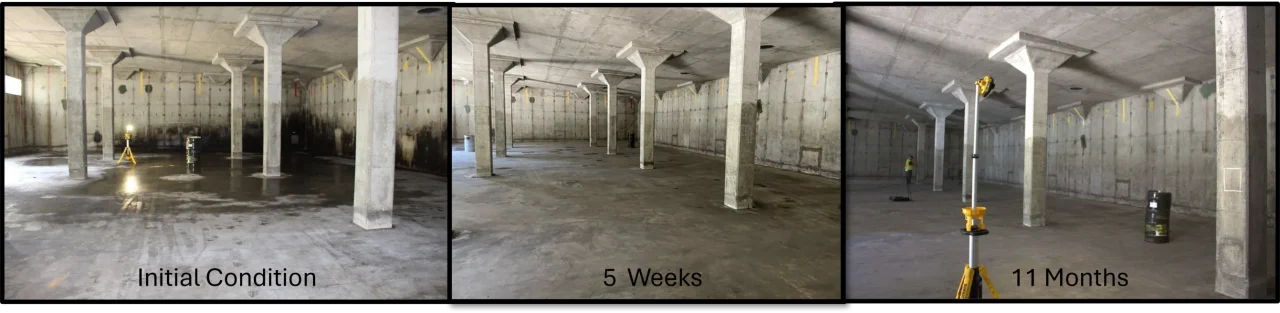
Description: To establish a durable preventative barrier, the project team transitioned NavClean—an aviation-grade, four-component formula utilizing a Sodium Perborate oxidizer—from non-porous aircraft surfaces to porous structural concrete. The refined methodology utilizes a low-pressure water pre-wash to wet biological films and suppress spore aerosolization, followed by a 20-minute chemical dwell period to ensure deep substrate penetration. Mechanical agitation via battery-powered rotary scrubbers and a final fresh-water rinse complete the sanitization process, depositing long-term fungicidal inhibitors.
Beyond biological remediation, the protocol improved structural conditions. Field data revealed that eradicating the mold layer resolved chronic standing water in magazine corners. The mold mass had functioned as a biological sponge, retaining moisture and preventing evaporation; eliminating this biomass restored natural drying cycles. Because concrete ECM designs are standardized across service branches, this protocol is immediately deployable to Army, Navy, Air Force, and Marine Corps depots globally.
Adapting a formulation optimized for smooth surfaces to coarse, porous concrete required key operational adjustments. Early trials with soft synthetic brushes failed to achieve adequate penetration of the concrete pore structure. The team resolved this by implementing the low-pressure pre-wash to strip surface organic films and migrating to mechanical scrubbing. Future transitions will utilize variable-speed wire brushes and commercial squeegees to optimize cycle times and water recovery.
Developed with ERDC CERL, the technology is field-verified. During a large-scale demonstration at the Crane Army Arsenal Activity, the protocol achieved complete biological remediation. While untreated control facilities experienced mold recurrence within an average of 50 days, the treated magazine exhibited zero visible regrowth at the 11-month (>363 days) post-demonstration assessment. The process utilizes low-cost, commercially available auxiliary equipment, ensuring an immediate, low-risk transition path.



