
Technology Title
Portable Acoustic AI for Maintenance Readiness
Tech Focus Area
CBM+
Abstract
Problem Statement: Maintenance teams need fast, repeatable ways to identify vehicles that warrant deeper mechanical review before a developing condition becomes an availability problem. Traditional screening relies on technician experience, fault codes, and manual inspection. Mechanical abnormalities may appear before an electronic fault code is generated, and results can vary across technicians and locations.
Graphic
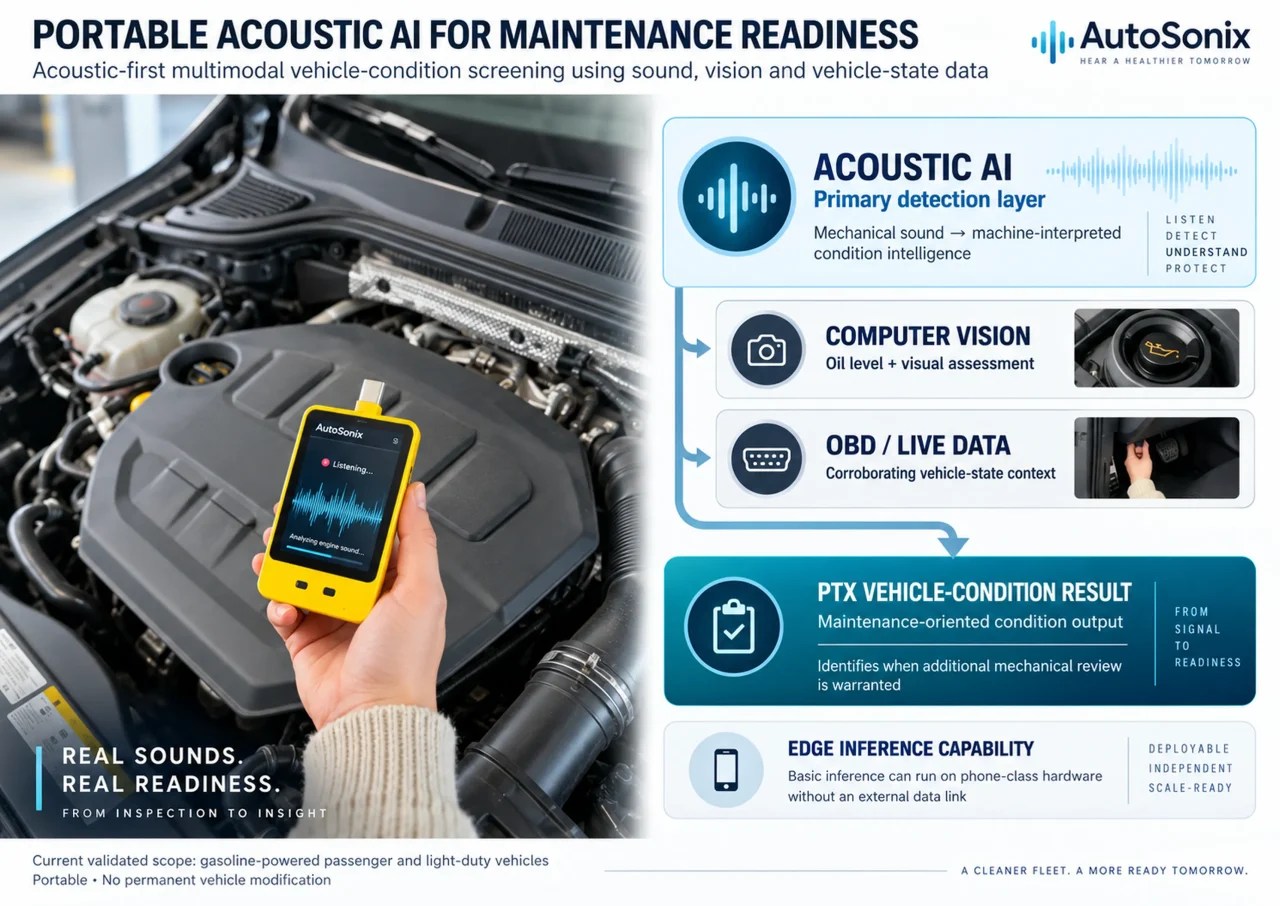
Description of the Innovation Solution: AutoSonix is a portable multimodal vehicle-condition screening system built around acoustic AI. During a standardized vehicle test, a purpose-built acoustic model analyzes under-hood mechanical sound for abnormal signatures. Acoustic intelligence is the primary novel detection layer. A computer-vision model evaluates an engine-oil dipstick image for fluid level and color, while OBD/DTC and live operating data provide corroborating context. Together, these inputs support a PTX vehicle-condition result indicating when additional mechanical review is warranted, with no permanent vehicle modification. Acoustic inference has also been demonstrated locally on iPhone-class hardware without an external data link, producing results on-device within seconds.
Benefits to the DoW: For gasoline-powered light-duty fleet assets, the capability could provide a consistent first-line screening layer before or between maintenance events. Potential benefits include faster triage, earlier identification of abnormal mechanical signatures, greater inspection consistency, better prioritization of maintenance resources, and improved vehicle availability. The dipstick vision workflow can standardize fluid-level verification with image-backed evidence. Local acoustic inference supports disconnected or network-restricted settings, and the workflow has cross-Service potential wherever comparable fleet assets are operated.
Innovation Challenges: Acoustic signatures vary across makes, models, engine families, and operating environments; faults may sound different across platforms. Broader equipment classes require sponsor-defined data and validation. Existing model-development infrastructure supports expansion but does not imply validation beyond the gasoline/light-duty scope. Longer term, the architecture is intended to support compact, equipment-specific models at the edge and ultimately at the sensor after representative data collection and validation.
Technical Maturity/ Demonstration Results: The platform is operational on real commercial vehicles and has been used in auction environments for approximately two years, with dealership pilots underway. In auction-environment evaluations, AutoSonix acoustic AI demonstrated above 90% condition-assessment accuracy using standard confusion-matrix measures. A low-risk DoW evaluation could compare the capability against known-condition fleet assets and determine where equipment-specific expansion is justified.



