
Technology Title
Easy Metal Strength Parts Production in Contested Environments
Tech Focus Area
Additive Manufacturing
Abstract
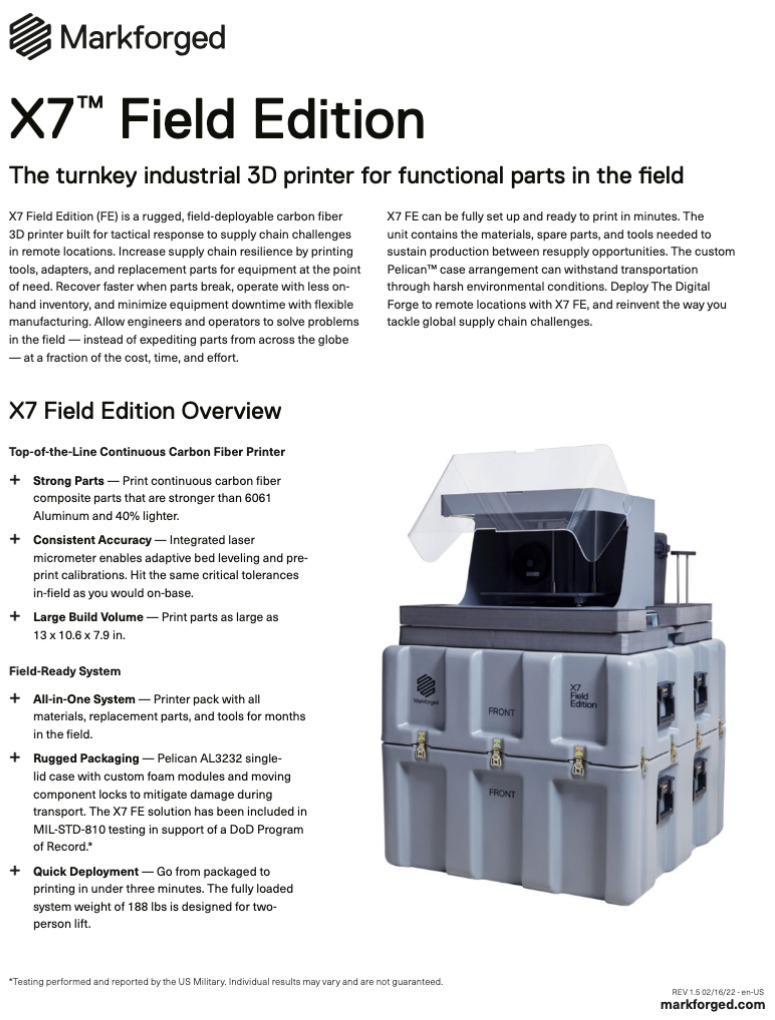
Contested logistics presents a threat to operational readiness. When adversaries disrupt transportation networks, restrict access to supply routes, or isolate deployed forces, a single unavailable component can sideline equipment. Traditional sustainment models depend on moving replacement parts from distant suppliers and depots through vulnerable distribution networks. The Markforged X7 Field Edition offers an alternative for suitable applications: producing strong, lightweight composite parts at the time and place of need, bringing manufacturing capability closer to the operational problem.
The X7 Field Edition combines a ruggedized, deployable platform with continuous fiber reinforcement technology. Using Onyx, a nylon material filled with chopped carbon fiber, the printer creates the part’s shape while incorporating continuous carbon fiber into selected layers. This reinforcement enables metal strength performance in appropriately designed applications, including parts that would otherwise be machined from aluminum. Strength depends on fiber placement, loading direction, geometry, and operating conditions, making application selection and engineering review essential. The result is a capability to manufacture functional components without the furnaces, metal powders, or extensive processing associated with many metal additive manufacturing systems.
Graphic
For deployed maintainers, this capability can turn an unavailable bracket, protective housing, equipment mount, fixture, or specialized maintenance tool into a locally producible item. Approved digital designs can be stored before deployment and manufactured when demand emerges, reducing dependence on forecasting every possible failure and carrying every potential spare. Depending on part size and complexity, production can occur within hours, helping shorten equipment downtime when conventional resupply could take days or weeks. Where authorized, reinforced composite replacements can also serve as temporary repair solutions until permanent metal components arrive.
Operating in contested environments also requires resilience when communications are limited or unavailable. With an appropriately configured Offline Eiger workflow, personnel can prepare and produce parts without relying on continuous internet connectivity. This supports distributed maintenance teams working from expeditionary locations, forward repair facilities, and other austere settings. Successful employment still requires suitable power, protected operating conditions, dry material storage, trained operators, and established inspection procedures. Integrating these requirements into deployment planning makes the printer a usable sustainment capability rather than simply another piece of equipment.
The operational value is a reduction in the number of replacement parts that must move through contested supply chains. Common feedstock and validated digital inventories can support multiple repair needs, increasing flexibility while reducing selected inventory burdens and emergency shipments. Local production can also help preserve transportation capacity for fuel, medical supplies, ammunition, and other items that cannot be manufactured at the point of need.
This abstract examines how the X7 Field Edition can support a more responsive, distributed approach to military sustainment. It emphasizes matching reinforced composite capabilities to approved applications, positioning digital designs and materials before deployment, and connecting field production with engineering authority. By enabling qualified parts to be produced closer to the user, expeditionary additive manufacturing can help restore equipment availability, sustain operational tempo, and reduce exposure to disrupted logistics networks, giving deployed forces greater control over when and where essential maintenance needs are met.



