
Technology Title
Autonomous Monitoring of Legacy Analog Gauges on Navy Ships and Land Based Equipment
Tech Focus Area
Enhanced Inspection
Abstract
Problem: Ships and other military assets still rely on thousands of analog gauges for critical systems including fire pumps, compressed air, hydraulics, cooling, fuel, and auxiliary equipment. Many of these gauges must be physically checked and recorded by sailors during routine rounds. That takes time and only tells you what the gauge was reading when someone happened to look at it. Problems can develop between rounds.
Graphic
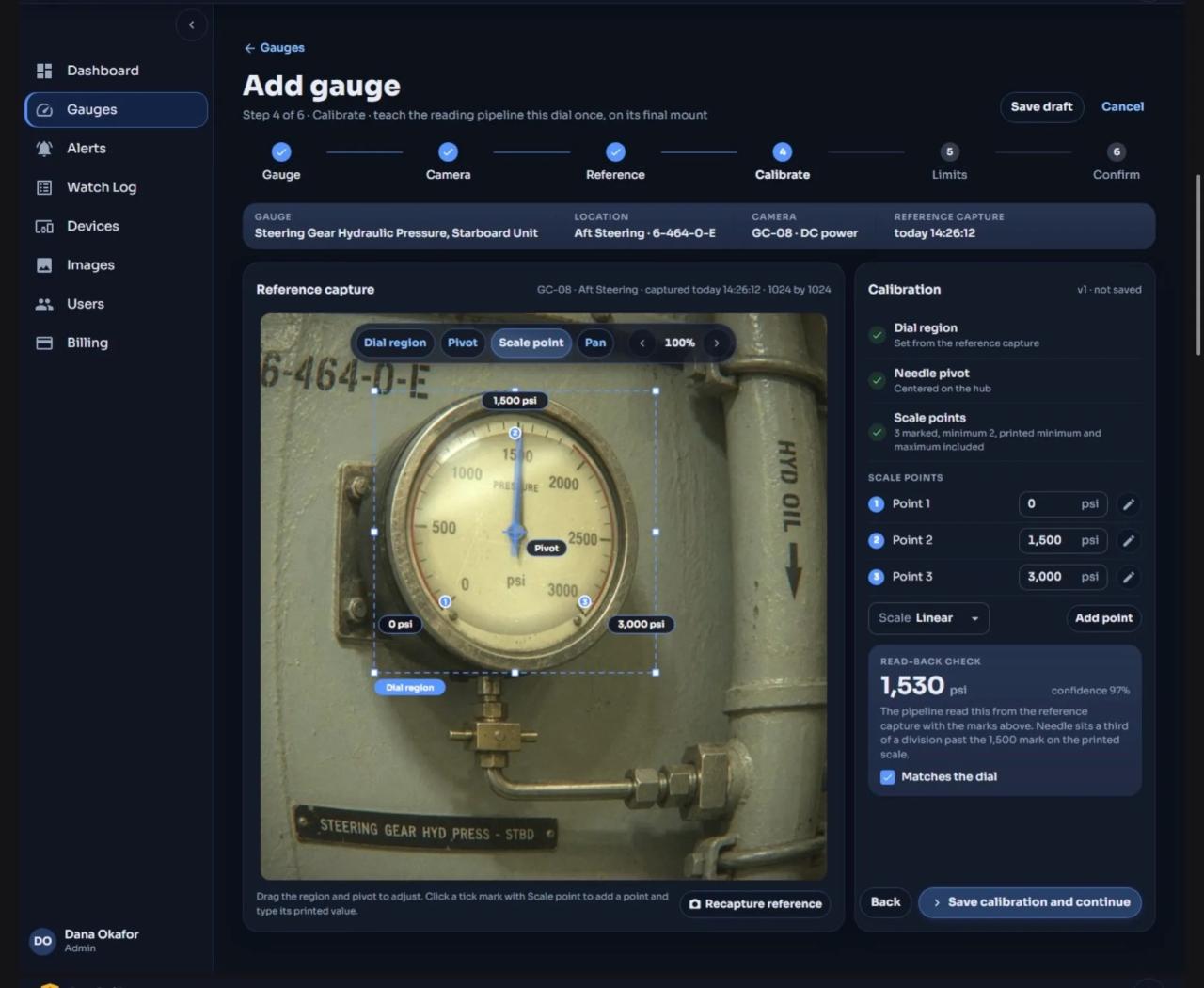
Solution: Our approach is simple: put a small camera in front of the gauges already installed. During setup, the system identifies the dial, needle, and scale. A maintainer verifies the calibration and establishes the normal operating range and warning limits. From that point forward, the camera can photograph the gauge at user-defined intervals, convert the needle position into a numerical reading, and track that reading over time. If a reading begins moving outside its normal range, the system can alert the watch team. Every reading retains the original photograph so a sailor can verify what the system saw. Low-confidence readings are flagged for human review rather than treated as reliable measurements. Most importantly, nothing has to be changed about the existing gauge or equipment.
Maintenance Impact: The goal is to reduce the amount of time skilled sailors spend walking from gauge to gauge simply to read and record numbers. One camera can monitor multiple gauges and collect readings at user-defined intervals, creating a continuous record without requiring a sailor or maintainer to physically visit and record each gauge. Sailors can spend less time performing repetitive rounds and more time troubleshooting and maintaining equipment. More frequent readings also create something traditional rounds cannot: a trend. A fire-pump gauge, for example, might still be within limits but steadily losing pressure. Instead of waiting for the next round—or an alarm—the watch team can see the deterioration developing and respond earlier. The architecture could also provide a foundation for secure, locally hosted condition-monitoring models that analyze multiple equipment signals together without requiring external connectivity.
Current Status: We have completed an initial proof-of-concept using photographs of real analog gauges collected over approximately seven hours. The test included both stable and changing pressure readings, and the vision model successfully converted gauge positions into numerical values. The next step is integrating the software with fixed camera hardware and testing it on representative military equipment. Testing will focus on accuracy, reliability, lighting and vibration, communications limitations, and measurable maintenance-hours saved.



