
Technology Title
SPIDER Inspection Kit: Forward Deployed Spatial Intelligence for Non-Destructive Inspection
Tech Focus Area
Enhanced Inspection
Abstract
Problem Statement: Non-Destructive Inspection (NDI) is critical to aircraft safety and mission readiness, identifying cracks, corrosion, and structural damage before they compromise airworthiness. Yet inspectors must manually connect instrument readings with inspection coverage and precise locations on the aircraft using markings, notes, images, and separate reports. This fragmented process increases inspection time and the risk of missed coverage, finding-location errors, repeat inspections, and delayed repairs. The challenge is particularly significant at flightlines and forward-deployed locations, where skilled personnel, infrastructure, connectivity, and time may be limited
Graphic
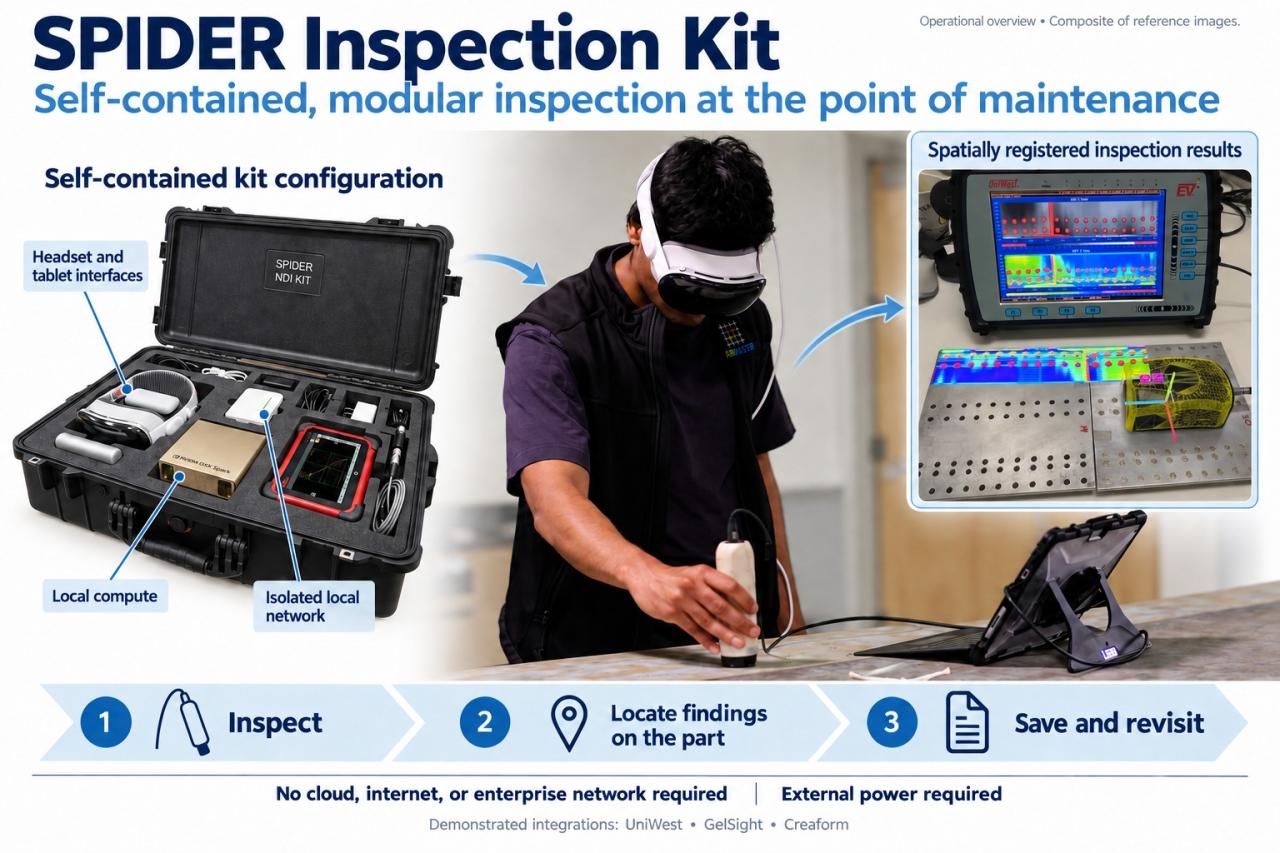
Description of the Innovation Solution: GridRaster’s SPIDER™ Inspection Kit introduces a new spatial intelligence layer between existing NDI instruments and the physical aircraft. Rather than replacing approved instruments or procedures, SPIDER uses Spatial AI and XR to register inspection measurements to their physical locations, visualize results directly on the asset, track coverage, and preserve findings within an asset-specific digital twin. The self-contained, transportable kit combines local compute, isolated networking, XR/tablet interfaces, and modular NDI-instrument integration. It requires only external power and operates without cloud, internet, or enterprise-network connectivity, enabling deployment from depots to flightlines and forward locations.
Benefits to the DoW: SPIDER transforms disconnected NDI measurements into a persistent spatial record of what was inspected, where it was inspected, and where damage was identified. This can accelerate inspection, engineering review, repair, and reinspection while improving traceability and reducing human error. Demonstrated results indicate potential 50–60% reductions in NDI time and up to 90% reduction in human error. Strategically, SPIDER brings advanced digital inspection to the point of need, supporting distributed sustainment, faster return-to-service decisions, aircraft availability, and readiness in disconnected and infrastructure-constrained environments.
Innovation Challenges: The primary technical challenge is maintaining accurate spatial registration across diverse aircraft geometries, inspection areas, and NDI instruments while making digital record creation seamless within existing operator workflows. The modular architecture must also preserve compatibility with approved inspection equipment and procedures.
Technical Maturity / Demonstration Results: SPIDER NDI has reached TRL 7, with operational demonstrations and pilot deployments underway at WR-ALC and OC-ALC. Demonstrated integrations include UniWest EVi/ECA-64, GelSight, and Creaform HandySCAN, with additional integrations underway for FARO metrology, Creaform scanning, and Virtek laser projection. This maturity provides a strong foundation for transitioning a deployable, multi-instrument NDI capability to operational DoW maintenance environments.



