
Technology Title
Autonomous Inspection: Driving Affordability, Availability, and Safety Through Advanced Aircraft Inspections
Tech Focus Area
Enhanced Inspection
Abstract
Problem Statement: To maintain safe operation and mission-readiness, USAF aircraft such as C-17, C-5 and KC-46 are carefully inspected every 72-hours, with more in-depth Isochronal (ISO)/Home Station Check (HSC) inspections occurring every 180 to 360 days. Existing processes are time-consuming, labor-intensive, pose safety risks, and limit the ability to record data. Most records are either paper copies or manually typed into a computer system. Images are rarely taken during the inspection process, further reducing traceability of findings.
Graphic
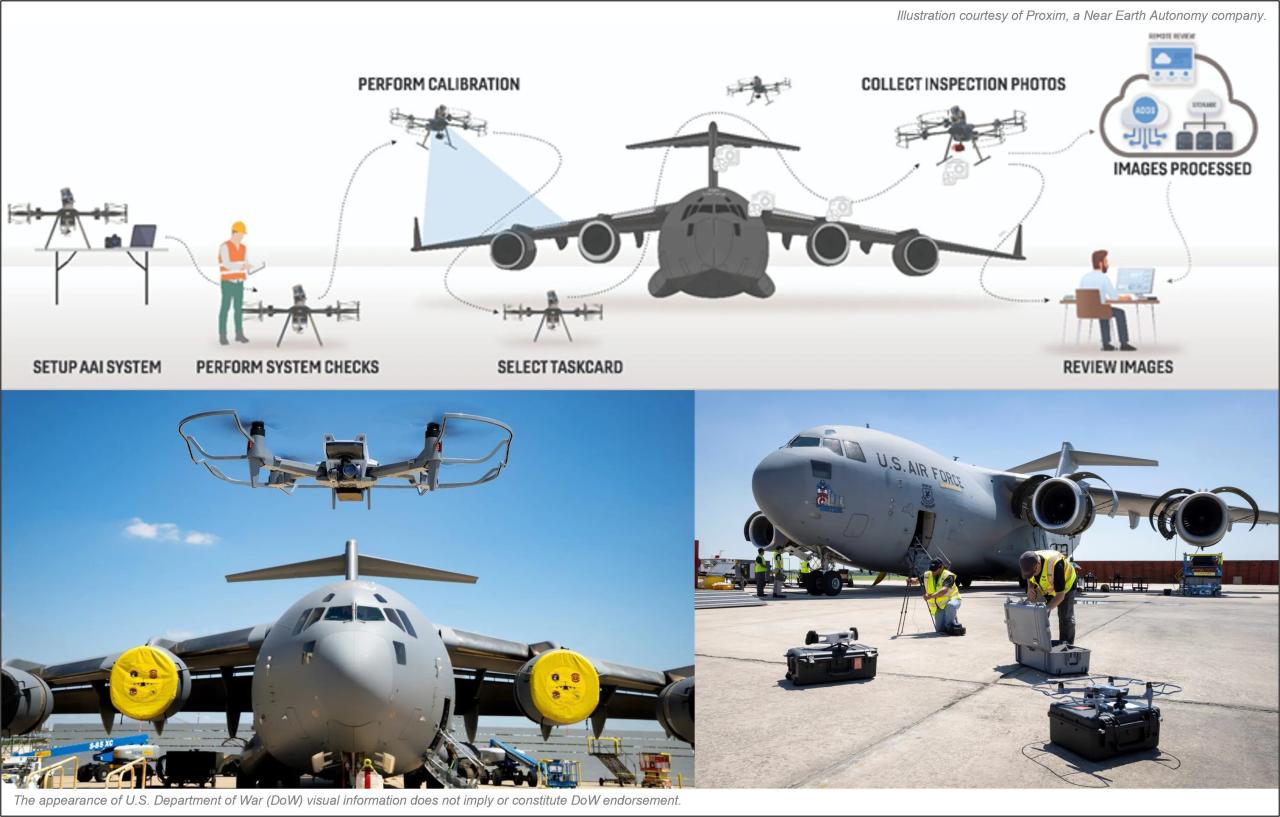
Description of the Innovation Solution: Advanced Inspection is an end-to-end autonomous drone inspection system that uses NDAA-compliant sUAS to capture high-resolution images mapped to aircraft coordinates, followed by AI-enabled automatic anomaly identification, measurement, and classification of defects in a cloud-based platform. The results are instantly analyzed, stored as tail-specific digital records, and accessible to authorized users worldwide through a secure review platform. The system highlights anomalies on a digital twin of the airframe and documents changes over time, enabling prediction and smarter maintenance decisions.
Benefits to the DOW: The system greatly decreases inspection time (at least 40% on C-17 HM inductions), reduces the need for heavy equipment, minimizes safety risks for maintenance crews, and improves speed and consistency of inspections across bases and fleets by following standardized task cards. Outputs from drone inspection are immediately actionable and create digital records to enable condition-based maintenance, improved repair effectiveness, digital twin redundancy, automated health alerting, and global collaboration through a cloud environment. By turning visual checks into fast, repeatable, data-rich inspections, operators can return aircraft to service sooner and keep fleets available for missions. The system has been tested on numerous platforms (i.e., C-17, KC-46, KC-135, P-8, EA-18G, C-5) with near-instant results.
Innovation Challenges: The system is lightweight and configurable for inspections in outdoor environments. Indoor or GPS-denied environments require manual flight or alternate drone configurations. Platform- and drone-agnostic configurations are in development but limited to NDAA-compliant options.
Technical Maturity/Demonstration Results: This activity began by deploying Near Earth Autonomy’s Aircraft Inspection (AAI) technology and Boeing’s patented Automated Damage Detection Software (ADDS) on the C-17 Globemaster III at Joint Base Pearl Harbor-Hickam (JBPHH). It is an integrated inspection tool at the Boeing San Antonio depot within the C-17 HM workflow and is also used to create digital records of the P-8 and KC-46. The existing C-17 ADDS model is TRL-9 and can identify 95%+ of all anomalies with each scan. ADDS models for additional aircraft types are in development. The KC-46 ADDS model is TRL-7 and is anticipated to reach TRL-8 in 2027.



