
Technology Title
Wire-Buddy: Self-Healing Insulation and Corrosion Barrier for DoW Wiring
Tech Focus Area
Coatings/Corrosion Prevention
Abstract
Problem Statement: Insulation on DoW aircraft, ship, ground vehicle, and field-electronics wiring degrades from aging, abrasion, inspection handling, moisture, chemicals, and aircraft deicers. Breached insulation enables dendritic growth. The primary driver of wet environments can cause short circuits. This can cascade into lost mission systems, electrical fires, and unscheduled harness or connector replacement. Cadmium plated connectors corrode in the same environments, adding depot and field workload. Maintainers often face a binary choice: live with degraded insulation until the assembly is swapped, or apply bulky wraps that do not re-heal. A field and depot usable coating that restores dielectric protection without masking or teardown is needed.
Graphic
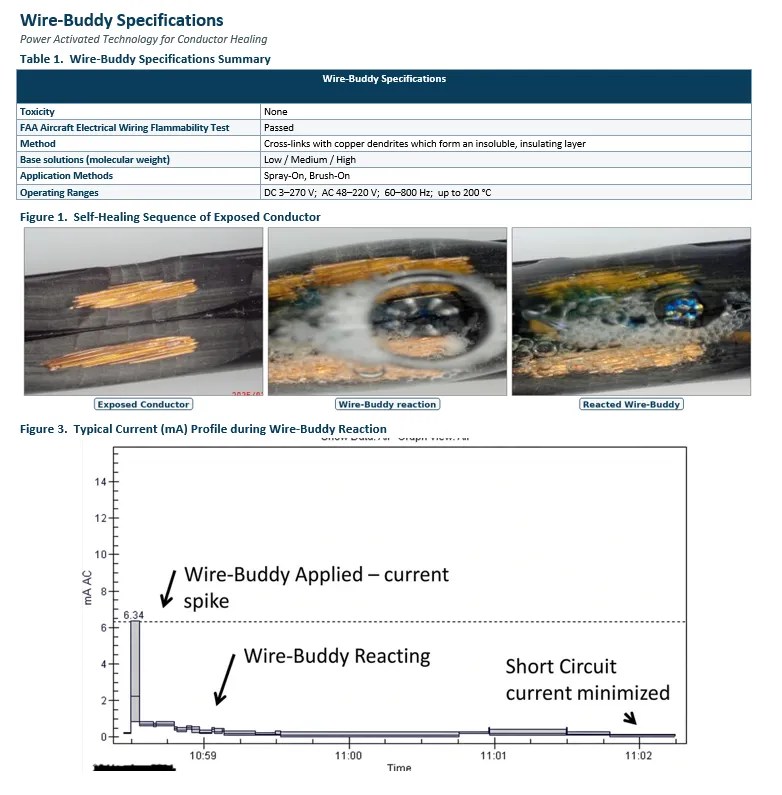
Description of the Innovation Solution: Wire Buddy is a non-toxic, water soluble coating developed for U.S. military wiring that forms a new insulating layer on conductors and connectors. Applied by brush or spray without masking, it adheres to existing insulation and metal hardware, fills gaps, and can rehydrate to reactivate healing after later abrasion or inspection damage. Formulated for 3–270 VDC and 48–240 VAC across 50–800 Hz, it is intended to arrest dendrite growth, restore wet environment dielectric integrity, resist abrasion, and inhibit corrosion on cadmium plated surfaces, including connectors exposed to aircraft deicers. Clear or colored versions can be supplied in bottles or bulk for O-, I-, and D-level use.
Benefits to the DoW: Wire-Buddy improves maintenance by restoring insulation in place rather than replacing failed harnesses and connectors. In place repair can reduce unscheduled removals, cut short-circuit and fire risk in wet and maritime conditions, and extend the life of cadmium coated hardware otherwise condemned for corrosion. Application without masking shortens work in crowded bundles and backshells and is harmless to surrounding equipment. The same approach serves aviation, naval, ground vehicle, and field-electronics maintainers and can lower part demand.
Innovation Challenges: Transition requires service qualification (electrical, environmental, flammability, and materials compatibility), insertion into technical orders and work cards, and training so the coating is used as a controlled repair. Color versus clear variants must match inspection practice. Long duration data under salt fog, deicer, vibration, and thermal cycling must be collected in DoW representative environments. Qualified supply to organic and commercial activities must be established.
Technical Maturity / Demonstration Results: Developed for military wiring and demonstrated on partially coated, corroded cadmium connector hardware, showing gap fill and surface protection. Brush on and spray packaging exist. Next step: a sponsored demonstration on aircraft wiring, naval connectors, or ground-vehicle harnesses to generate data for technical order approval and organic industrial base adoption.



