
In late January, a CTMA initiative that is developing an autonomous surface vessel called NightTrain marked a key milestone with a keel laying ceremony in Baltimore’s Curtis Bay, hosted by leaders from the DoW, the US Department of Commerce, the Maryland Department of Commerce, NCMS, and more.
This keel laying ceremony, a naval tradition dating back centuries, signifies NightTrain’s transition from design to physical construction and reflects growing confidence in autonomous logistics as a viable operational capability. NightTrain is a low-profile logistics vessel designed to deliver containerized payloads directly to forward forces operating in contested maritime environments.
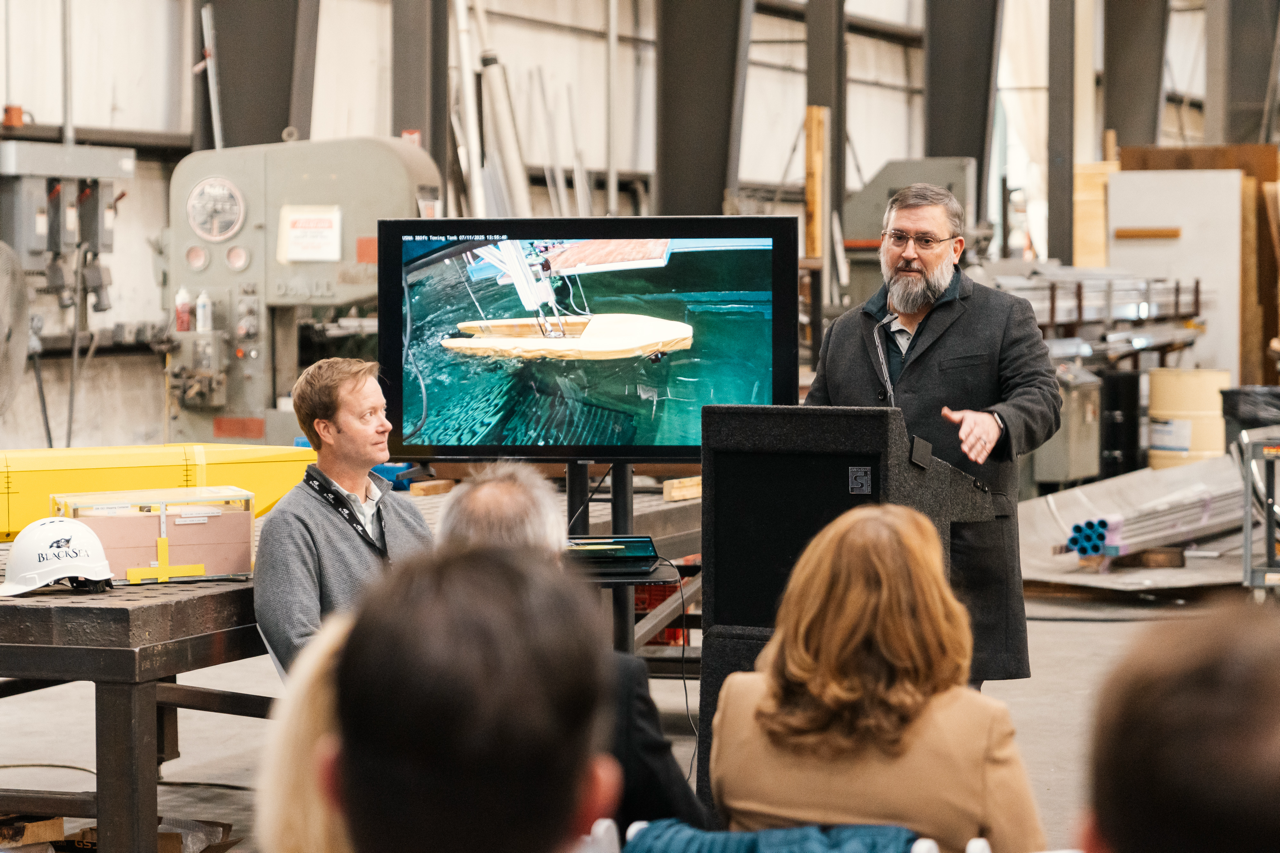
“NightTrain is a leap forward in technology,” Patrick Kelleher, Deputy Assistant Secretary of War for Material Readiness, said. “It is a way to think about moving cargo that is completely different than the way we do it now, and it adapts to the operational realities that we will face in an era where we are being challenged on every front by peer adversaries. The simple fact of making it and thinking about it presents our adversaries with a dilemma.”
The NightTrain platform is being designed and built in a CTMA collaboration launched in August 2025 between the Office of the Deputy Assistant Secretary of War – Materiel Readiness and industry partner BlackSea Technologies. NightTrain is designed to transport meaningful cargo over long distances, reducing risk to personnel while supporting distributed operations. Built to move at scale across inter-theater distances, NightTrain carries standard ISO containers and releases cargo without reliance on ports, cranes, aircraft, or protected infrastructure.
NightTrain supports multiple classes of supply including subsistence, fuel, and ammunition using standard container interfaces. This compatibility allows seamless integration into existing logistics planning and supply chains. The result is a flexible resupply platform that adapts to evolving operational demands without specialized infrastructure.
“With NightTrain we have engineered a system that enables end-to-end resupply from staging bases to austere shorelines, sustaining forces operating inside denied environments,” Todd Greene, BlackSea’s Director of Advanced Technologies, said. “Its survivable design, long-range performance, and ability to operate without fixed logistics nodes allow commanders to sustain forces where traditional sealift and airlift cannot operate.”
As NightTrain was a creative concept born and proven at the US Naval Academy, distinguished faculty and Midshipmen Naval architects and weapons, robotics, and controls engineers attended the ceremony.
“Today, we’re celebrating a milestone in innovation for the naval warfighter and over a dozen Midshipman projects since 2021 that have worked to develop this concept,” Professor Jenelle Piepmeier, PhD, Chair of the US Naval Academy Weapons, Robotics, and Control Engineering Department, the sponsor for the ceremony, said. “This collaboration really showcases the unique strength of a joint military civilian faculty at the United States Naval Academy with direct contribution to the Navy and the warfighter.”
The keel laying follows completion of detailed design work and the establishment of production fixtures, marking forward progress for the program. Construction activities will continue as the platform advances toward on-water testing.