
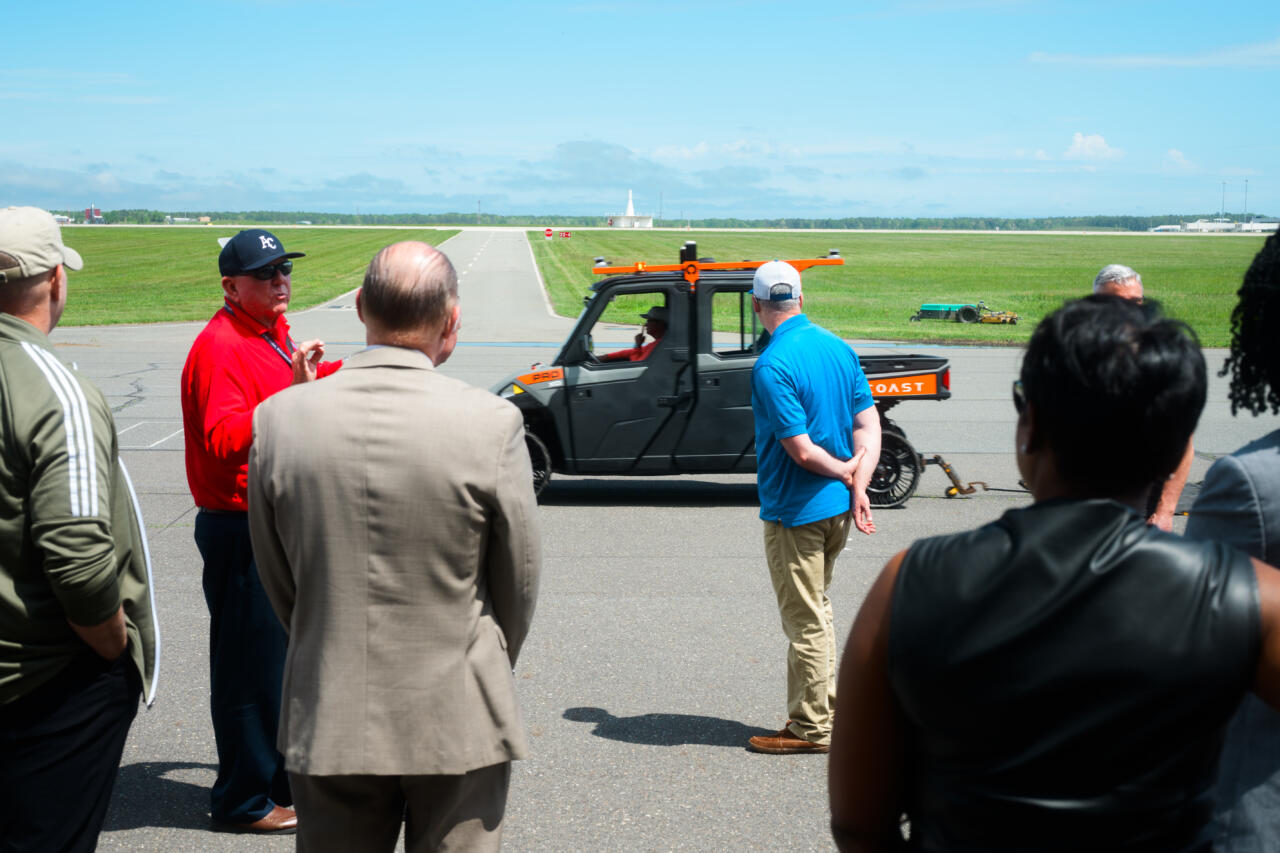
The AAI Next group selected COAST consortium to build and demonstrate an autonomous system for perimeter patrol, foreign object debris sweeping, and grass cutting. The consortium consists of COAST Autonomous, Pratt Miller Engineering, Renu Robotics, and ARIBO. (Photo by Travis Shea.)
In spring 2025, the second phase of the Airfield Autonomy Initiative (AAI), AAI Next, achieved extraordinary success with utilizing autonomous ground vehicle systems for three routine airport tasks: perimeter patrol, foreign object debris (FOD) sweeping, and grass cutting. Over eight weeks, the vehicles completed 1,763 autonomous missions with zero safety issues and a 99.55 percent success rate, including a 100 percent success rate during two weeks of steady-state daily operations.
“The Airfield Autonomy Initiative Next was groundbreaking,” Greg Kilchenstein, NCMS Chief Technologist said. “The demonstrations, held at the Atlantic City International Airport (ACY) and the adjacent National Airport Pavement and Materials Research Center (NAPMRC), were wildly successful. AAI Next is on the cutting-edge of integrating autonomous capabilities into commercial airfields.”
The Airfield Autonomy Initiative was launched in 2022 after the Federal Aviation Administration (FAA) received Congressional funding to advance autonomous capabilities on airfields. The AAI leadership team consists of experts from the FAA, the Air Force’s Air Mobility Command (AMC), the National Aerospace Research and Technology Park (NARTP), and the National Center for Manufacturing Sciences (NCMS). Working with partners from commercial industry, AAI is automating routine airport tasks to reduce costs, improve efficiency, and increase safety in both military and commercial aviation. Early demonstrations were conducted at Joint Base McGuire-Dix-Lakehurst (JB MDL) in New Jersey, enabling the consortium to view potential technology solutions from industry partners.
“A lot of things moved forward in the journey from the first Airfield Autonomy Initiative to AAI Next,” Kilchenstein said.
The first stage of AAI similarly gathered proposals from industry teams and ultimately moved forward with Maren-Go Solutions, Inc., a firm that designs and builds autonomous systems. The team developed and demonstrated an autonomous airport operations (A2O) system paired with a few robotic operators. The initiative resulted in four military airfields requesting a setup pairing the A2O system with a FOD detection rover that employs radar and a FOD collection unit that utilizes both an industrial vacuum and industrial magnets.
“For AAI Next, there has been a lot more integration of commercial capabilities,” Kilchenstein said. “Also, the FAA has been more deeply involved as a sponsor and enabler for the movement toward technology transition to operations.”
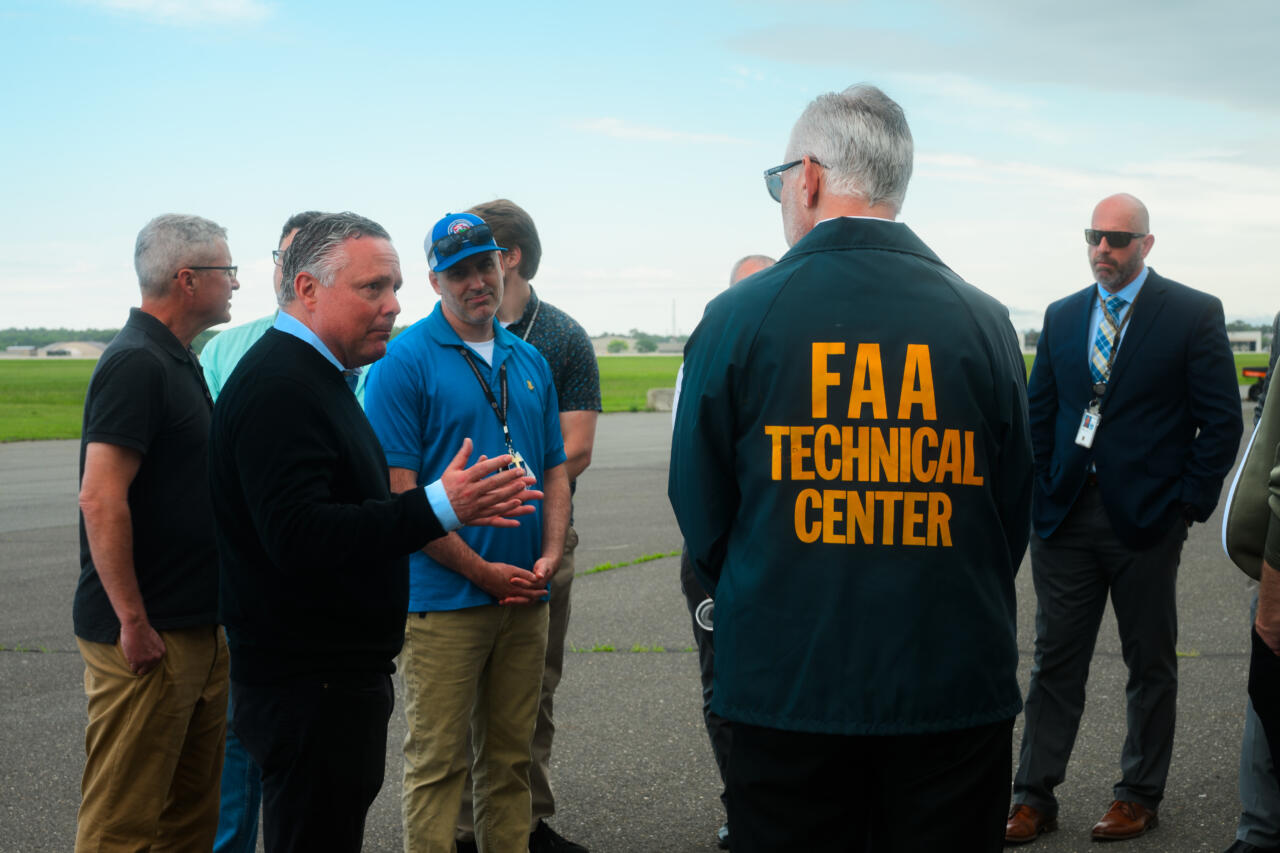
For the AAI Next initiative, the FAA has been more deeply involved as a sponsor and enabler for the movement toward technology transition to operations. (Photo by Travis Shea.)
The AAI Next initiative was launched when NCMS issued a request for proposal (RFP) that solicited autonomous capabilities needed at airfields for perimeter patrol, FOD sweeping, and grass cutting. “We received a significant number of proposals from companies as well as industry consortiums,” Kilchenstein said. “The Airfield Autonomy Initiative leadership team reviewed each proposal, and the COAST consortium was the clear winner.”
The COAST consortium consists of COAST Autonomous, Pratt Miller Engineering, Renu Robotics, and ARIBO. For planning and deploying the three autonomous vehicles, ARIBO drew on their organization’s experience with 60 autonomous vehicle projects that aligned military, public sector, and commercial ground vehicle robotics R&D.
COAST Autonomous utilized their command and control (C2) system to govern the interactions between all three autonomous ground vehicles operating on the airfield.
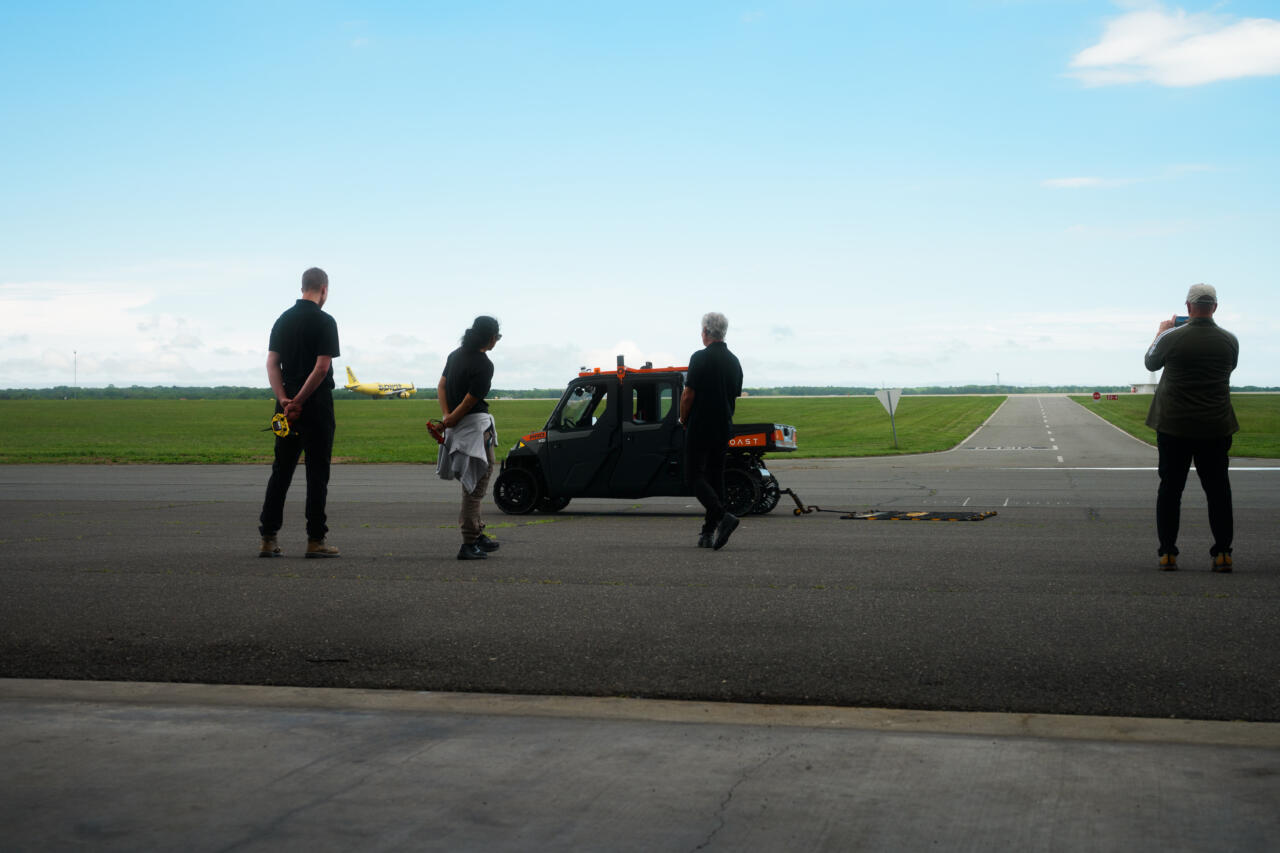
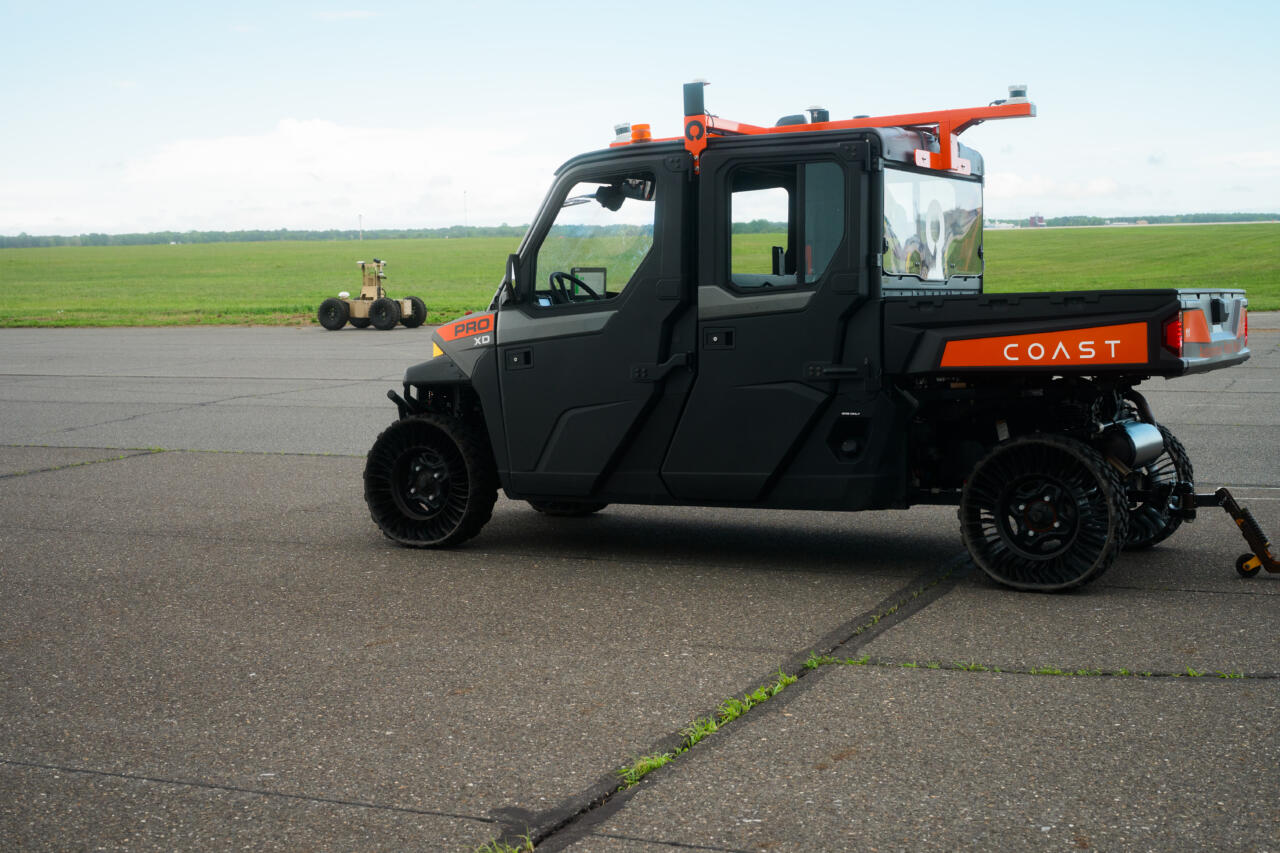
COAST Autonomous demonstrated their foreign object and debris (FOD) Pro XD Autonomous Road Machine (ARM), based on a modified Polaris Pro XD utility task vehicle, equipped with a FOD*BOSS sweeper. (Photo by Travis Shea.
A cloud-based platform, the COAST C2 System oversees vehicle scheduling, routing, and coordination, ensuring seamless integration into airfield operations. The COAST C2 System updates the map of the environment, service, and schedule of operation.
For FOD sweeping, COAST Autonomous demonstrated their Pro XD Autonomous Road Machine (ARM), based on a modified Polaris Pro XD gas-powered utility task vehicle, equipped with a FOD*BOSS sweeper. The COAST Pro XD ARM executes missions by schedule, operator command, or dynamic operational events as defined via the COAST C2 System interface. Throughout the Airfield Autonomy Initiative, operations persisted successfully during heavy rainfall, confirming system ruggedness and reliability.
To perform autonomous perimeter control, Pratt Miller Engineering employed their Flexible Robotic Platform Light (FRP-L) platform. Guided by mission paths and directives defined within the COAST C2 system, the FRP-L overlays pre-surveyed map attributes with real-time autonomy sensor data to ensure path adherence and identify and report surveillance events or anomalies. When the platform detects obstacles or objects of interest, it halts and alerts the COAST C2 System, awaiting further instruction to proceed, ensuring operational transparency and safety.
For autonomous grass cutting, Renu utilized their Renubot, which integrates GPS with real-time kinematic (RTK) positioning, light detection and ranging (LiDAR), and cameras to allow the platform to precisely position, detect obstacles, and safely operate near airfields, all while continuously reporting its progress and operational health to the C2 system. The Renubot can be fully controlled, either locally or remotely, and maintains areas in the 120+ acre range. Additionally, the unit is 100 percent electric, which reduces maintenance requirements.
By the end of the Airfield Autonomy Initiative, the team successfully demonstrated real-time management and coordination of the three autonomous vehicles via the COAST C2 System. All vehicles exhibited reliability in obstacle avoidance, geofencing, and emergency stop functions using sensor fusion (LiDAR and cameras), maintaining safe and error-free performance, including during inclement weather. Real-time fleet supervision was ensured by both on-site and remote operators through a cloud-based dashboard, supporting distributed oversight, planning, and immediate human override if necessary.
Secure communications were provided by two-factor authentication, bi-directional data exchange, and flexible integration with third-party maps and APIs. The team ensured secure data management and analysis by establishing comprehensive telematics collection, secure cloud-based storage, real-time access controls, and systematic management of operational data to enable transparent evaluation, compliance, and future scalability.
Bringing together multiple autonomous ground vehicle systems to demonstrate over an eight-week period required NCMS’s team to provide expertise in contracts, accounting, and project management.
“NCMS took on the administrative role of getting all partners on contract, organizing demonstrations, and making sure that the resources the FAA provided to the NAARTP were applied correctly to get the Airfield Autonomy Initiative Next demo done,” said Kilchenstein. “For AAI Next, the FAA led the initiative, and the Air Force was an interested observer. This is a great example of how NCMS is championing and facilitating the development and transition of dual-use capabilities for airfield autonomy.”
To view videos of the autonomous vehicles demonstrated in AAI Next, see:
https://www.nbcnews.com/nightly-news/video/researchers-test-new-airport-tarmac-technology-242441797571