
NCMS Technology Briefs highlight NCMS’s cultivation and growth of innovative technologies. Through our management of government and industry collaborations, we’ve gained insights into novel approaches and best practices that can assist all companies to navigate the sometimes complex journey toward advancement. Based on the results of NCMS technology projects, the briefs show the applicability and usefulness of proven technical advances—all in an effort to speed adoption and eliminate duplication of effort. NCMS is pleased to share these insights to support U.S. manufacturing competitiveness.
Introduction
A large and growing percentage of companies across multiple sectors—manufacturing, defense, automotive, transportation, energy, construction, agriculture, utilities, and more—are investing in predictive maintenance technologies. Recent research has found that predictive maintenance can reduce maintenance costs by up to 30 percent and significantly decrease malfunctions by predicting approximately 70 percent of failures. Companies that invest in predictive maintenance yield an average return of ten times the initial investment, according to industry studies and research conducted by the US Department of Energy.
To advance the capabilities of integrated vehicle health management (IVHM) systems, the term for a unified collection of technologies that enable predictive maintenance, an NCMS initiative made progress in solving three technical challenges. The solutions developed can be applied to a broad range of IVHM systems for vehicles and other complex assets including manufacturing equipment, aircraft, maritime vessels, and autonomous systems.
One challenge of IVHM systems occurs because on-vehicle and on-asset requirements are often not adequately defined or addressed early in the vehicle/asset design and development process, which limits the ability to create health-management-ready subsystems for the vehicles. Another challenge is that IVHM is not always fully integrated into the solid-state power distribution (SSPD). To support effective health monitoring, SSPD systems typically need the capability to export data collected from solid-state power controllers (SSPCs)—electronic devices that replace traditional mechanical circuit breakers—or host onboard processing that can analyze the data and communicate results to the IVHM system. A third challenge—faced by nearly the entire field of predictive maintenance technologies—is that traditional reliability models based on mean time between failure (MTBF) measurements are often insufficient because they assume independent, stationary failures without accounting for fault coupling or interactions between subsystems.
IVHM Requirements Analysis
Many modern vehicles and assets currently integrate predictive maintenance technologies to some extent. A large and growing number of vehicles transmit diagnostics and performance data via telematics systems, such as GM’s OnStar and BMW’s Proactive Care. However, full predictive maintenance integration—with analytics, forecasting, and actionable decision support—is currently limited to a minority of vehicles and assets.
The most advanced form of predictive maintenance is IVHM, a comprehensive, system-level approach that assesses, predicts, and manages the “health” or operational status of vehicles and other complex assets. Using strategically placed sensors, data on vibration, temperature, pressure, strain, fluid levels, engine performance, and more is gathered to detect anomalies. While these technologies focus on forecasting component failures, IVHM extends these capabilities to system-level health assessment and operational decision support.
An NCMS initiative conducted a vehicle sustainment system baseline study that specified requirements for incorporating advanced diagnostic and prognostic capabilities into vehicle and asset design. As a case study, the team selected a tracked Army vehicle, similar to the Bradley Fighting Vehicle, that can be operated with a manned crew or semi-autonomously. This is a hybrid vehicle powered by both a variable frequency alternating current (AC) electric motor and a diesel engine and driveshaft. This vehicle contains an IVHM processor to gather data and report vehicle health measures. The team analyzed the vehicle electronics, which host the on-vehicle element of IVHM and is the enabler for advanced diagnostic and predictive maintenance technologies.
This analysis began by identifying the data generated by digital processors in various vehicle subsystems including the electric motor and motor controller, mechanical drive train, diesel engine, power generation and distribution, environmental control system, and battery. Then, the team identified the sustainment data flow: 1) on-vehicle data, generated by built-in elements; 2) at-vehicle data, generated by units located outside the vehicle but which interact with vehicle components, including maintenance aids, part tracking, and configuration management; and 3) off-vehicle enterprise services such as root cause analysis, fleet data management, maintenance logistics, supplier/OEM operations, monitoring, and data analytics.
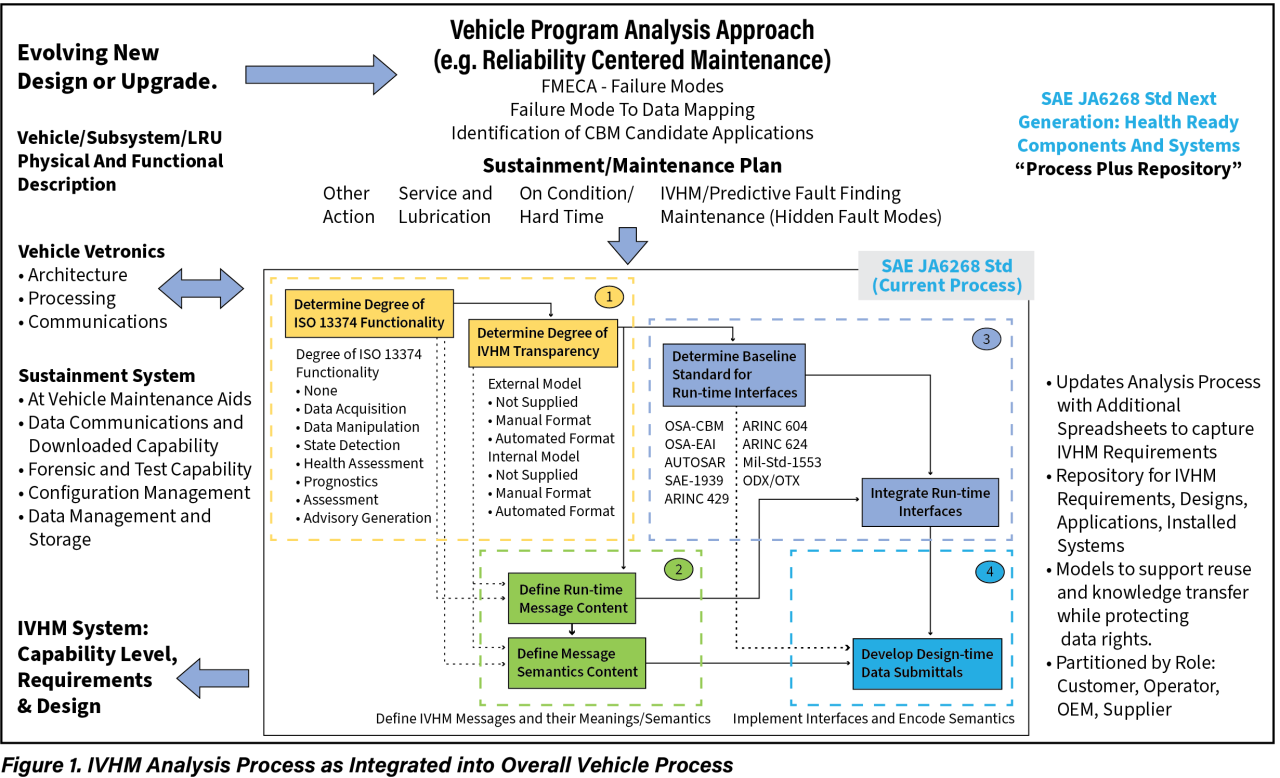
After this analysis, the NCMS team established a process for identifying IVHM system requirements. The first step is to perform a Failure Mode, Effects, and Criticality Analysis (FMECA). This type of analysis acts as a blueprint or map that tells an IVHM system what to look for and which failures matter most.
Next, create a data-to-failure mode traceability matrix to help determine the maintenance strategy for each failure mode. This should be in the form of a data catalog that is structured to link relevant IVHM data to the end-item component; it should be reviewed periodically since hardware and software modifications are common.
After these initial steps, the team recommends a four-step process:
- Characterize the specific design functions, methods, and interfaces available for IVHM implementation, including on-vehicle IVHM, the at-vehicle automated logistics environment, automatic test equipment applications, and enterprise services.
- To do this, the NCMS team recommends consulting two technical standards. The first, SAE International Standard JA6268: Design & Run-Time Information Exchange for Health-Ready Components, provides a framework for developing, integrating, and verifying IVHM systems to support effective predictive maintenance. The second, ISO 13374: Condition monitoring and diagnostics of machines — Data processing, communication and presentation, establishes general guidelines for software specifications related to data processing, communication, and presentation of machine condition monitoring and diagnostic information.
- Define the run-time message content: the health-related data that a system or component generates, packages, and transmits during operation. Also define message semantics content: the standardized, machine-interpretable meaning, context, and purpose of data exchanged between sensors, diagnostic systems, and ground-based maintenance systems.
- Determine the baseline standard for run-time interfaces: the standardized mechanisms, protocols, and software connectors that enable the exchange of health-related data between components, subsystems, and the central vehicle or asset management system during active operation. Next, integrate run-time interfaces.
- Develop design-time data submittals: technical documentation and data, often formatted as SAE JA6268 data sheets, that enable the development, verification, and integration of IVHM capabilities before vehicle or asset operation.
In addition to establishing this process, the NCMS team identified an ideal architecture for effective IVHM integration into the vehicle sustainment system. The digital data needed is generated by the digital processors in various subsystems. An issue is that a fault on one subsystem can propagate and cause abnormal behavior in other subsystems. To solve this issue, the team recommends an ideal IVHM architecture that implements partitioned processing within the subsystem as needed and partitioned communications to enable transmission of data.
Finally, the team focused on progressing the capabilities of IVHM systems, drawing on SAE’s technical standards for Health-Ready Capability Levels that range from an initial Level 0 (limited on-vehicle warning indicators) to the highest Level 5 (self-adaptive health management). The NCMS team created a Health Ready Capability Level Overview matrix to provide a standard way to communicate vehicles’ and assets’ current and future capability levels; this matrix can be adapted and used by any company or organization. Additionally, the team built on SAE’s work to identify the impacts of increasing the IVHM capability on the sustainment system.
Improving Reliability Models for Predictive Maintenance
As discussed earlier in this article, a significant challenge faced by all predictive maintenance technologies needs to be solved: traditional reliability models based on MTBF are often insufficient for predictive maintenance because they assume independent, stationary failures and do not account for fault coupling or interactions between subsystems. To improve reliability predictions, the NCMS team developed a newer, more accurate state-of-the-art prognostics and health management (PHM) system called the Self-Adaptive, Predictive Prognostics and Health Optimization System (SAPPHOS). Organizations can adapt the algorithms used in SAPPHOS to accurately predict the remaining useful life (RUL) of their assets, which will reduce failures, lower maintenance and sustainment costs, speed up repair timelines, and generate data to improve the engineering of future assets, including robotics platforms.
SAPPHOS is based on lessons learned from a software system developed at the NASA Jet Propulsion Laboratory for remote maintenance analysis of long-duration space missions: the beacon-based exception analysis for multi-missions (BEAM), which has attained the highest technology readiness level (TRL) of 9. While the software’s algorithms originally focused on autonomous space systems, the datasets on which they are based can be used to support the development and evaluation of AI for predictive maintenance on vehicles, unmanned ground vehicles (UGVs), and other complex assets. The team’s novel method of using a health index demonstrated that SAPPHOS is remarkably accurate in predicting RUL.
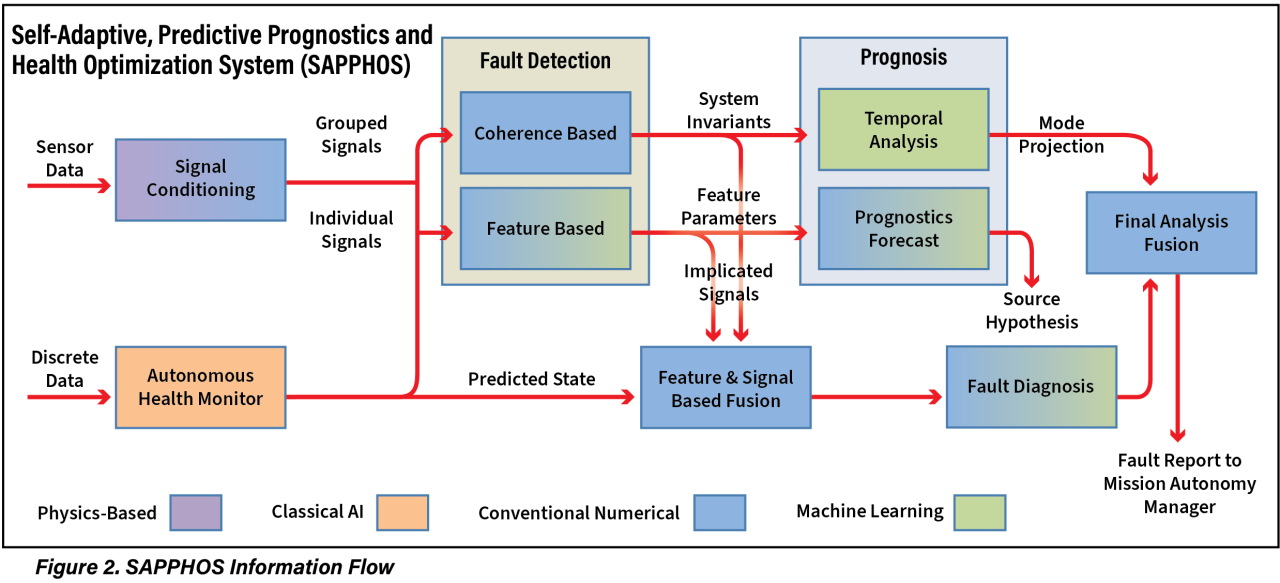
In this initiative, the NCMS team applied a fusion of methods—physics-based, classical AI, machine learning (ML), and conventional numerical—to NASA datasets, including the Bearing and Turbofan Jet Engine datasets. This fusion approach aligns with current trends in predictive maintenance methodologies, which are dominated by ML and hybrid approaches that combine data-driven, physics- and knowledge-based methodologies.
SAPPHOS analyzes all system-level instrumentation or sensor feeds (up to 2,048 simultaneous channels), vehicle models and states, mission operational modes, and prevailing environmental conditions. The following figure illustrates the information flow to and from each module and node within the system.
With the NASA Bearing dataset, the team’s goal was to predict bearing failures before they happened. To do this, the team advanced the use of AI for predictive maintenance by using a type of ML algorithm—an autoencoder neural network—which is trained to independently learn the underlying structure of data and capture its most important features. Within this autoencoder neural network, the team used a long short-term memory algorithm, which is trained to identify both normal patterns and anomalies.
These algorithms effectively identified vibrational anomalies from sensor readings in the set of bearings. The autoencoder algorithm accurately predicted the specific dates the bearings would begin to fail, continue to degrade, and ultimately fail. The team also used traditional statistical methods, which accurately predicted approximate times of failure for each bearing. When used in conjunction, these two methods provided a holistic and detailed solution that delivered the ability to determine points of failure-specific components or the whole system.
With the NASA Turbofan Jet Engine dataset, the team utilized the same autoencoder algorithm they used on the NASA Bearing Dataset. They also employed another algorithm: a health index, which provided a way to estimate point of failure in turbofan engines without prior knowledge of the engines. Additionally, the team trained two more ML algorithms on the NASA Turbofan Jet Engine dataset: a decision tree classifier and a neural network. The decision tree classifier algorithm was very effective, resulting in an accuracy of 86 percent.
Neural networks are a subset of ML, modeled after the human brain, that use interconnected nodes (neurons) in layers to recognize patterns, classify data, and make predictions by learning from large datasets. The NCMS team created a neural network and trained the model on the data. After 200 complete passes over the training data, the accuracy of the model reached 85 percent. By the end of this initiative, the prediction accuracy of the neural network algorithm rose to 90 percent.
Conclusion
This NCMS initiative advanced the capabilities of IVHM systems by making progress in solving several technical challenges in the field. The solutions outlined in this Technology Brief can be found in more detail in the initiative’s final reports. More information about best practices for addressing IVHM early in the vehicle/asset design and development process can be found in the first final report here. For further details about the more accurate alternative to traditional reliability models based on mean time between failure (MTBF)—the Self-Adaptive, Predictive Prognostics and Health Optimization System (SAPPHOS)—see this initiative’s second final report here.
These solutions could be applied to a broad range of IVHM systems for vehicles and other complex assets including manufacturing equipment, aircraft, maritime vessels, and autonomous systems. NCMS’s predictive maintenance initiatives aim to support the growing number of manufacturing companies investing in these technologies accurately predict the remaining useful life (RUL) of their assets, decrease equipment malfunctions and failures, reduce maintenance costs, speed up repair timelines, and generate data to improve the engineering of future assets.