NCMS Technology Briefs highlight NCMS’s cultivation and growth of innovative technologies. Through our management of government and industry collaborations, we’ve gained insights into novel approaches and best practices that can assist all companies to navigate the sometimes complex journey toward advancement. Based on the results of NCMS technology projects, the briefs show the applicability and usefulness of proven technical advances—all in an effort to speed adoption and eliminate duplication of effort. NCMS is pleased to share these insights to support U.S. manufacturing competitiveness.
Introduction
Almost all US industrial firms (95 percent) across manufacturing and other essential industrial sectors are planning to introduce new automation by 2028, according to recent survey research. Manufacturing companies are investing heavily in robotics to protect workers, increase production quality, and reduce costs. Over the past several decades, NCMS has partnered with industry, academic, and government experts to develop, demonstrate, and transition robotics capabilities.
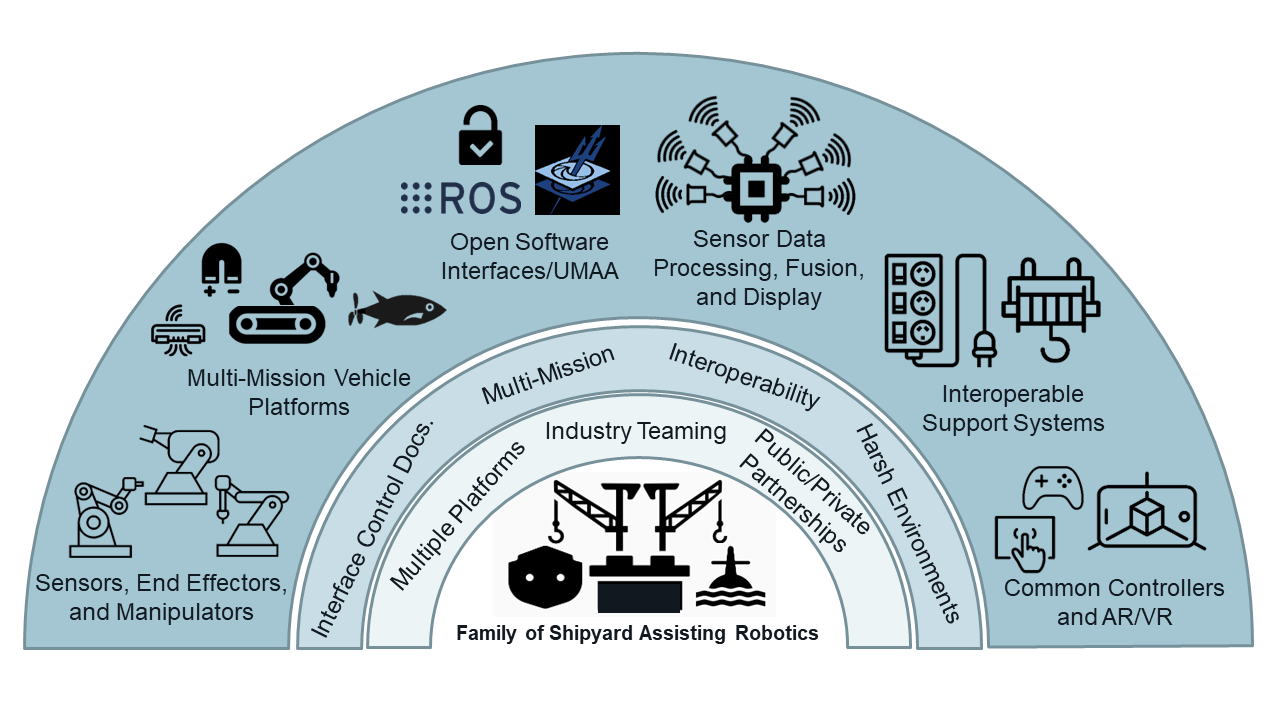
One recent initiative, the Family of Sustainment Augmentation Robots (FOSAR), winner of NCMS’s 2024 CTMA Technology Competition, uses highly portable, easy-to-use automation capabilities in environments that are hazardous to humans or where skilled labor is scarce. A multi-industry collaboration developed by Boston Engineering Corporation, the FOSAR initiative utilizes robotics for maintenance, repair, and operational tasks in fleets of ships, aircraft, vehicles, and other large assets.
The FOSAR initiative, rather than relying solely on Boston Engineering technologies, is designed for collaboration among private-sector companies and public organizations. This consortium approach simplifies integration, reduces duplication of effort, and accelerates the adoption of advanced solutions. FOSAR capabilities, provided by multiple companies, include robotic systems; payloads and sensors; digital tools such as augmented reality (AR), virtual reality (VR), and mixed reality (MR); Internet of Things (IoT); and exoskeleton technology for use by maintenance and sustainment personnel. By leveraging modular, scalable, and flexible technologies, FOSAR promotes innovation while ensuring “plug-and-play” compatibility across diverse platforms and applications.
FOSAR’s robotic capabilities include remotely operated vehicles (ROVs) and swimming robots, which have a highly maneuverable, flexible body capable of performing many missions in challenging environments. Easy to launch and recover, they deliver real-time data. Magnetic climbing robots maneuver within complex and confined tank spaces to enable thorough inspections and sustainment activities. Vacuum crawlers are ruggedly designed for durability, maintaining contact over challenging surface conditions and performing multiple missions including cleaning, damage evaluation, and radiation exposure evaluation.
In addition, to foster on-the-job training, digital twin and AR workflows are being developed to allow maintenance personnel to visualize real-time data and access interactive AR overlays and digital work instructions. In conjunction, secure remote collaboration tools are enabling real-time video-assisted troubleshooting, allowing experts who are not based locally to guide personnel remotely, reducing delays and enhancing decision‑making speed. Together, these technologies form a single, cohesive system to make workplaces safer, more efficient, and significantly more cost-effective.
FOSAR technologies are being used in a variety of commercial settings including manufacturing, materials handling, building operations and maintenance, warehousing, commercial airlines, transportation, logistics, and mining. These capabilities can handle a wide range of tasks: welding, laser cutting, inspection, and corrosion removal. FOSAR capabilities reduce physical demands on workers, reduce sustainment costs, and improve asset availability.
Vacuum Crawler Demonstration
A recent NCMS initiative improved and demonstrated the capabilities of FOSAR’s vacuum crawler robot at Portsmouth Naval Shipyard (PSNY) in Kittery, ME. This robotic platform allows maintenance professionals to stay in a safe location while piloting the vehicle via a portable touchscreen interface. The vacuum crawler successfully traversed ships, both above and below the waterline, and accessed places on the hull that are physically difficult or impossible for personnel to reach. When outfitted with unique tools, it performed cleaning, non-destructive inspection (NDI), evaluation of corrosion and other damage, and radiation detection.
This robotics system assists, rather than replaces, workers, which will lower the amount of labor and cost required for ships that undergo major maintenance and hull inspections. Moreover, the initiative’s use of robotics and modernized workflows will make shipyard jobs more appealing, which is especially important as the maritime sector faces a critical workforce shortage. In addition to shipyards, this technology can be used for a wide range of applications across multiple sectors—manufacturing, logistics, energy, and more.
Currently, an NCMS project team is ruggedizing the vacuum crawler to optimize its performance in diverse industrial environments. The improved vacuum crawler integrates advanced sensors, robotic arms, digital tools, AI, and machine learning to optimize robotic operations, enabling systems to adapt in real time to changing conditions. Some main features of the vacuum crawler include an open-source software platform, a scalable modular network architecture, rugged electrical components, and a universal tool mounting system.
Expanding the FOSAR Program
Currently, NCMS is partnering with Boston Engineering and a number of additional companies whose technologies are being incorporated into the FOSAR program, which include Compass Systems, Edlore, Life Cycle Engineering, Orbis International, and Southwest Research Institute. At present, the main government collaborator is the Navy; FOSAR also serves other military branches and a variety of commercial industries. The following elements of the FOSAR program are being enhanced:
- Developing a FOSAR policy and governance framework. This framework will establish the FOSAR governance structure, processes, decision‑making model, and coordination mechanisms to enable all partners to collaborate efficiently.
- Expanding the FOSAR network. By reporting on expanded shipyard engagement, industry partner outreach, and recommended membership criteria, the team will document how the FOSAR effort is broadening its national stakeholder base of partners, supporting future scalability and improving industry adoptability.
- Conducting a technology inventory. The curated inventory of active and emerging technologies within FOSAR will include robotics, digital tools, and sensing systems. Additionally, the team will establish a technology sharing infrastructure for industry partners and Navy stakeholders to solicit early feedback to inform long-term designs. Gathering input from shipyards, industry partners, and related standards bodies will ensure that FOSAR technologies meet user needs.
- Aligning requirements and capabilities. By assessing shipyard needs, industry gaps, applicable standards, and recommended technology‑need pairings, the FOSAR team will prioritize the highest‑value industrial modernization opportunities and accelerate pathways to operational deployment.
- Advancing the Technology Readiness Level (TRL) of FOSAR technologies. These technologies include robotic crawlers, digital work tools, underwater systems, and remote assistance platforms. By developing and executing targeted demonstrations in operational environments, the team will validate performance, safety, and ROI. The work will culminate in a technology advancement report that documents the readiness of technologies for demonstrations.
- Developing and executing targeted demonstrations in operational environments. After each demonstration, the team will produce a report detailing performance data, lessons learned, and the practical impact of robotics and digital modernization.
Broad Impact of the FOSAR Program
The FOSAR program is scaling for national expansion to drive measurable productivity and safety improvements across numerous industries. FOSAR technologies—robotic systems, payloads, sensors, AR/VR/MR, IoT, and exoskeleton technology—can be used in a variety of industries: shipping and handling, building operations and maintenance, commercial airlines, and more. For example, the vacuum crawler can be employed to quickly assess potential structural damage of large assets and infrastructure, removing the need for maintenance professionals to inspect hard-to-reach areas. The modular robotics framework can streamline factory automation, enabling rapid adaptation to product changes and reducing the need for extensive retooling. With a broad range of modular, flexible systems, the FOSAR program supports commercial enterprises as they adapt quickly to market needs, achieving greater resilience and efficiency.
Currently, the FOSAR initiative is integrating interoperable systems that standardize software, user interfaces, and modular hardware to create a common technology ecosystem. By developing and demonstrating multiple technologies under a single platform “family of systems” theme, FOSAR will give numerous industries access to a common user-interface and common tools that will dramatically reduce construction, maintenance, and sustainment costs. By 2027, these advanced technologies will be introduced into private shipyards, energy infrastructure, and industrial automation sectors, proving their adaptability beyond naval applications. The FOSAR program welcomes collaboration. Top priorities include expanding robotic production capacity for widespread deployment, enhancing AI-driven automation for predictive maintenance and real-time analytics, and implementing cybersecurity enhancements to meet stringent defense and commercial compliance standards.